Details of operation
36
The input buffer option (CED1902-4-B) is used in multi-
channel configurations where a shared reference potential is
required. The option is completely housed inside one of the
boxes (usually channel 0) of a multi-channel configuration. It
uses spare pins on the isolation input connector to take an input
signal in, buffer it and feed it back out. The user may then
connect the buffer output to one terminal of several normal
input channels without imposing additional load on the
reference electrode. The presence of the buffer option does not
affect the normal operation of the channel that houses it.
To understand why a buffer amplifier may be necessary, we
need an explanation of the effects of input impedance: practical
considerations that receive scant attention in medical
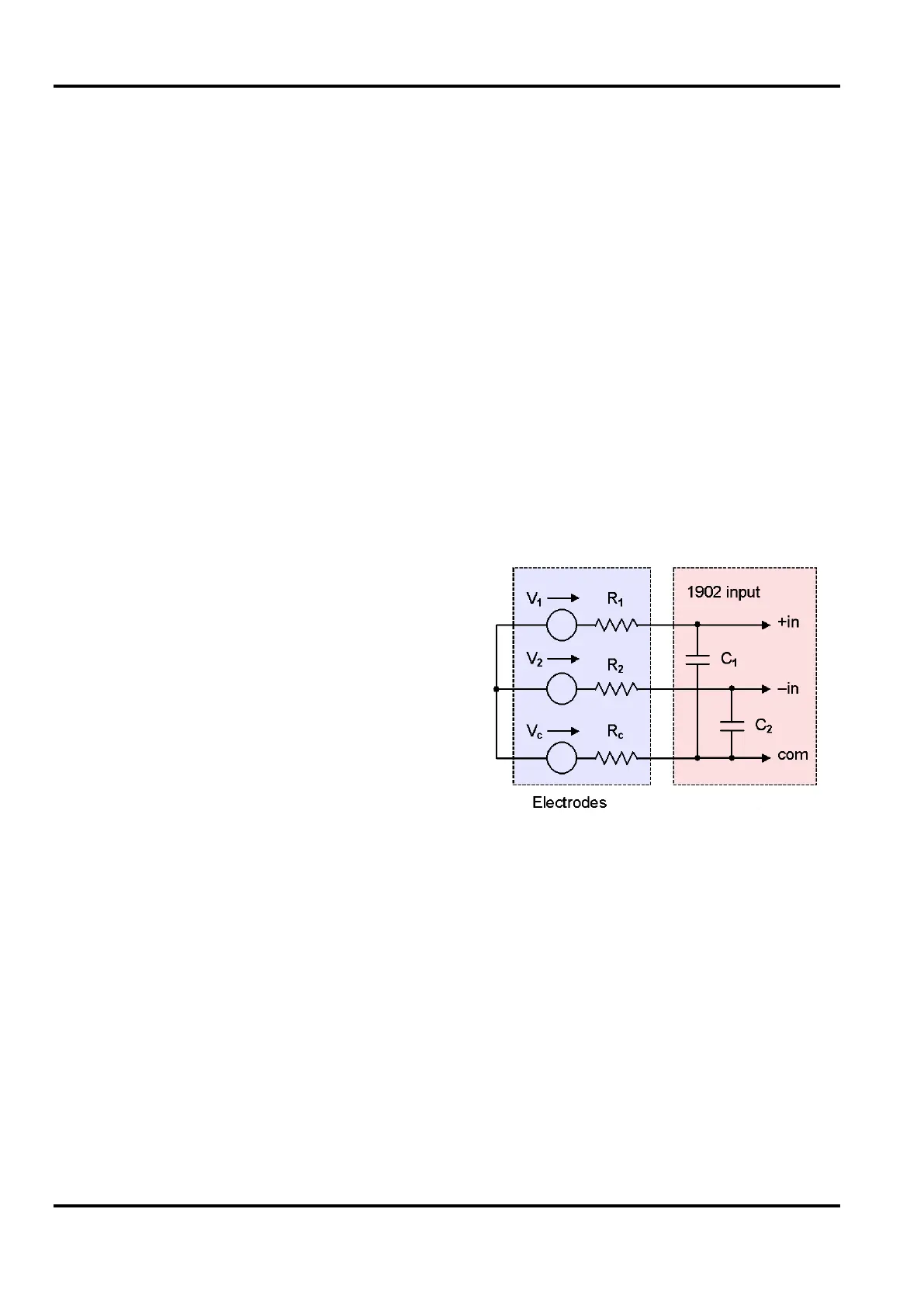
instrumentation literature. The diagram shows a single bipolar
channel using two
electrodes (plus
common). It shows
the electrode–skin
junction as a pure
voltage generator
with series output
resistance. It shows
the capacitance of
the cable, plus the
input capacitance of
the amplifier, as a
single component.
It is important that the time-constants, the products of the series
resistance and the combined capacitance at each input, should
balance. Unbalanced time-constants cause differential phase
shifts in the input, which lead to a reduction in the common-
mode rejection ratio (CMRR). Common-mode rejection is
particularly important for reducing pickup of mains-frequency
and its harmonics.
Since the input capacitances tend to be similar, and in any case
difficult to modify, the emphasis is on ensuring that the
electrode contact resistances are balanced; the usual way to
achieve this is to try to make them as close to zero as possible.
configurations
and the1902
Channel with unshared electrodes


 To Next Page