The copier’s image formation block con-
sists of the following steps; see the descrip-
tions for each step given under its respective
heading:
Step 1: pre-exposure
Step 2: primary charging (-)
Step 3: image exposure
Step 4: development (AC + DC bias)
Step 5: transfer (-)
Step 6: separation (+)
Step 7: fixing
Step 8: drum cleaning
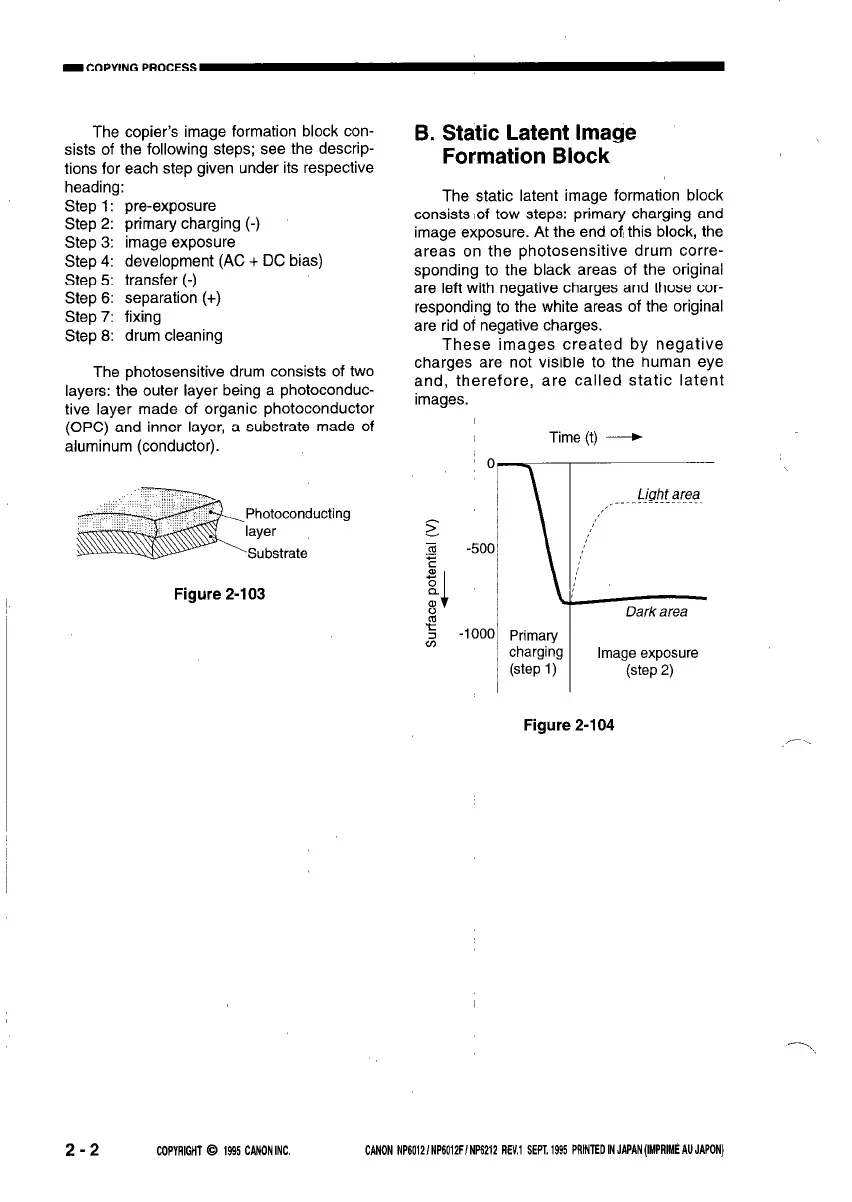
The photosensitive drum consists of two
layers: the outer layer being a photoconduc-
tive layer made of organic photoconductor
(OPC) and inner layer, a substrate made of
aluminum (conductor).
onducting
ate
Figure 2-103
B. Static Latent Image
Formation Block
The static latent image formation block
consists #of tow steps: primary charging and
image exposure. At the end of, this block, the
areas on the photosensitive drum corre-
sponding to the black areas of the original
are left with negative charges and those cor-
responding to the white areas of the original
are rid of negative charges.
These images created by negative
charges are not visible to the human eye
and, therefore, are called static latent
images.
Time (t) -----)
~ 0
1
z
3
-500
E
d
x
8
1
E
cz
-1000
Light area
,,...._......~...
,’
Primary
1
charging
(step 1)
Dark area
Image exposure
(step 2)
Figure 2-104
2-2
COPYRIGHT 0 19% CANONINC.
CANON NP6012lNP6012F/NP6212 REV.1 SEPT.1995 PRlNTEDINJAPAN(IMPRIM~AUJAPON)



 To Next Page