2. Controlling the Scanning Lamp for
Pre-Heating
Preheating is controlled for the follow-
ing:
l before the scanning lamp turns on.
l while the scanning lamp remains on.
a. Controlling Pre-Heating before the
Scanning Lamp Turns On
When the Copy Start key is pressed, the
microprocessor (QlOl) on the DC controller
PCB sends the pre-heating voltage control
signal (FLPRHT) to the pre-heating voltage
control circuit on the composite power sup-
ply PCB. In response, the pre-heating volt-
age control circuit supplies 4 Vrms (effective
value) to the filament of the scanning lamp.
About 3 set later, the microprocessor on
the DC controller causes the pre-heating
voltage control signal (FLPRHT) to go ‘O’, to
end the pre-heating operation executed
before the scanning lamp turns on.
b. Controlling Pre-Heating While the
-\
Scanning Lamp Remains On
While the scanning lamp remains on, the
microprocessor (Q501) on the composite
power supply PCB sends the duty ratio of
the on control signal to the microprocessor
(QlOl) on the DC controller PCB. In
response, the microprocessor (QlOl) on the
DC controller sends the pre-heating control
signal (FLPRHT) to the pre-heating voltage
control circuit to execute pre-heating control
suited to the duty ratio of the on control sig-
nal for pre-heating control.
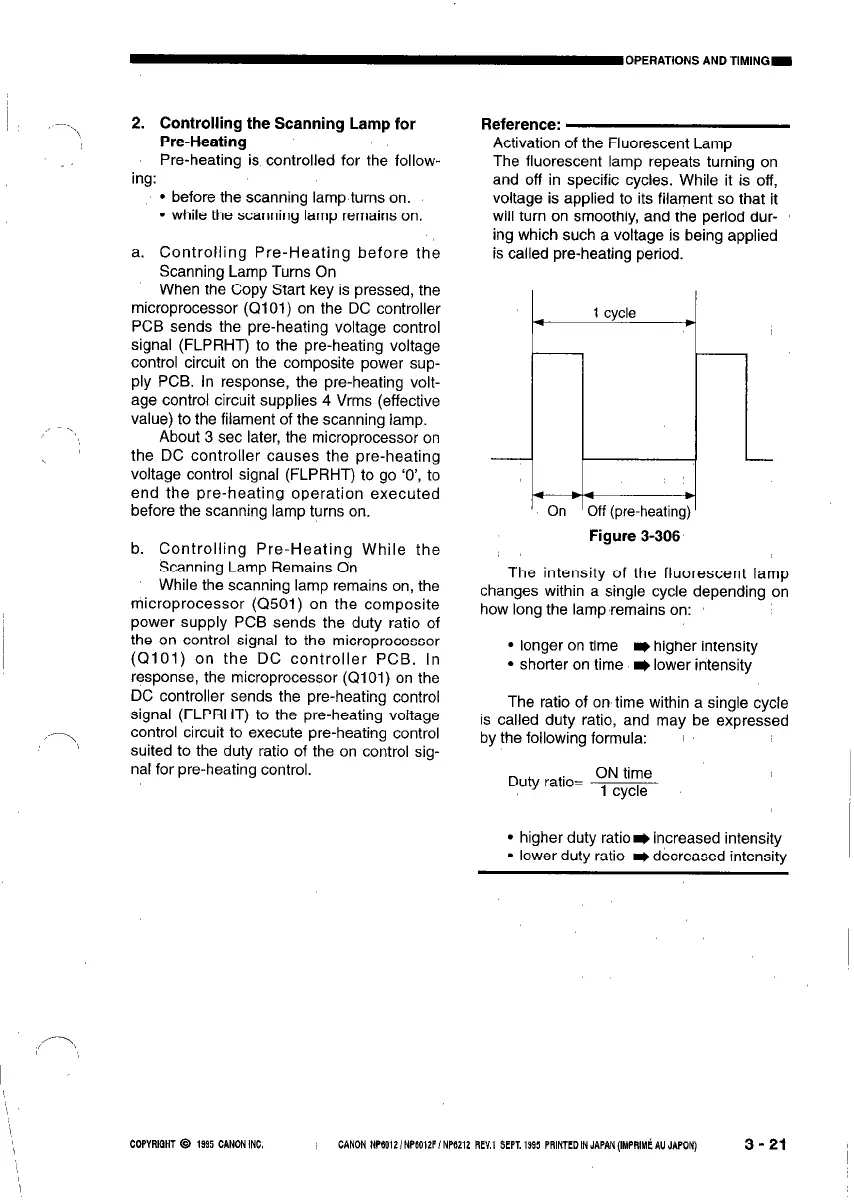
Reference:
Activation of the Fluorescent Lamp
The fluorescent lamp repeats turning on
and off in specific cycles. While it is off,
voltage is applied to its filament so that it
will turn on smoothly, and the period dur-
ing which such a voltage is being applied
is called pre-heating period.
. .
3 Off (pre-heating)
Figure 3-306
The intensity of the fluorescent lamp
changes within a single cycle depending on
how long the lamp remains on:
l longer on time
I) higher intensity
l shorter on time w lower intensity
The ratio of on time within a single cycle
is called duty ratio, and may be expressed
by the following formula:
ON time
Duty ratio= ~
1 cycle
l higher duty ratio w increased intensity
l lower duty ratio I) decreased intensity
COPYRIGHT 0 1995 CANONINC.
CANON NP60i2/NP6012FINP6212 REV1 SEPT.1995 PRlNTEOINJAPAN(IMPRIM~AUJAPON)
3-21



 To Next Page