OPERATIONS AND TlMlNGl
d. Controlling (automatic) the Primary
Charging roller Bias Application Voltage
Level and the Scanning Lamp ON
Voltage Level (APVC, ALVC control)
Copy images will suffer changes if
changes occur in their static latent images,
which in turn are caused by the’following:
l changes in drum sensitivity; and
l changes in the degree of charge by
the primary charging roller.
These symptoms are brought about by
changes in the site environment (tempera-
ture, humidity) deterioration, wear, or dirt on
parts.
The copier’s light area potential (VL) and
dark area potential (VD) have a tendency to
increase; to compensate for this tendency,
the copier corrects the primary charging
roller bias application voltage level (APVC
control) and the scanning lamp ON voltage
level (ALVC control), thereby ensuring a spe-
cific light area potential (VL) and dark area
potential (VD) at all times.
Study the following for an idea of how
the mechanism is activated (after power-on,
during initial rotation for 1st copy):
. Flow
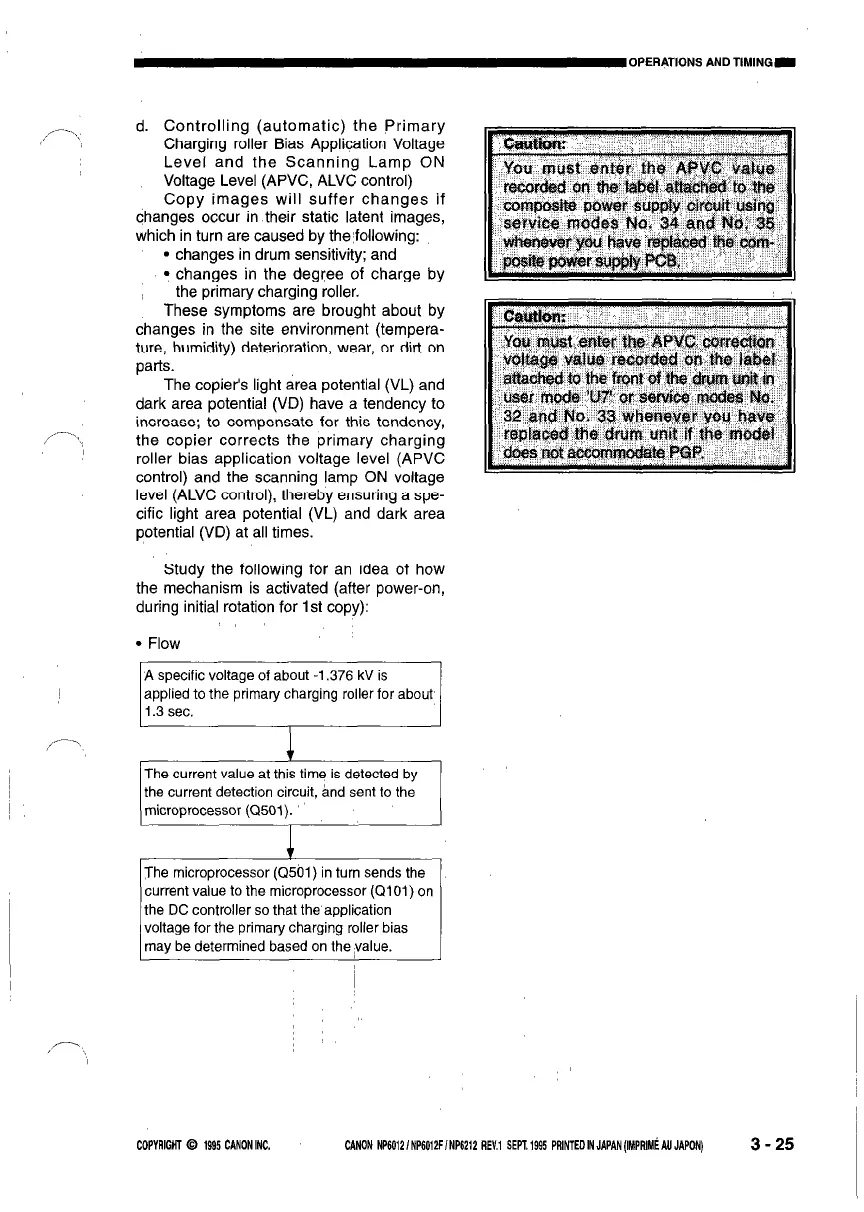
A specific voltage of about -1.376 kV is
applied to the primary charging roller for about
I .3 sec.
1
The current value at this time is detected by
the current detection circuit, &d sent to the
microprocessor (Q501).
I
The microprocessor (Q501) in turn sends the
current value to the microprocessor (QIOI) on
the DC controller so that the application
voltage for the primary charging roller bias
may be determined based on the Ivalue.
I
COPYRIGHT 0 1995 CANON INC. CANON NP6012 I NP60i2F/NPS212 REV.1 SEPT. 1995 PRINTED IN JAPAN (IMPRIM~ AU JAPON)
3-25



 To Next Page