Chapter 2: Main Application 72
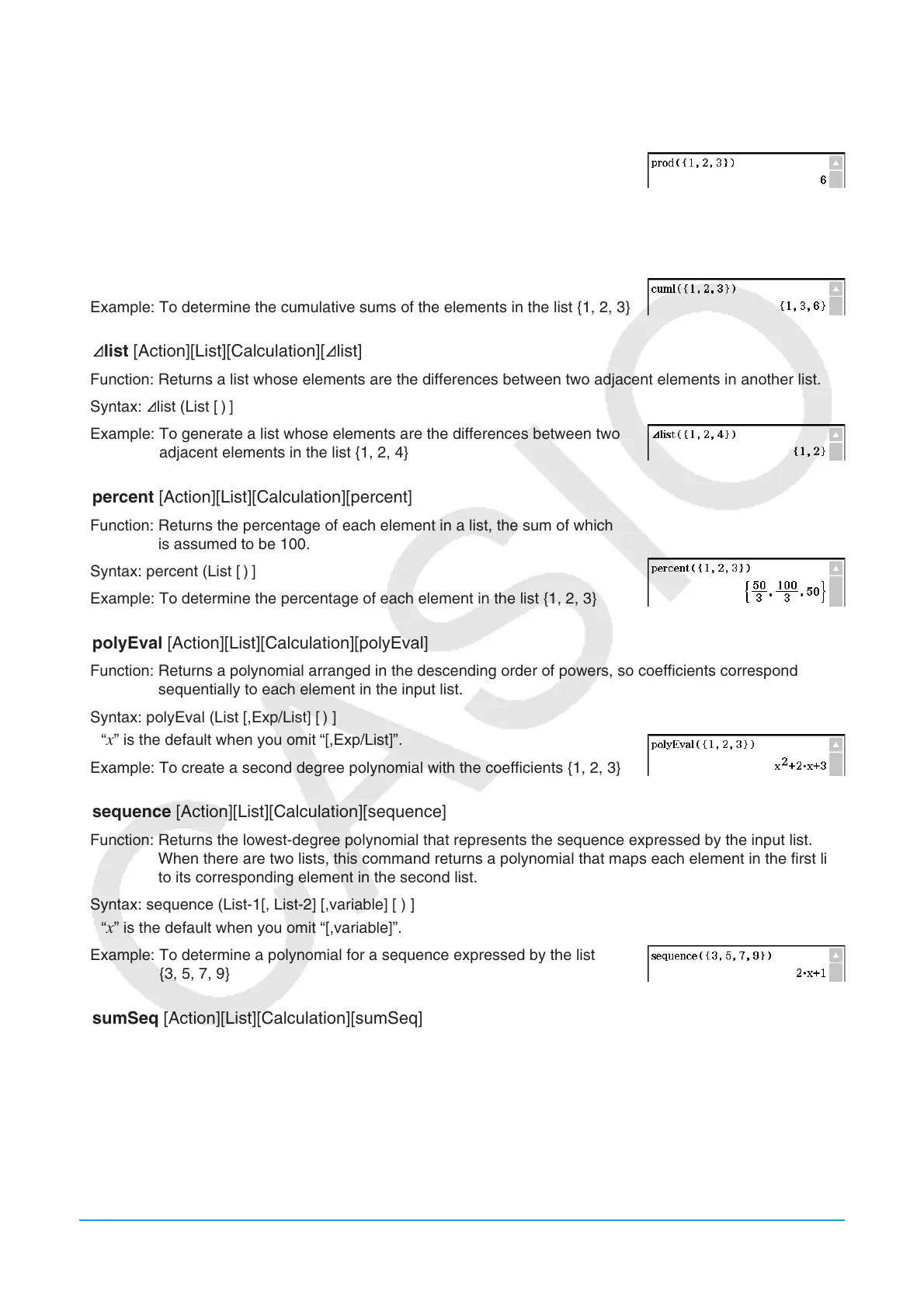
u prod [Action][List][Calculation][prod]
Function: Returns the product of the elements in a list.
Syntax: prod (List-1[, List-2] [
)
] (List-1: Data, List-2: Freq)
Example: To determine the product of the elements in the list {1, 2, 3}
u cuml [Action][List][Calculation][cuml]
Function: Returns the cumulative sums of the elements in a list.
Syntax: cuml (List [ ) ]
Example: To determine the cumulative sums of the elements in the list {1, 2, 3}
u Alist [Action][List][Calculation][Alist]
Function: Returns a list whose elements are the differences between two adjacent elements in another list.
Syntax: Alist (List [
)
]
Example: To generate a list whose elements are the differences between two
adjacent elements in the list {1, 2, 4}
u percent [Action][List][Calculation][percent]
Function: Returns the percentage of each element in a list, the sum of which
is assumed to be 100.
Syntax: percent (List [
)
]
Example: To determine the percentage of each element in the list {1, 2, 3}
u polyEval [Action][List][Calculation][polyEval]
Function: Returns a polynomial arranged in the descending order of powers, so coefficients correspond
sequentially to each element in the input list.
Syntax: polyEval (List [,Exp/List] [
) ]
• “
x ” is the default when you omit “[,Exp/List]”.
Example: To create a second degree polynomial with the coefficients {1, 2, 3}
u sequence [Action][List][Calculation][sequence]
Function: Returns the lowest-degree polynomial that represents the sequence expressed by the input list.
When there are two lists, this command returns a polynomial that maps each element in the first list
to its corresponding element in the second list.
Syntax: sequence (List-1[, List-2] [,variable] [ ) ]
• “
x ” is the default when you omit “[,variable]”.
Example: To determine a polynomial for a sequence expressed by the list
{3, 5, 7, 9}
u sumSeq [Action][List][Calculation][sumSeq]
Function: Finds the lowest-degree polynomial that represents the sequence expressed by the input list and
returns the sum of the polynomial. When there are two lists, this command returns a polynomial that
maps each element in the first list to its corresponding element in the second list, and returns the
sum of the polynomial.









 To Next Page