5 - 2 Vibrometer mode
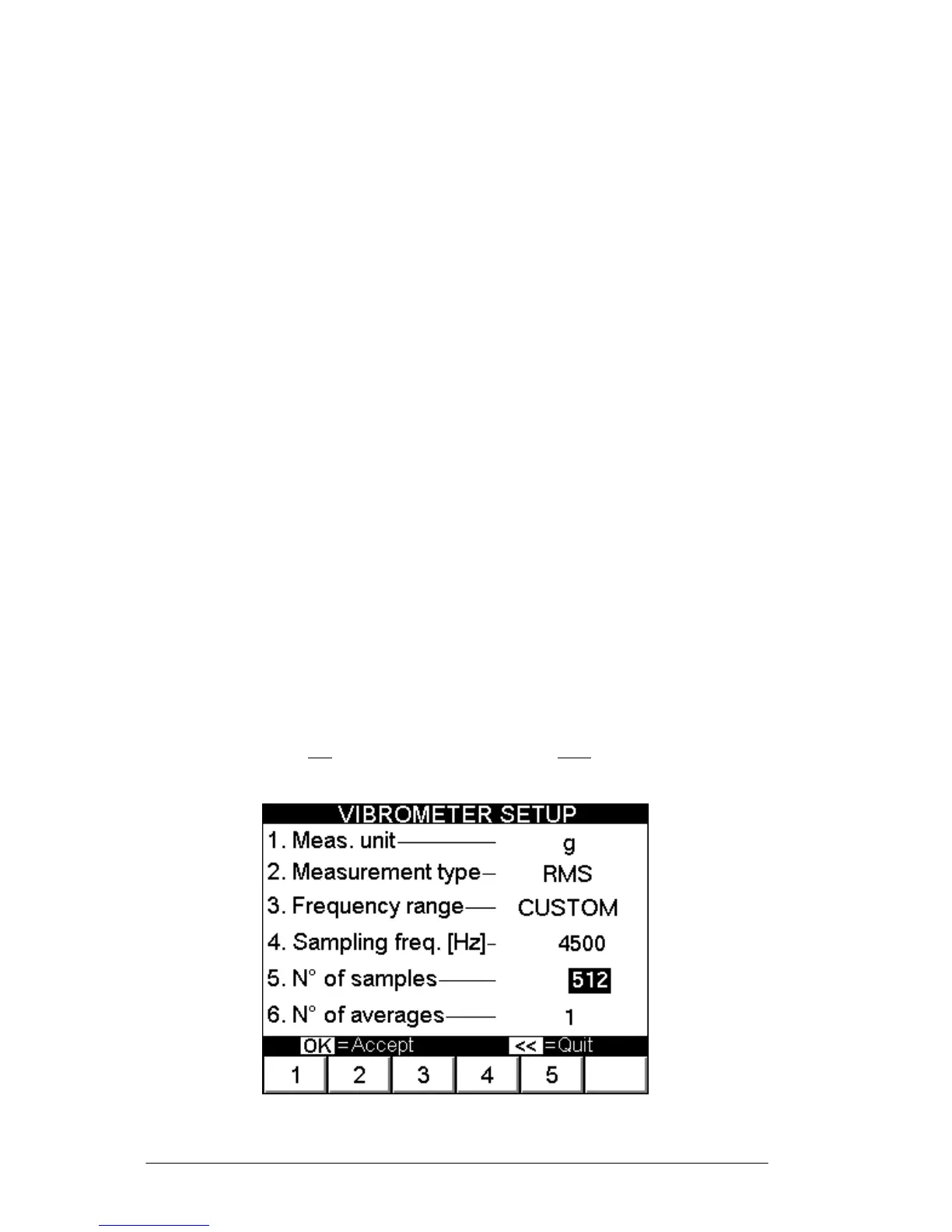
2. Type of measurement
As with all physical quantities, vibration has a value which can vary from instant to instant:
mathematically it may be described as a function of time. Hence its overall value can be
calculated according to three different types:
– RMS (Root Mean Square):
This is the average value of the vibration previously squared;
This is the typically used value, above all, for acceleration or speed measurements.
– PK (Peak):
This is the maximum value reached by the vibration in a certain interval of time.
– PP (Peak-to-Peak):
This is the difference between maximum value and minimum value reached by the
vibration in a certain period of time;
It is normally used for measuring displacement.
3. Frequency range
The overall value of vibration normally originates from the sum of various contributory
factors, caused by several phenomena, and therefore they occur associated with different
frequencies. Depending on the case, it could be of interest to take into account, in the
overall value, only those corresponding to a certain frequency band, namely:
– 3-300 Hz if the range of interest is limited to phenomena with low frequencies
– 10-1000 Hz to meet conditions of ISO 10816-1 standard (typical)
– 10-10000 Hz to take into account a wide band
A CUSTOM frequency range is available for expert users (and for very particular
conditions). This range allows setting as required both the sampling frequency f
s
and the
number of samples N
s
. In fact the overall value is calculated with digital techniques starting
from the signal spectrum; therefore, the sampling parameters determine the band limits
according to the following relationships:
s
s
min
N
f
=f 2
2.56
s
max
f
=f


 To Next Page