Operation Overview
Slew Rate (Rise, Fall A/µS)
Slew rate determines the rate at which the current input of changes to a newly programmed
value. There are two slew rate values, which are rise rate and fall rate.
CC mode voltage specification setting
The Load can do GO/NG test by pressing the GO/NG key under loading condition. It will
check if the measured data is within the specification that set at the end of each mode setting.
We can select are two types of parameters, percent or value, under the configure setting.
This operation will be described in detail in section 4.2.4 Setting the Specification.
3.5.2 Constant Resistance Mode
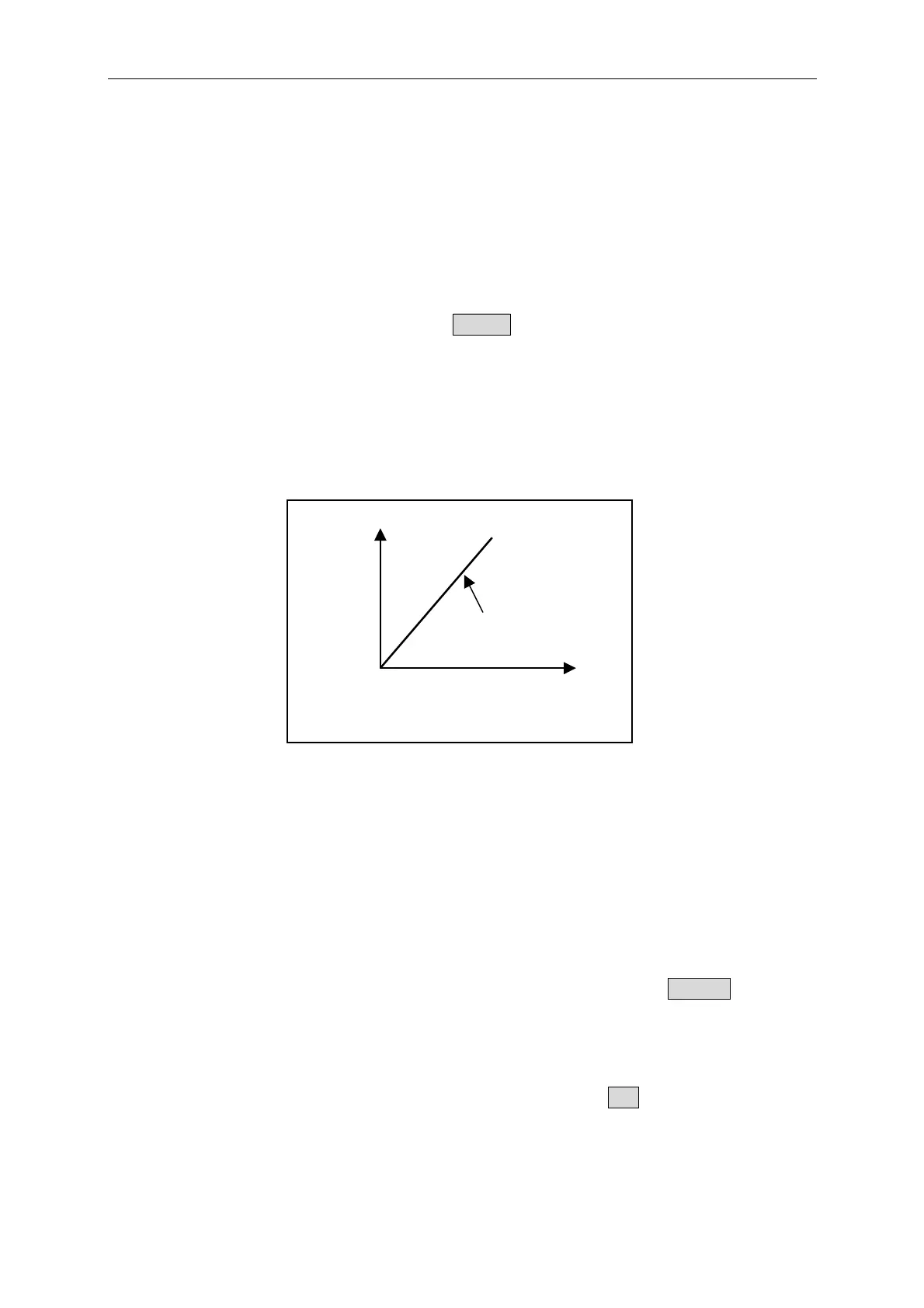
V
Input
Voltage Slope
(R setting)
I
Load Current
Figure 3-6 Constant Resistance Mode
In CR mode, the Load will sink a current linearly proportional to the input voltage in
accordance with the programmed resistance. There is a double pole RC filter of input
voltage, so high frequency parts will be removed. The load sink current of CR mode is
proportioned to the input voltage through a double pole RC filter. To prevent the load
current change caused by the input voltage variation, the power source impedance should be
as low as possible, and remote sensing cable must be used to sense load input voltage when
high sink current (low setting resistance) is programmed.
Resistance can be programmed in either of low range or high range by the RANGE key. The
low range is used for input voltage in low voltage range while the high range is for the input
voltage over low voltage range. The current range of CR mode is high range.
There are two resistance levels (A or B) for CR function as static CC mode. Both A and B
states use the same range. You can select CRLA or CRLB using A/B key. Slew rate
determines the rate that the load level changes from one state to another.
3-7



 To Next Page