© CIAS Elettronica S.r.l. Ed. 1.2
Installation Manual Page 40 of 47 MICRO-RAY
The number from 00 to 15 represented on switches SW2 (tens) and SW3 (units) corresponds
to the channel currently assigned to the ray.
4.1.1.2 Read/Write Barrier Number
By turn the function switch SW1 to position 8 it is possible to read and/or set the barrier number
NB: Set the same barrier number for all the rays of the same barrier.
Write barrier number:
• Select the desired barrier number (from 1 to 99) using the switches SW2 (tens) and SW3
(units)
• Press the microswitch "S2". In this phase the Fault (D6) and Tamper (D5) leds will turn on,
confirming the acquisition of the new barrier number set.
Read barrier number:
• Turn the SW2 switch (tens) until the red LED D6 is on
• Turn the SW3 switch (unit) until the red LED D5 is on
The number from 01 to 99 represented on switches SW2 (tens) and SW3 (units) corresponds
to the barrier number currently assigned to the barrier.
4.1.1.3 Final Operations
Turn the function switch SW1 to position 0 and press the microswitch "S2". This operation
concludes all the ray installation phases, stores the parameters selected and put into use in the
previous phases.
In this phase the Fault (D6) and Tamper (D5) leds will resume their functionality.
Operations on RX rays
Open the column starting from the top cover, remove the screws using a crosshead screwdriver,
remove the cap (this action causes the Tamper switch to open), open the cover.
Connect the direct current power supply wires (13.8 V ) to terminals 1 and 2 of CON3
(MICRO-RAY Interface).
To optimize the alignment of each ray and set the parameters, proceed as follows:
a) Make a first Optical/Visual alignment
b) Open the tamper removing the terminal block MS1 of the RX circuit. Only the rays 2, 3, 4
(the ray 1 tamper is already open because column tamper)
c) Turn the function switch SW1 to position 1. This operation activates the barrier installation
phase.
d) Press the button S2. This operation will activate the system of rapid adjustment of the
received signal. After a few seconds, the rapid signal adjustment system stops, and the
Buzzer BZ1 will emit an intermittent sound (1 Hz), indicating that the signal has reached
the correct working level.
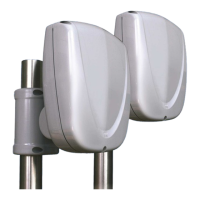
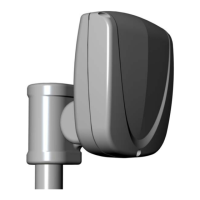
e) Loosen the fixing screw located on the upper side of the joint, adjust the horizontal
orientation of the receiving antenna (Rx), so as to search for the maximum signal value.
f) If during orientation, the intermittent sound frequency increases, it means that the received
signal has increased compared to the previous situation.
Press the S3 button again and when the intermittent sound frequency returns to the 1 Hz
frequency (due to the signal recovery), proceed with the next antenna orientation
operations.
If during the orientation, instead of increasing, the frequency of the intermittent sound
decreases, it means that the signal received after the antenna movement has decreased,
and it is therefore necessary to rotate the head in the opposite direction and search for a
possible new maximum value, indicated by the increase of the frequency of intermittent
sound. If no other better positions are found, it means that the current orientation provides
the maximum signal.


 To Next Page