Water chillers and
air-water heat pumps
HEAT PUMPS - AIR CONDITIONING - REFRIGERATION - AIR HANDLING - HEAT EXCHANGE - NA 12.122 H
28
CIATCooler LP
Concentration %
0 10 20 30 40 50
Mono-ethylene glycol (MEG) ºC
0 -3 -7 -13 -20 -29
Mono-propylene glycol (MPEG) ºC
0 -2 -5 -10 -15 -21
-25
-30
-15
-20
-5
-10
0
20 40 5010 30
-45
-35
-40
0
3
4
1
2
Temperature °C
Volume concentration %
Anti-freeze protection with glycol water
If a pure product is used for dilution in order to protect the hydraulic
circuit, the following instructions must be followed:
- Do not introduce any of the pure anti-freezing product separately
and then the water in the installation.
- Always prepare the water mixture + anti-freeze + corrosion inhibitor
at the correct dosage prior to introducing it into the installation.
Procedure:
- At minimum, a complete rinsing of the hydraulic installation must be
performed.
- After the fi nal rinsing, the installation must be completely drained.
- Introduce the water/anti-freeze/inhibitor mixture and increase the
pressure with a hydraulic pump.
We recommend using a fi lling device with a non-return valve for
compliance with the domestic anti-contamination standards. The
device must never in any case be connected to the city network if
the additives used in the hydraulic circuit are not approved by the
Ministry of Sanitation in the country of installation.
- Completely purge the installation.
- Circulate the mixture throughout the entire installation for a minimum
of 2 hours prior to starting up the unit.
- Check the fi nal dosage obtained with a densimeter or refractometer.
- Check the pH obtained with pH paper strips or a pH metre.
Warning: the glycol concentration must keep the fl uid at least 6°C
below the outlet water temperature foreseen in the evaporator in order
to allow a correct adjustment of the evaporator's minimum pressure
regulation. If the concentration is below the necessary amount, there
is a risk of freezing. On the other hand, any excess of concentration
entails a decrease in performance.
Required glycol concentration
Note: The values are offered as a guide according to the standard
characteristics of the MEG. These may vary based on the MEG
manufacturer, which is why it is necessary to consult the manufacturer
data in order to guarantee protection up to the desired temperature.
Minimum freezing and usage temperature graphs
Minimum usage temperature:
- Mono-propylene glycol
- Mono-ethylene glycol
Freezing temperature:
- Mono-propylene glycol
- Mono-ethylene glycol
- Place a label in a visible place that indicates:
* the presence of anti-freeze in the installation,
* the name of the product and the supplier,
* the dosage and the pH as of the time the unit is started up.
If more amount is needed, it must be exactly the same mixture as
the product initially used.
The following table and curves feature the minimum glycol percentages
required for the installation in accordance with the freezing point.
The pumps that incorporate the LPC / ILPC units can work with any
concentration of mono-ethylene glycol, albeit with a reduction in the
available pressure due to the variation of water fl ow. The pump must
be changed for mono-propylene glycol (upon request).
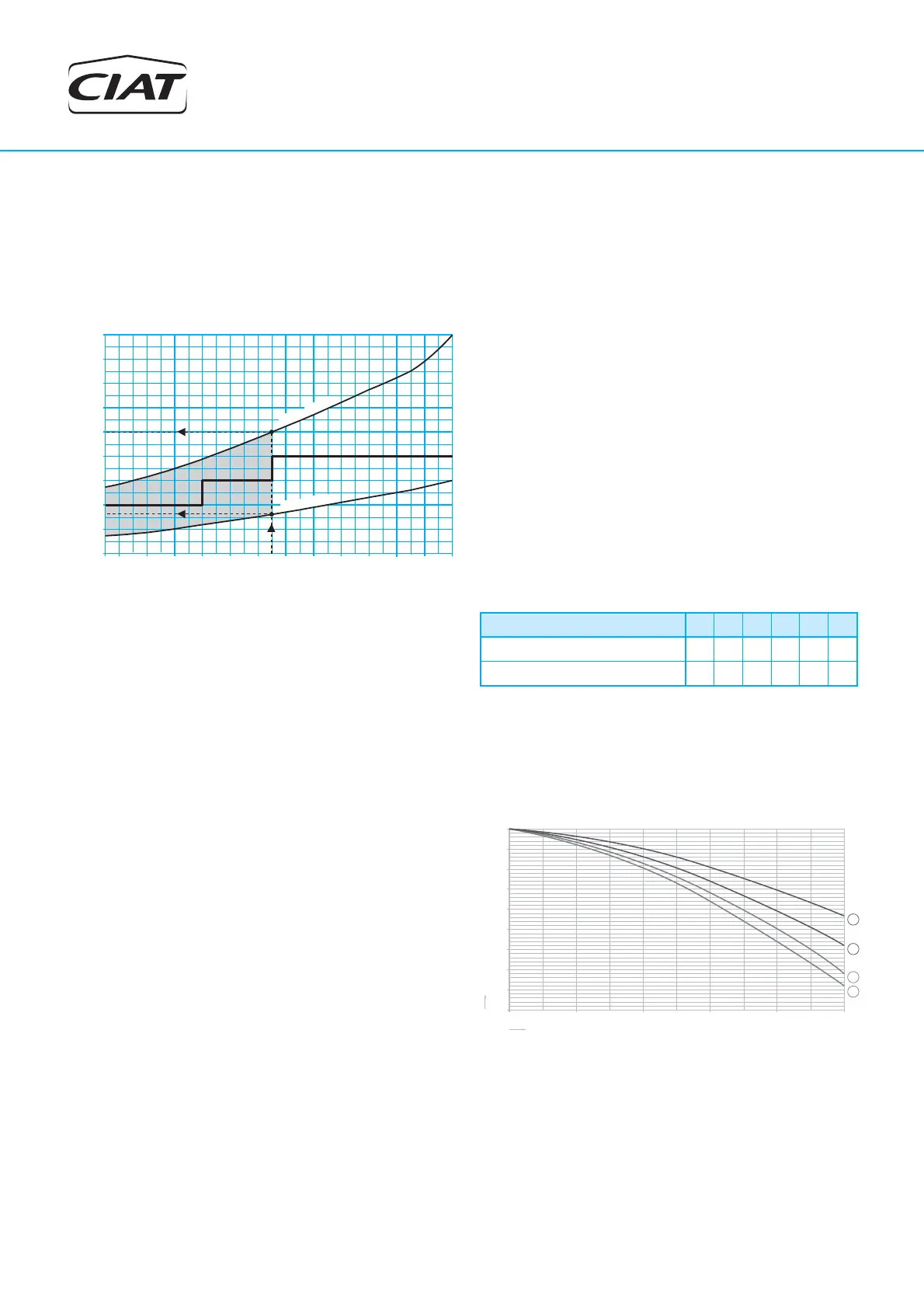
Evaporator operating limits
The curves represent the minimum and maximum admissible
temperature increases based on the outlet (discharge) temperature,
for both pure water and glycol water. For temperature changes that are
not listed between the curves, please consult.
The minimum outlet temperature for the unit will be +5ºC with pure
water and -7ºC with glycol water.
• Example
For an outlet water temperature of +5ºC:
Minimum temp.: 2,6ºC T. condition 7,6ºC / 5ºC
Maximum temp.: 6,0ºC T. condition 11ºC / 5ºC
9
8
7
6
5
4
3
2
1
10
-7 -6 -4 -2 0 2 4 6 8 10 12 14 16 18
Water outlet temperature °C
ΔT Admissible difference between water I/O °C
maximum ΔT
minimum ΔT


 To Next Page