Water chillers and
air-water heat pumps
HEAT PUMPS - AIR CONDITIONING - REFRIGERATION - AIR HANDLING - HEAT EXCHANGE - NA 12.122 H
48
CIATCooler LP
14. CONTROL AND ANALYSIS OF BREAKDOWNS
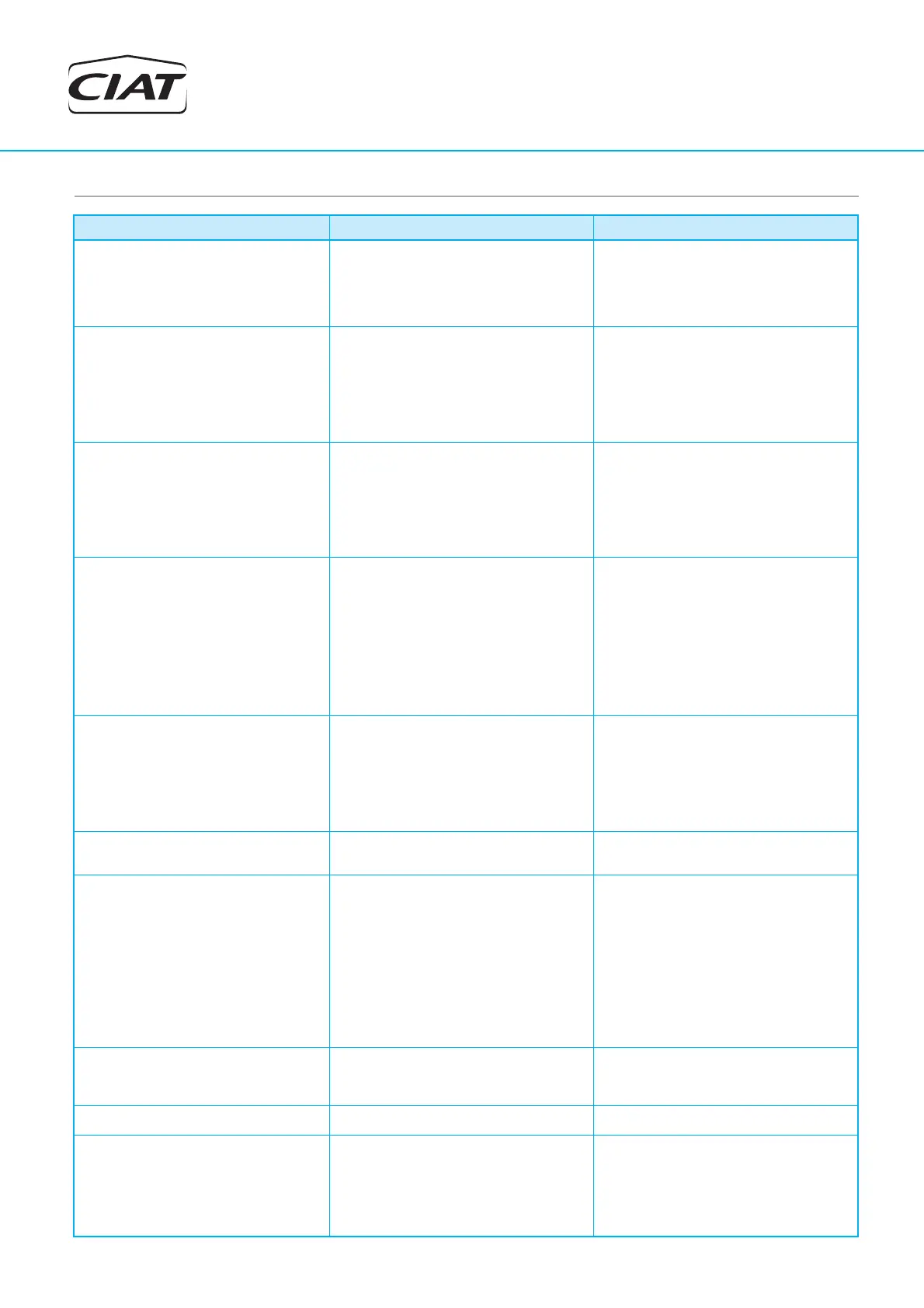
Symptom Cause Solution
Evaporation pressure very high in relation
with the air or water inlet
a) Charge excess
b) High water temperature
c) Compressor suction not air tight
d) Cycle reversing valve in middle position
a) Collect refrigerant
b) Verify overheating
c) Verify compressor state and replace
d) Check that the valve is not clogged. Replace
if necessary
Very low condensation pressure a) Gas lack
b) Low water temperature
c) Compressor suction not air tight
d) Cycle inversion valve in middle position
e) Liquid circuit plugging
a) Search for leaks, complete charge
b) Wait for regular speed
c) Verify compressor state and replace
d) Check that the valve is not clogged. Replace
if necessary
e) Verify the dehydrating fi lter and expansion
valve
Condensation pressure very high in relation
to the air or water outlet, high pressure
pressostat cut-off
a) Air or water fl ow insuffi cient
b) Air or water inlet temperature very high
c) Dirty condenser (does not exchange)
d) Much refrigerant load (fl ooded condenser)
e) The condenser fan is broken down
f) Air in the cooling circuit
a) Verify the air or water circuits (fl ow, fi lter
cleanliness etc.)
b) Verify the control thermostat readjustment
c) Clean it
d) Collect refrigerant
e) Repair
f) Make vacuum and load
Evaporation pressure too low (low pressostat
cut-off)
a) Low fl ow in evaporator. Air recirculation
b) Frozen evaporator
c) Liquid line as different temperatures at fi lter
inlet and outlet
d) Gas lack
e) Very low condensation pressure
f) Evaporator fan broken down
a) Verify the air or water circuits (fl ow, fi lter
cleanliness etc.)
b) Verify defrost
c) Replace fi lter
d) Search for leaks, complete charge
e) Temperature of air or water in condenser
very low (air or water fl ow very high), adjust
fl ow
f) Repair
Compressor does not start, does not make
noise (humming)
a) No power
b) The contacts of a control element are open
c) Timing of anti cycle short does not allow the
starting
d) Open contact
e) Contactor coil burnt
f) Indoor Klixon open
a) Check differential, fuses
b) Verify the safety chain of the electronic
control
c) Verify electronic control
d) Replace
e) Replace
f) Wait for reactivation, verify intensity absorbed
Compressor does not start, motor sounds
intermittently
a) Electrical power supply very low
b) Power cable disconnected
a) Control line voltage and locate voltage drop
b) Verify connections
Repeated compressor starts and stops a) Because of high pressure
b) Control differential too short (short cycle)
c) Insuffi cient gas, cut-off because of low
pressure
d) Dirty or frosted evaporator
e) The evaporator fan does not work, cuts off
the low pressostat
f) Expansion valve damaged or clogged by
impurities (cuts off low pressostat)
g) Dehydrating fi lter clogged (cuts off low
safety)
a) Verify charge
b) Increase differential
c) Search for leak, reload unit
d) Clean, verify evaporator air circuit
e) Replace or repair
f) Replace, as well as fi
lter
g) Replace
The compressor makes a noise a) Loose attachment
b) Oil lack
c) Compressor noise
a) Fix
b) Add oil to recommended level
c) Replace
Noisy operation a) Unit installed without antivibration protection a) Place base over shock absorbers
Cycle reversing is not carried out:
- No defrosting
- Does not change winter - summer cycles
a) Electrical fault
b) Inversion valve coil defective
c) Defrost method not working
d) Cycle inversion valve in middle position
e) Control fault
a) Locate and repair
b) Replace
c) Verify parameters
d) Tap with running compressor Replace if
necessary
e) Locate and repair


 To Next Page