Section 5. Operating Procedures
5.5
Concluding Inspection
Positioning Forks and Upright
When driving, with or without a load, it is good practice to always raise
the forks slightly and tilt the forks backward. Raising the forks and tilting
them back prevents the fork tips from catching on possible obstructions
and reduces the wear on the fork blades from striking or dragging on
the fl oor or ground. See the NOTICE and CAUTION below.
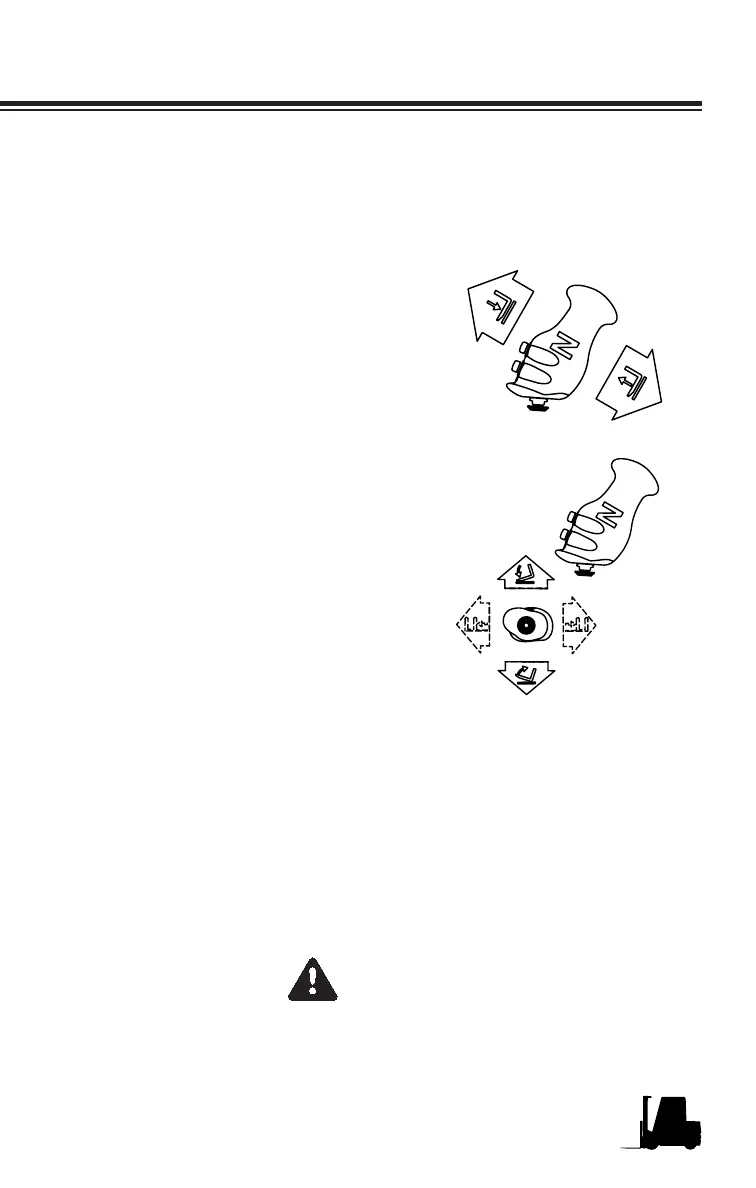
Pull back on the multi-function
control lever and raise the forks 6
to 8 inches (152 to 203 mm) above
the fl oor.
Then, using the tilt control, tilt the
forks back slightly to raise the tips.
The amount of forward and rearward
tilt to be used is governed by the
application.
NOTICE
When the upright (carriage and/or load) is raised into a high (el-
evated) position, the stability of the truck is reduced. Some of the
other conditions that may affect stability are: ground and fl oor
conditions, grade, speed, loading, dynamic and static forces and
the judgment exercised by the operator. Trucks equipped with at-
tachments behave as partially loaded trucks even when operated
without a load on the attachment. Also, improper operation, faulty
maintenance or poor housekeeping may contribute to a condition
of instability
CAUTION
For stability reasons, do not travel with the load or carriage in
an elevated position. Travel with the lift mechanism raised only
enough to clear the ground or obstacles.


 To Next Page