5.10
Adjusting the Load Forks
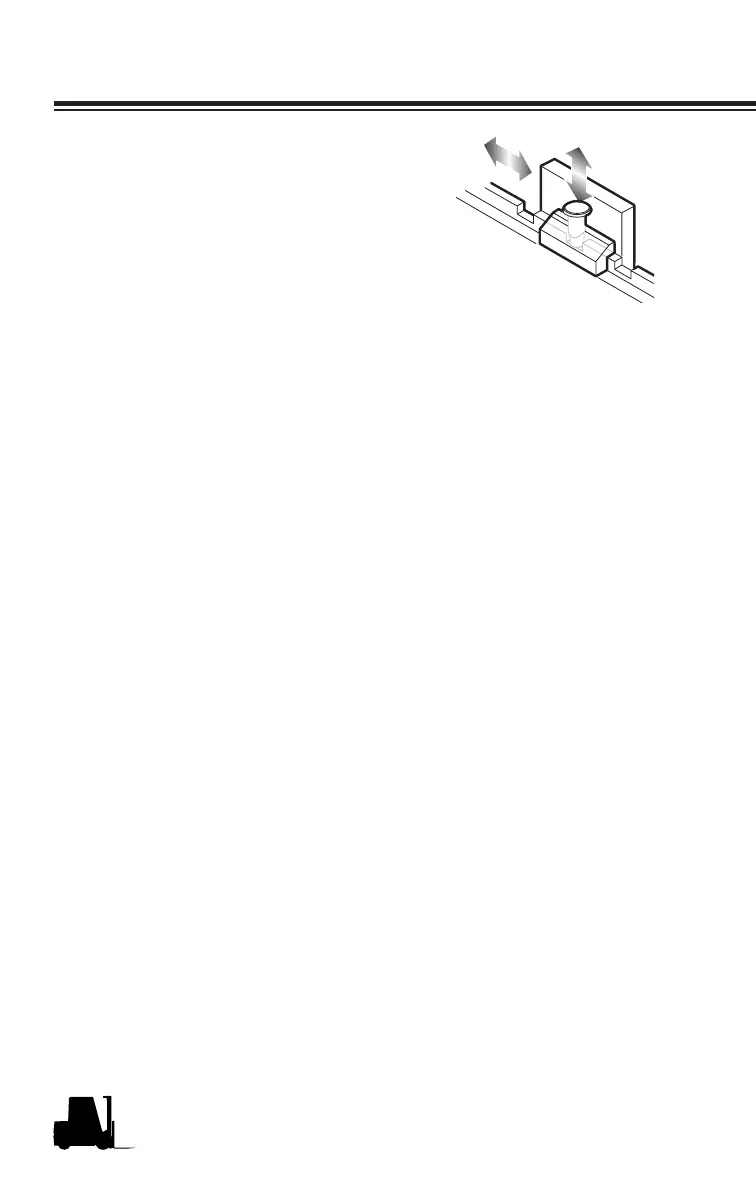
The load forks are adjustable on the car-
riage fork bar. Forks should be spaced
as far apart as the load being carried will
allow. Both forks should always be the
same distance from the center of the fork
carriage.
IMPORTANT
When adjusting forks ALWAYS push forks away from you,
never pull forks toward you.
To adjust the forks, raise the carriage slightly. Tilt the upright fully for-
ward to reduce friction and make the forks slide easier. Unlock the fork
locking pins. Position the forks. Secure the fork locking pins.
Load Handling
Load Handling • Adjusting the Load Forks
718082
Handle only loads that are within the truck rated capacity as shown on
the nameplate. This rating specifi es the maximum load that should be
lifted. However, other factors such as special load handling attachments,
loads having a high center of gravity, or uneven terrain may dictate
that the safe working load be less than the rated capacity. Under these
conditions, the operator must reduce the load being carried so that the
lift truck remains stable.
Handle only stable or safely arranged loads. Do not handle loads made
up of loose, unevenly stacked or unstable items that can easily shift
and fall. Take the time to correctly stack and band loose items. Center
the load on the forks.
Do not lift anything that might fall on the operator or a bystander.
Do not handle loads that are higher than the fork carriage or load backrest
unless the load is secured so that no part of it can fall backwards.
Keep the load back against the carriage. Loads placed out on the
ends of the forks can make the lift truck less stable and more likely to
tip forward.
Lift and lower with the upright mast vertical or tilted slightly back — never
lift or lower with the upright mast tilted forward.
Operate lift and tilt controls slowly and smoothly. Never tilt forward
when carriage is raised, except to pick up or deposit a load over a
rack or stack.


 To Next Page