7
Conventional Wheel Hubs – Recommended Service
ConMet
4. Conventional Wheel Hubs – Recommended Service
10. Slide the hub off the spindle.
Remove and save the outer
bearing cone. Be careful when
you remove the hub that you do
not damage the outer bearing
by dropping it on the oor.
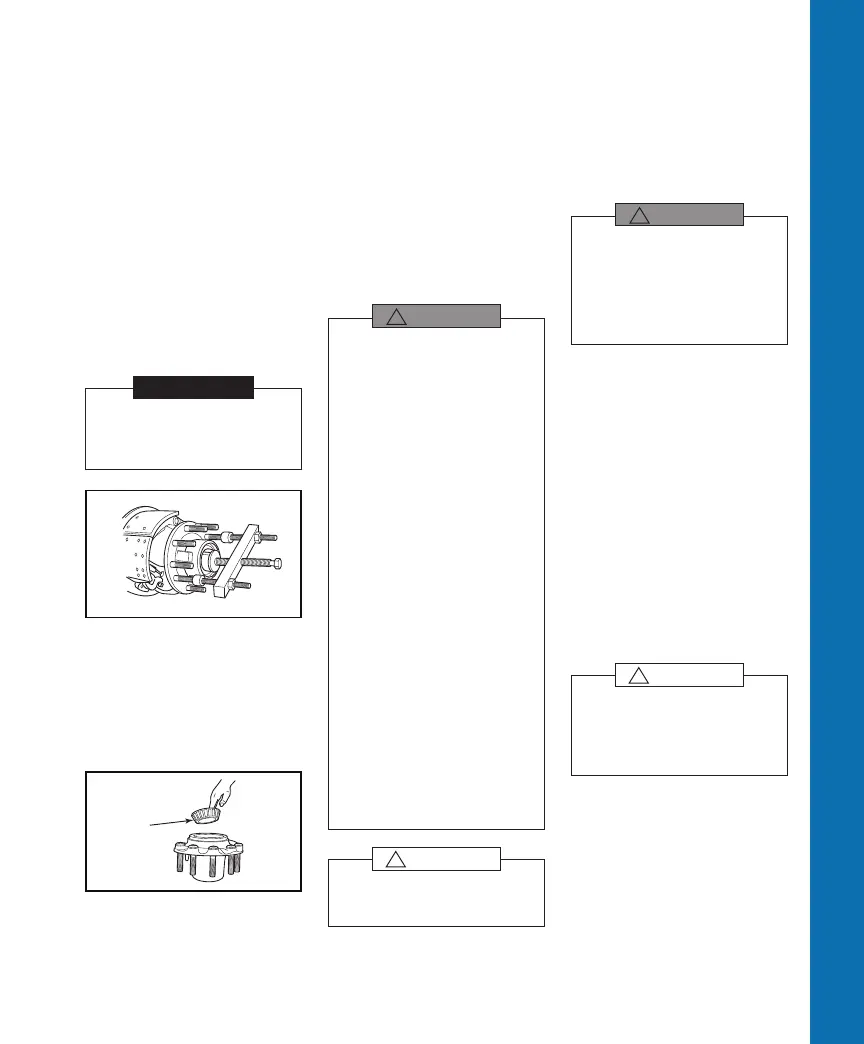
- If the hub is difcult to remove
because the seal or bearings
are stuck on the spindle, use
a mechanical puller to remove
the hub (see gure 25).
- If part of the seal remains on
the spindle, carefully remove
the part of the seal that
remains on the spindle.
This can be done by striking the remaining portion
of the seal with the round end of a ball-peen
hammer. Use caution not to damage the seal
journal on the spindle.
NOTE
105740a
FIGURE 25
11. Place the hub on its outboard
end and remove the seal.
Retain the seal if it needs
to be returned for warranty
consideration.
12. Remove the inner bearing cone
(see gure 26).
INNER
BEARING
CONE
Hub Disassembly
FIGURE 26
COMPONENT
INSPECTION AND
REPLACEMENT HAZARD
ALERT MESSAGES
Read and observe all hazard alert
messages in this publication. They
provide information that can help
prevent serious personal injury,
damage to components, or both.
To prevent serious eye injury, always wear
safe eye protection when you perform vehicle
maintenance or service.
Observe all warnings and cautions provided
by the press manufacturer to avoid damage to
components and serious personal injury.
Do not hit steel parts with a steel hammer. Pieces
of a part can break o. Serious personal injury and
damage to components can result. Use a brass or
synthetic mallet for assembly and disassembly
procedures.
Solvent cleaners can be ammable, poisonous
and cause burns. Examples of solvent cleaners
are carbon tetrachloride, and emulsion-type
and petroleum-base cleaners. Read the
manufacturer’s instructions before using a solvent
cleaner, then carefully follow the instructions. Also
follow the procedures below.
- Wear safe eye protection.
- Wear clothing that protects your skin.
- Work in a well-ventilated area.
- Do not use gasoline or solvents that contain
gasoline. Gasoline can explode.
- You must use hot solution tanks or alkaline
solutions correctly. Read the manufacturer’s
instructions before using hot solution tanks
and alkaline solutions. Then carefully follow
the instructions.
WARNING
!
Do not use hot solution tanks or water and
alkaline solutions to clean ground or polished
parts. Damage to parts can result.
CAUTION
!
CLEAN AND DRY
COMPONENTS
Worn or Damaged Components
Do not repair or recondition wheel-end
components. Replace damaged, worn or out-of-
specication components. Do not mill or machine
any components. Using repaired, reconditioned,
damaged or worn components can cause wheel
end failure, which can result in serious injury and
property damage.
WARNING
!
Hub and Component Cleaning
1. Use a cleaning solvent to clean
the hub and all wheel end
components.
2. Do NOT clean ground or
polished parts in a hot solution
tank or with water, steam
or alkaline solutions. These
solutions will cause corrosion of
the parts.
3. Clean and inspect the wheel
bearing cups and cones,
race, spindle bearing and seal
journals on the spindle and hub.
Bearings should be cleaned
with clean ltered solvent and
dried with either compressed
air or a lint-free rag.
If compressed air is used, do not spin dry the
bearings. The rollers may score due to lack of
lubricant and rollers could come o which can
result in serious injury. Ensure that the air line is
moisture free.
CAUTION
!
4. Clean and inspect the spindle.
Be sure to clean the full length
of the seal journal on the
spindle.
5. Parts must be dried
immediately after cleaning. Dry
parts with clean paper towels or
rags, or compressed air. Do not
dry bearings by spinning with
compressed air.


 To Next Page