47ConMet
10. Hub and Rotor Inspection
HAZARD ALERT
MESSAGES
Read and observe all hazard alert
messages in this publication. They
provide information that can help
prevent serious personal injury,
damage to components, or both.
To prevent serious eye injury, always wear
safe eye protection when you perform vehicle
maintenance or service.
Do not work under a vehicle supported only by
jacks. Jacks can slip and fall over. Serious personal
injury and damage to components can result.
Park the vehicle on a level surface. Block the
wheels to prevent the vehicle from moving.
Support the vehicle with safety stands.
WARNING
!
Some brake linings contain asbestos bers, a
cancer and lung disease hazard. Some brake
linings contain non-asbestos bers, whose long-
term eects to health are unknown. Use caution
when handling both asbestos and non-asbestos
materials.
WARNING
!
DISC BRAKE ROTOR
INSPECTION
A disc brake component inspection
should be a part of any pre-trip
inspection and regularly-scheduled
preventive maintenance program.
Follow all shop safety procedures before
beginning vehicle inspection.
WARNING
!
1. Lift and support the axles
with safety stands. Refer to
the vehicle manufacturer's
recommended instructions.
2. Remove the wheels from the
hub.
3. Rotate the hub and visually
inspect both sides of the rotor
for the out of service conditions
detailed in this section. If any
of these conditions are found,
remove the hub and replace
the rotor according to the
instructions in this manual.
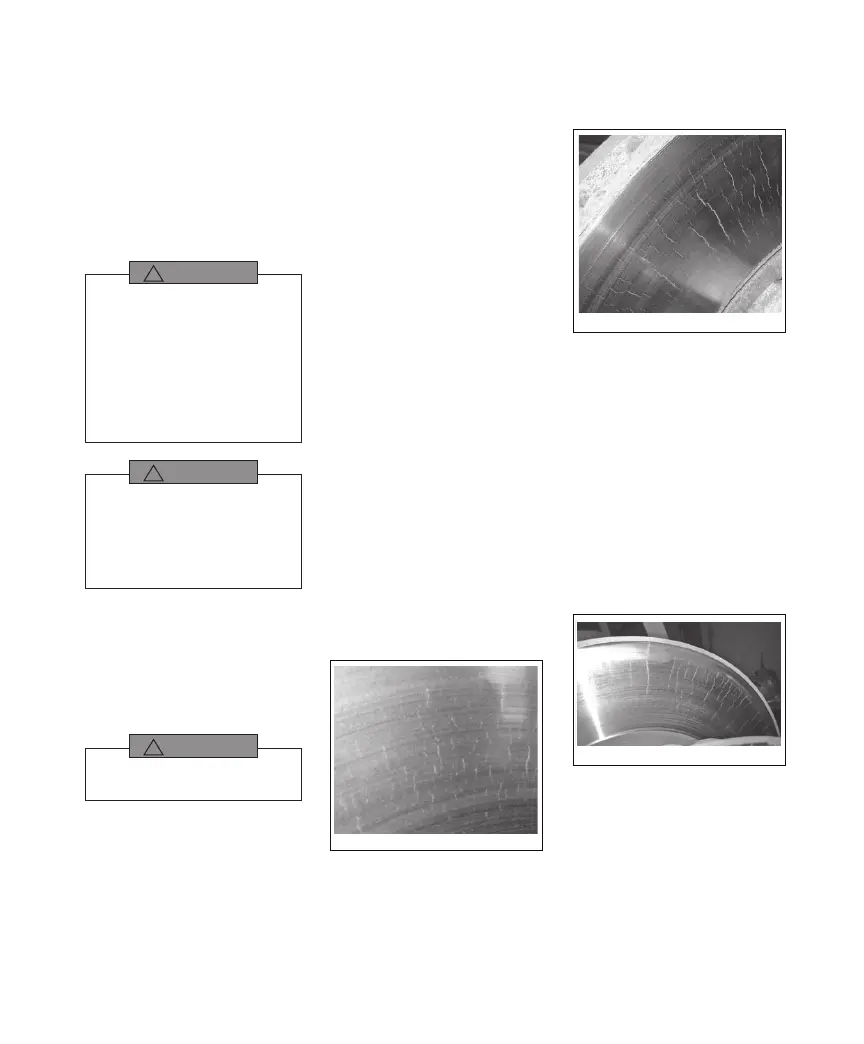
Heat Checks
Heat checks are caused by the
repeated heating and cooling of
the braking surface. They appear
as short, thin, radial interruptions
in the braking surface. There may
be numerous light and heavy heat
checks on the braking surface. See
gure 106 for examples of light heat
checking and gure 107 for heavy
heat checking.
Cracks
Heat checks may wear away
or they may eventually become
braking surface cracks. Rotors
should be replaced if cracks
become over 0.060" wide or over
0.060" deep and extend over 75%
of the braking surface in the radial
direction.
106836a
Light Heat Check
FIGURE 106
106837a
Heavy Heat Check
FIGURE 107
Cracked rotors may be caused
by mishandling, brake balance
issues, wear beyond the minimum
allowable thickness, or driver
abuse. If a crack extends through a
section of the rotor, the rotor should
be replaced. If a crack is found
on the mounting section of the
rotor, the rotor should be replaced.
Figure 108 shows a cracked rotor
that should be replaced. The crack
in gure 109 is acceptable to run,
but the rotor should be inspected
on a regular basis to ensure that
the crack has not progressed.
106834a
Unacceptable Crack
FIGURE 108


 To Next Page