The final stage of the gauge manufacturing process is the
calibration. The density calibration method used by most
manufacturers utilizes an exponential equation that models the
relationship between the known densities and the counts.
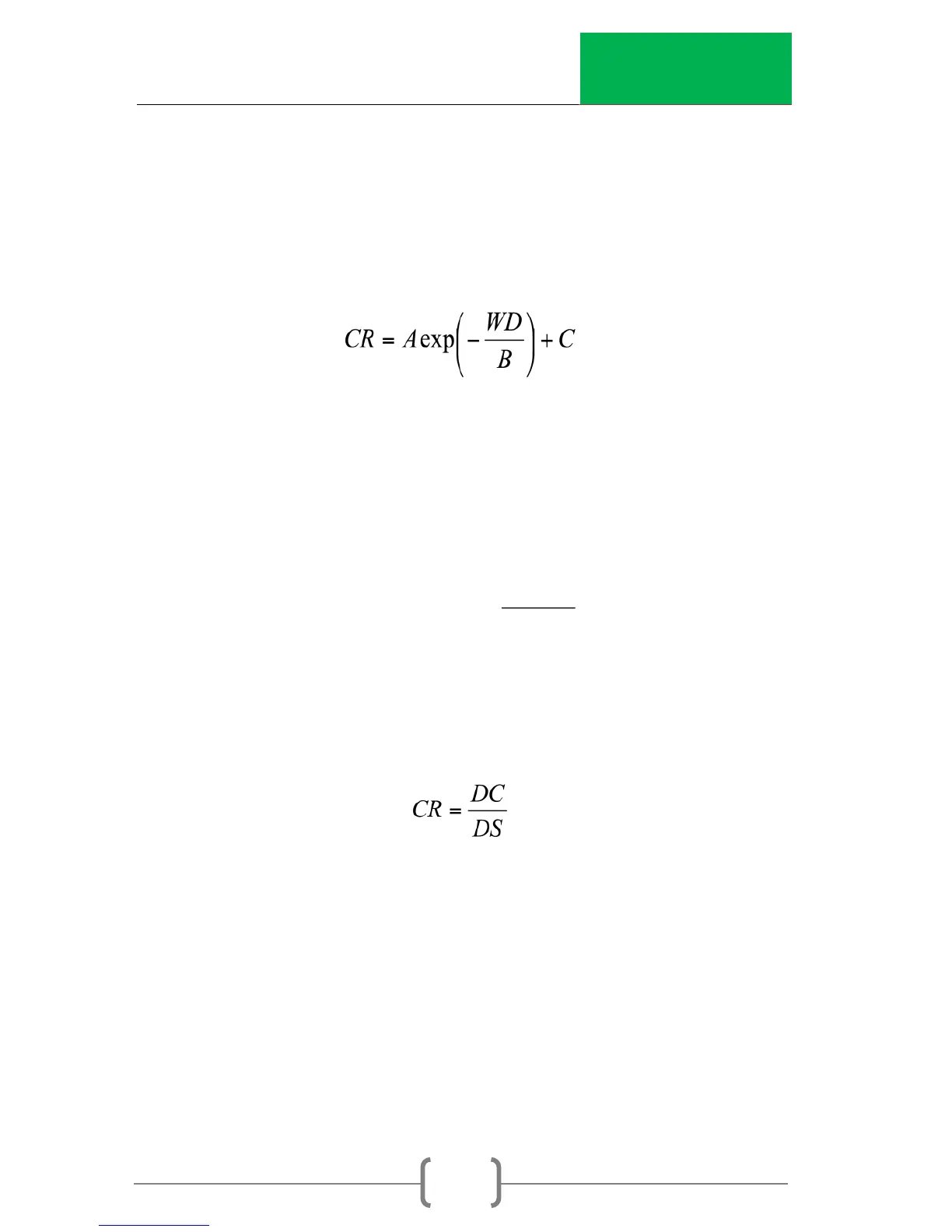
InstroTek uses the following equation.
Where A, B and C are gauge parameters, CR is the count ratio
and WD is the material density. The A, B and C values are
commonly known as calibration constants. In the field when a
count is collected on the test material, the resulting wet density
(WD) displayed on the screen is calculated by:
Count ratio (CR) in the above equation is calculated by the
ratio of counts to reference standard counts. Test Count (DC) is
divided by Standard Count (DS).
Cs-137 has a half-life of 30 years, 2.2 % reduction in intensity per
year. The count ratio is used in this case to correct for natural
decay of the source. For this reason it is very critical that users
obtain an accurate reference standard count on a daily basis.
This will ensure that any decay in the counts is canceled by the
decay in the reference standard count. For example, six
months after calibration, the Cs-137 source will decay 1.1%
(1.1% reduction in counts). The 1.1% change will be reflected in
the test counts and the reference standard count. Ratio of


 To Next Page