soils, chlorine in coastal soils, and iron oxide in deposits can be
encountered in sufficient concentration to affect the readings.
Gauge software contains offset features so that gauge
readings can be corrected for these influences in the field.
Depth of Measurement
In density backscatter mode, the depth of measurement is
independent of the density of the material. In backscatter
mode 85% of the density reading is from the top 2.5 inches (64
mm) of the material and the remaining 15% is from the top 2.5
to 4 inches (64 to 100 mm) of the material.
Moisture measurement depth depends on the gauge geometry
and moisture content of the material. The measurement of
moisture is heavily weighted by the material closest to the
gauge. In general a gauge with a range in moisture
measurement of 0-40 PCF (0 to 640 kg/m3); the measurement
depth is approximately 9 inches (230 mm) for soils containing 10
PCF (160 kg/m3) of moisture.
Calibration
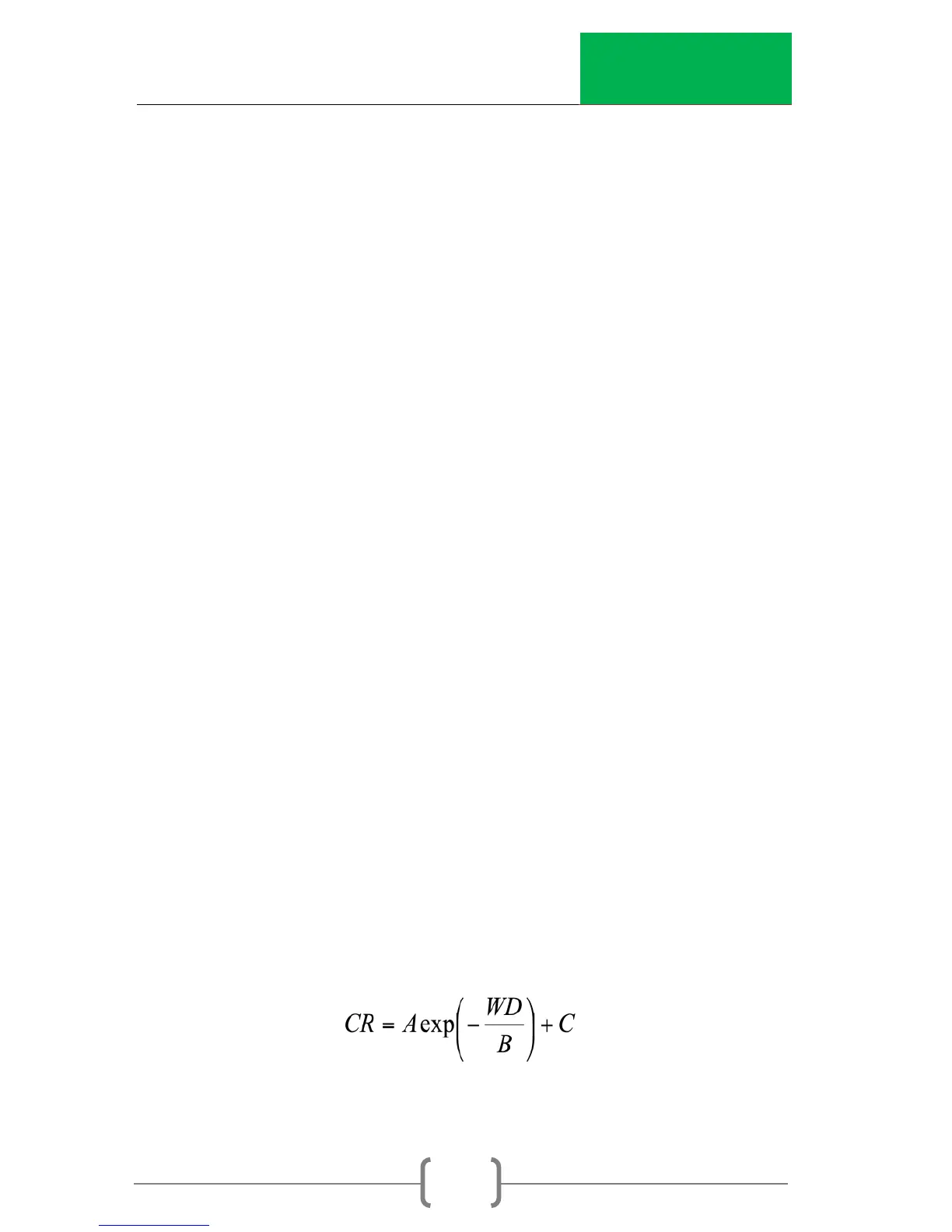
Density Calibration - Calibration of density in the gauge is
achieved by using blocks of known density. The objective of
the calibration is to calculate the constants, A, B and C that are
used in the density equation. Once these constants are
determined, the gauge can be used in the field to calculate
wet density.


 To Next Page