109D-Link DSL-226 User Manual
Appendix C - Technical Specications
Technical Specications
Device Interfaces
• One RJ-11 DSL port
• 802.11n/g/b
1,2
Wireless LAN
• One 10/100Base-TX Ethernet WAN/LAN port
• Three 10/100Base-TX Ethernet LAN ports
• One USB 2.0 port
Standards
• IEEE 802.11n/g/b
• IEEE 802.3/u/i
ADSL Standards
• G.dmt/G.lite/G.hs/VBR, CBR, UBR
• ITU-T G.992.5/ G.992.3/ G.992.2/ G992.1
VDSL Standards
• ITU-T G.993.5
• Prole 8a/8b/12a/12b/17a/30a/35b
Antenna Types
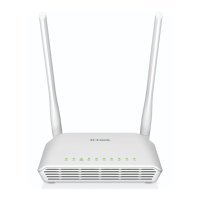
• Two external antennas
Wireless Signal Rate
1,2
• 2.4 GHz up to 300 Mbps
2
Security
• WEP-128Bit/64Bit
• WPA™
- Personal/Enterprise
• WPA2™
- Personal/Enterprise
• Wi-Fi Protected Setup (WPS)
Power
• Input: 100 to 240 V AC, 50/60 Hz
• Output: 12 V DC, 1 A
Operating Temperature
• 0 to 40 °C (32 to 104 °F)
Storage Temperature
• -20 to 70 °C (-4 to 158 °F)
Operating Humidity
• 5% to 95% maximum (non-condensing)
Storage Humidity
• 5% to 95% maximum (non-condensing)
Certications
• CE
• RCM
• RoHS
Dimensions
• 141.2 mm (5.6 inches)
• 100.1 mm (4 inches)
• 35 mm (1.2s inches)
Weight
• 150 grams (5.3 ounces)
Notes:
1. Maximum wireless signal rate derived from IEEE Standard 802.11b, 802.11g, and 802.11n specications. Actual data throughput will vary. Network conditions and environmental factors, including
volume of network trac, building materials and construction, and network overhead, lower actual data throughput rate. Environmental factors will adversely aect wireless signal range.
2. Frequency Range varies depending on country’s regulation.


 To Next Page
 Loading...