EasyManua.ls Logo

Datakom D-200 MK2 - User Manual

Datakom D-200 MK2
135 pages
Print Icon
To Next Page IconTo Next Page
Loading...
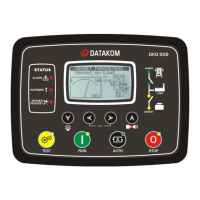
D-200 MK2 User Manual Firmware V-6.3
D-200 MK2
ADVANCED
GENSET
CONTROLLER
The D-200-MK2 is a next generation genset control unit
combining multi-functionality and wide communication
possibilities together with a reliable and low cost design.
The same controller provides AMF, ATS, Remote Start,
Engine Control functionalities.
The module comes ready for remote monitoring over
GSM or Ethernet with plug-in communication modules.
Various plug-in modules provide unlimited expansion
capabilities allowing to meet any special requirement.
The unit complies and mostly exceeds world’s tightest
safety, EMC, vibration and environmental standards for
the industrial category.
Software features are complete with easy firmware
upgrade process through USB port.
The Windows based PC software allows monitoring and
programming through USB, serial and GPRS.
The Rainbow Scada central monitoring service allows
monitoring and control of an unlimited number of
gensets from a single central location.
AMF unit
ATS unit
Remote start controller
Manual start controller
Engine controller
Waveform display of V & I
Harmonic analysis of V & I
CTs at genset or load side
GSM Modem (2G-3G-4G) *
Ethernet 100Mbps *
Wi-Fi *
RS-485 isolated (2400-57600baud) *
RS-232 isolated (2400-57600baud) *
USB Device
J1939 CANBUS (optional)
Web monitoring *
Web programming *
Central Monitoring through internet *
SMS message sending *
E-mail sending *
PC software: Rainbow Plus
Central monitoring *
Modbus RTU through RS-485 *
Modbus TCP/IP *
*Optional with plug-in module
3 phases 4 wires, star & delta
3 phases 3 wires, 3 CTs
3 phases 3 wires, 2 CTs
2 phases 3 wires
1 phase 2 wires
FUNCTIONALITIES
COMMUNICATIONS
DESCRIPTION

Table of Contents

Question and Answer IconNeed help?

Do you have a question about the Datakom D-200 MK2 and is the answer not in the manual?

Datakom D-200 MK2 Specifications

General IconGeneral
BrandDatakom
ModelD-200 MK2
CategoryController
LanguageEnglish

Summary

1. INSTALLATION INSTRUCTIONS

2. MOUNTING

2.1. DIMENSIONS

Physical dimensions and panel cutout details.

2.2. SEALING, GASKET

Information about gasket and IP rating.

2.3. ELECTRICAL INSTALLATION

Guidelines for electrical installation and wiring.

3. TERMINAL DESCRIPTIONS

3.1. VOLTAGE AND CURRENT INPUTS

Details for battery, AC voltage, and AC current inputs.

3.2. DIGITAL AND ANALOG INPUTS

Details for digital and analog sender inputs.

3.3. MISCELLANEOUS INPUTS;OUTPUTS

Details for charge input, magnetic pickup, and contactor outputs.

3.4. COMMUNICATION PORTS

Details for RS-485, J1939, USB, GSM, Ethernet, Wi-Fi ports.

4. TOPOLOGIES

4.1. SELECTING THE TOPOLOGY

How to select the topology via software.

4.2. COMMON TOPOLOGY DIAGRAMS

Connection diagrams for various 3-phase and 2-phase topologies.

4.9. SINGLE PHASE TOPOLOGY

Connection diagram for the 1 Phase, 2 Wire topology.

5. FUNCTIONALITIES

5.1. BASIC FUNCTIONALITIES

CT location, AMF, ATS, Remote Start, Engine Controller functionality.

5.7. SPECIAL OPERATION MODES

Details on 400Hz operation capabilities.

6. CONNECTION DIAGRAMS

6.1. AMF FUNCTIONALITY DIAGRAMS

Connection diagrams for AMF functionality.

6.3. ATS FUNCTIONALITY DIAGRAM

Connection diagram for ATS functionality.

6.4. REMOTE START FUNCTIONALITY DIAGRAM

Connection diagram for Remote Start functionality.

6.5. ENGINE CONTROL FUNCTIONALITY DIAGRAM

Connection diagram for Engine Control functionality.

9. DESCRIPTION OF CONTROLS

9.1. FRONT PANEL LAYOUT

Overview of front panel buttons, LEDs, and display.

9.2. BUTTON AND DISPLAY FUNCTIONS

Details of button functions and parameter navigation.

12. STATISTICAL COUNTERS

12.1. FUEL FILLING COUNTER

Details on the incremental counter for fuel filling.

12.2. FUEL CONSUMPTION MONITORING

How the unit displays actual fuel consumption.

13. OPERATION OF THE UNIT

13.1. QUICK START GUIDE

Basic steps for starting and operating the unit.

13.2. CORE OPERATING MODES

Details on STOP, AUTO, RUN, TEST modes for unit operation.

14. PROTECTIONS AND ALARMS

14.1. PROTECTION MANAGEMENT

Disabling protections and service request alarms.

14.3. ALARM TYPES AND CAUSES

Details on shutdown, loaddump, warnings, and non-visual alarms.

15. PROGRAMMING

15.1. BASIC PROGRAMMING OPERATIONS

Resetting defaults, entering mode, navigating menus.

15.4. PARAMETER MODIFICATION AND EXIT

How to modify parameter values and exit programming mode.

16. PROGRAM PARAMETER LIST

16.1. CONTROLLER CONFIGURATION

Parameters for general controller configuration.

16.2. ELECTRICAL PARAMETERS

Parameters related to electrical measurements and settings.

16.3. ENGINE PARAMETERS

Parameters related to engine operation and control.

16.4-16.9. ADDITIONAL CONFIGURATIONS

Settings for time, schedules, senders, inputs, and outputs.

16.10-16.15. MODEM AND NETWORK CONFIGURATIONS

20. CRANK CUTTING

21. OVERCURRENT PROTECTION (IDMT)

22. MOTORIZED CIRCUIT BREAKER CONTROL

23. J1939 CANBUS ENGINE SUPPORT

24. SMS COMMANDS

25. SOFTWARE FEATURES

25.1. LOAD MANAGEMENT FEATURES

Load shedding, dummy load, load add/subtract, and five-step load management.

25.4. OPERATION MODES AND CONTROL

Remote Start, Disable Auto Start, Mains Simulation, Dual Genset, Volt/Freq.

25.9. SPECIALIZED OPERATION MODES

Single Phase, External Control, Exerciser, Scheduler, Engine Heating.

25.16. FUEL AND BATTERY MANAGEMENT

Fuel pump, fuel solenoid, pre-transfer, battery charging, and engine heating.

25.20. ADVANCED FEATURES

External digital outputs, combat mode, controller reset, zero power.

26. MODBUS COMMUNICATIONS

26.1. RS-485 MODBUS SETUP

Required parameters for RS-485 Modbus communication.

26.2. DATA FORMATS

Explanation of data formats used in Modbus communication.

27. DECLARATION OF CONFORMITY

28. MAINTENANCE

29. DISPOSAL OF THE UNIT

30. ROHS COMPLIANCE

31. TROUBLESHOOTING GUIDE

Related product manuals