Need help?
Do you have a question about the Datakom D-500 MK2 and is the answer not in the manual?
Details communication options like Ethernet, GSM-GPRS, web server, Modbus, and USB.
Defines supported electrical configurations for gensets and mains, including phase and wire counts.
Outlines various functions like synchronization, load share, AMF, ATS, and engine control.
Provides information about the document's scope, purpose, and contact details for queries.
Lists supplementary documentation for further information and configuration guidance.
States copyright and usage restrictions for the document content.
Details the revision history of the firmware and the user manual.
Defines key terms like CAUTION, WARNING, and ATTENTION used throughout the manual.
Explains how to order different versions of the D-500 family units based on features.
Lists available spare parts such as mounting brackets and sealing gaskets.
Lists various electrical connection topologies supported by the controller.
Details functionalities like CT location, synchronization, AMF, ATS, and engine control.
Provides wiring diagrams for various genset synchronization and mains parallel functionalities.
Provides detailed descriptions of each terminal's function and technical data.
Lists detailed technical specifications of the D-500 MK2 controller.
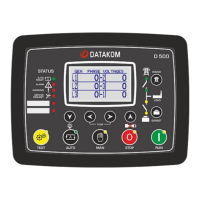
Explains the front panel controls, button functions, and display organization.
Details the unit's capability to display waveforms and analyze harmonic content.
Explains how to view and interpret event logs for diagnostics and monitoring.
Details the unit's non-resettable incremental counters for statistical purposes.
Explains how to operate the unit, including quick start and different operational modes.
Covers entering programming mode, navigating menus, and modifying parameters.
Lists and describes various programmable parameters for controller configuration.
Details configuration settings for Ethernet, Wi-Fi, and GSM modem connectivity.
Explains crank cutting, overcurrent protection, and MCB control features.
Covers auto learning, speed/voltage control, J1939 support, SMS commands, and load transfer.
Explains load sharing and genset operation in parallel with mains, including protections.
Explains how to record data to USB flash memory or SD card.
Lists various software features like load shedding, remote start, and engine heating.
Details Modbus and SNMP communication protocols for data exchange and monitoring.
States compliance with directives, maintenance, and proper disposal procedures.
Provides solutions for common problems encountered with the unit and its operation.
Lists critical checks and steps to perform before proceeding with unit installation.
Highlights conditions that can cause damage to the controller unit.
Lists conditions that can lead to abnormal operation or malfunction of the controller.
Details the physical mounting procedures for the controller unit.
Provides the physical dimensions and panel cutout specifications for the controller.
Illustrates the panel cutout dimensions required for mounting the controller.
Shows the necessary depth required in the panel for installing the controller.
Explains the two types of mounting brackets supplied with the unit and their installation.
Describes the gasket's role in watertight mounting and defines IP protection levels.
Specifies the voltage input range, dropouts, overvoltage, and accuracy for the battery.
Details measurement methods, ranges, accuracy, and supported topologies for AC voltage inputs.
Details measurement methods, ranges, accuracy, and CT selection for AC current inputs.
Explains CT accuracy class selection and correct CT connection procedures.
Illustrates the impact of polarity reversal and phase swapping in CT connections.
Details the number, function, and configuration parameters for digital inputs.
Details the analog sender inputs, their configuration, and specifications.
Explains the function and specifications of charge input and magnetic pickup inputs.
Describes digital outputs, mains/generator contactor outputs, and their specifications.
Details J1939 CANBUS and USB device ports for engine communication and PC connection.
Lists types of plug-in modules for modem, synchronization, and analog expansion.
Describes the communication plug-in slot and its options.
Details the GSM modem module, its features, and specifications.
Details the Wi-Fi slot, its protocols, security, and functionalities.
Details the Ethernet slot, its data rate, connector, and LED functions.
Details the RS-485 slot, its protocol, baud rate, and maximum distance.
Describes the analog AVR and governor control output specifications.
Details the Datalink-CANBUS port, its connection, and termination requirements.
Describes the analog load share signal for load sharing functionality.
Explains the analog I/O extension plug-in module and its input switching.
Details the specifications for the 3x Mains CT inputs plug-in module.
Details the Ethernet port specifications, data rate, and LED functions.
Describes the USB Host port for data recording and its functionality.
Details the RS-485 port, its protocol, baud rate, and maximum distance.
Guides on selecting the correct topology through the program parameter.
Illustrates the wiring diagram for a 3-phase, 4-wire star topology.
Illustrates the wiring diagram for a 3-phase, 3-wire delta topology.
Illustrates the wiring diagram for a 3-phase, 4-wire delta topology.
Illustrates the wiring diagram for a 3-phase, 3-wire delta with 2 CTs (L1-L2).
Illustrates the wiring diagram for a 3-phase, 3-wire delta with 2 CTs (L1-L3).
Illustrates the wiring diagram for a 2-phase, 3-wire delta with 2 CTs (L1-L2).
Illustrates the wiring diagram for a 2-phase, 3-wire delta with 2 CTs (L1-L3).
Illustrates the wiring diagram for a 1-phase, 2-wire topology.
Explains the parameter for selecting CT location and its effect on measurements.
Describes the synchronization functionality for paralleling multiple gensets.
Explains the functionality for synchronizing a genset group to the power grid.
Details how a single genset can operate in parallel with the grid.
Describes AMF and ATS functionality for mains failure backup and load transfer.
Details the Remote Start functionality for controlling the genset remotely.
Explains the Engine Controller functionality for controlling engines without an alternator.
Describes how the unit can function as a remote display and control panel.
Details the unit's capability to operate at 400Hz frequency.
Illustrates the connection diagram for genset synchronization functionality.
Illustrates the connection diagram for mains synchronization functionality.
Illustrates the connection diagram for single genset parallel operation with mains.
Illustrates the connection diagram for AMF functionality.
Illustrates the connection diagram for ATS functionality.
Illustrates the connection diagram for remote start functionality.
Illustrates the connection diagram for engine control functionality.
Illustrates the connection diagram for remote display panel functionality.
Describes Digital Outputs 1 and Digital Input 1, their technical data, and factory set functions.
Describes sender ground, oil pressure sender, generator contactor, and GEN-L1 terminals.
Describes generator current inputs (I1+), mains neutral, mains-L1, and mains contactor terminals.
Details data link termination, communication terminals, and AVR/Governor control outputs.
Explains the analog I/O extension plug-in module and its input switching.
Details parameters for the AC Current Inputs Plug-in Module, including I1+ input.
Details the operation and indicators on the front panel of the controller.
Describes the function of each pushbutton on the controller's front panel.
Continues the description of pushbutton functions and special mode activations.
Explains how parameters are organized and navigated on the controller's display.
Describes the automatic scrolling feature for displaying measurements and its settings.
Shows the main menu structure and navigation path for parameters.
Displays sub-menu items, including parameters for various functions.
Describes the graphical representation of harmonic analysis results.
Describes the alphanumeric display of harmonic analysis results.
Explains how to access and interpret event logs, including stored values and event sources.
Details how to navigate and view event logs on the controller's display.
Describes the incremental counter for tracking fuel filling operations.
Explains how the unit monitors fuel consumption through J1939 or pulse counting.
Offers a brief guide to starting and stopping the engine and basic operations.
Explains the operation and behavior of the controller in STOP mode.
Details the AUTO mode operation, including mains availability evaluation and start sequences.
Explains the RUN mode for manual engine start, control, and contactor operation.
Describes the TEST mode for running the genset under load for verification.
Explains how to disable protections and the service request alarm for maintenance.
Lists and explains various shutdown alarms and their causes.
Lists and explains various loaddump alarms and their causes.
Continues the list of loaddump alarms and their associated conditions.
Lists and explains various warning alarms and their causes.
Continues the list of warning alarms and their associated conditions.
Describes warnings that do not appear on the front panel but are logged or sent via SMS/email.
Provides step-by-step instructions for resetting the controller to its factory default settings.
Explains how to enter the programming mode and handle password entry.
Guides on navigating the two-level menu system for accessing program groups and parameters.
Explains how to change parameter values using the front panel controls.
Describes how to exit the programming mode and the auto-cancel timer.
Details parameters for LCD contrast, language, default display, and timers.
Covers modem, GPS, and network settings within controller configuration.
Details RS-485, SMS, oil pressure priority, and flashing relay parameters.
Covers email, warnings, remote control, and annunciator mode configurations.
Details unit functionality, LCD backlight, topology detection, and SMS settings.
Lists final controller configuration parameters like fuel counter, dual genset aging, and time zone.
Covers CT primary ratings, voltage transformer ratio, and nominal voltage/frequency settings.
Details parameters for mains dropout, frequency limits, and genset voltage/frequency limits.
Details parameters for genset frequency limits, battery voltage limits, and voltage unbalance.
Covers genset current unbalance, reverse power, and overcurrent parameters.
Details parameters for genset overload, load shedding, and mains/genset connection topologies.
Covers contactor timers, MCB control parameters, and phase order check.
Details GCB alarm, busbar timers, and multi-load management parameters.
Covers nominal RPM, low/high RPM limits, and RPM fail timer.
Details parameters for charge voltage, engine heating, start delay, and cooldown timers.
Explains idle speed timers, crank cut functions, and fuel tank capacity.
Details parameters for coolant control, fan control, and service interval settings.
Covers service interval parameters and J1939 enable settings.
Details J1939 Engine Brand parameter for identifying engine types.
Lists J1939 ECU Type options for various engine manufacturers and ECUs.
Covers J1939 speed adjust, air inlet temp, coolant level, and battery charge parameters.
Continues sender configuration, detailing sender curves, name, and fault strings.
Explains the purpose and entry of the site identity string for controller identification.
Explains how to enter the engine serial number for identification.
Details how to configure telephone numbers for modem calls and SMS sending.
Details SNTP parameters for time synchronization with atomic clock servers.
Details Wi-Fi parameters for network connection, including SSID and password.
Covers governor and AVR control parameters, droop settings, and excitation loss alarm.
Details parameters for synchronization contactor timing, frequency, voltage, and soft transfer.
Covers ramp parameters, power sharing gains, and nominal frequency/voltage synchronization.
Details parameters for multi-genset delayed stop, parallel check delay, ROCOF, and vector shift.
Covers peak lopping parameters, power export, and speed/voltage control parameters.
Details voltage up/down pulse parameters and reactive load sharing settings.
Shows tripping delay tables and curves for the IDMT overcurrent protection.
Illustrates MCB control using open-close coils and close-UV coils with relay assignments.
Continues the process of activating auto learning for governor and AVR control.
Explains how to activate auto learning and its successful completion.
Details the parameters for controlling speed via up/down pulses.
Details the parameters for controlling voltage via up/down pulses.
Lists common electronic engine fault codes (SPN-FMI) relevant to the J1939 interface.
Continues the list of electronic engine fault codes (SPN-FMI).
Provides a basic list of Fault Mode Identifier (FMI) codes and their descriptions.
Details the support for external GPS modules for location determination.
Shows the GPS screen display with latitude, longitude, and satellite information.
Discusses GPS location determination factors, priority, and storage.
Provides additional SMS commands for mode selection and output control.
Explains the conventional load transfer method with a brief power interruption.
Details the uninterrupted transfer mode, its conditions, and setup parameters.
Explains the soft transfer mode for gradual load transfer with power control.
Describes digital load sharing using Datalink communication for best performance.
Continues the explanation of digital load sharing parameters and operation.
Details analog load sharing as an emergency backup and its limitations.
Explains droop mode load sharing for emergency cases where communication is unavailable.
Describes the Peak Lopping feature for supplementing mains power during high demand.
Explains the Power Export to Mains mode for supplying power to the grid.
Describes the distributed power export mode for exporting power without inter-controller communication.
Explains Peak Lopping with Genset Priority for prioritizing genset power supply.
Explains the ROCOF function for detecting mains failures based on frequency change.
Explains the Vector Shift function for detecting mains failures based on phase angle changes.
Describes over/under frequency and over/under voltage protection functions for detecting mains failures.
Explains mains reverse power and no frequency protection functions.
Specifies the use of USB flash memory for data recording.
Describes the directory structure and CSV format for recorded data files.
Lists the parameters recorded and explains the adjustable recording period.
Explains the load shedding and dummy load features for managing power limits.
Describes the load add/subtract functions for controlling external multi-step systems.
Explains the five-step load management feature for prioritizing and supplying loads.
Details the Remote Start mode of operation and input assignments.
Explains the Disable Auto Start and Simulate Mains inputs for controlling genset start.
Describes battery charging operation and delayed mains simulation features.
Explains dual genset intermittent operation and priority settings.
Details voltage/frequency protection limits, single phase operation, and external control.
Describes automatic exerciser programs and the weekly scheduler for genset operation.
Details engine heating operation modes, idle speed, and engine block heater control.
Explains fuel pump control, gas engine fuel solenoid control, and pre-transfer signal.
Details battery charging, externally controlled outputs, and combat mode functions.
Explains how to manually reset the controller.
Details the automatic detection of connection topology and its parameters.
Lists parameters required for RS-485 and Modbus-TCP/IP via Ethernet setup.
Explains data formats like 16-bit variables, 32-bit variables, and bit arrays.
Lists available Modbus registers for reading and writing data.
Continues the list of Modbus registers, including unit operation status and counters.
Lists parameters required for SNMP via Ethernet configuration.
Explains SNMP trap messages sent upon fault cases or status changes.
States compliance with EU directives, norms, UL/CSA standards.
Provides basic maintenance instructions and proper disposal procedures for the unit.
Explains RoHS compliance and the use of lead in solder.
Provides solutions for common problems related to AC mains, voltages, frequency, and readings.
Continues troubleshooting for engine start failures, cranking issues, and unit inoperability.
 General
| Magnetic Pickup Voltage | 0.5 to 80 V-AC |
|---|---|
| Output Relay Ratings | 5 A / 250 VAC |
| Maximum Humidity | 95% RH (non-condensing) |
| Input Voltage | 9-35 VDC |
| Display | LCD |
| Mounting | Panel Mount |

 To Next Page