Need help?
Do you have a question about the Datakom D-100 MK2 and is the answer not in the manual?
Steps to follow before installing the unit, including reading the manual and checking connections.
Lists conditions that can damage the device or cause abnormal operation.
Specifies the physical dimensions, panel cutout size, and weight of the unit.
Details the rubber gasket's role in watertight mounting and IP protection levels.
Provides instructions for safe and correct electrical installation, including cable use.
Describes DC supply, digital outputs, and charge input terminals.
Details analog sender inputs, sender ground, and communication ports.
Explains generator phase inputs, current transformer inputs, and mains inputs.
Explains how to select the topology for genset and mains sections via programming.
Illustrates connection diagrams for various 2-phase and 3-phase topologies.
Describes how CT location affects parameter display and configuration.
Details Automatic Mains Failure, ATS, and Remote Start functions.
Explains controlling the engine directly without an alternator.
Illustrates wiring for AMF functionality with CTs at load or alternator side.
Shows connection diagrams for ATS and Remote Start functionalities.
Depicts the connection diagram for engine control functionality.
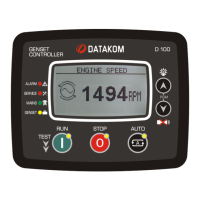
Identifies indicators, screen, and mimic diagram on the front panel.
Explains the function of each button on the control panel.
Describes the organization of parameters into groups and items on the display.
Lists the AC and engine parameters measured by the unit.
Explains the meaning of status LEDs on the front panel.
Details how the unit displays actual fuel consumption via J1939 messaging.
Provides basic instructions for stopping, starting, and operating the genset.
Explains Stop, Auto, Run, and Test modes of operation.
Covers disabling protections and understanding service request alarms.
Details the unit's shutdown, loaddump, and warning alarms.
Instructions on how to reset the unit's parameters to factory default settings.
Guides on entering programming mode, password levels, and modifying values.
Covers adjusting the real-time clock and setting weekly operation schedules.
Details automatic exerciser programs and sender configuration.
Configures digital inputs, outputs, site ID, serial number, and telephone numbers.
Covers GSM modem, TCP/IP, and Wi-Fi network configuration settings.
Explains load shedding, load add/subtract, and five-step load management.
Covers remote start, auto start disable, mains simulation, dual gensets, and external control.
Details automatic exercise programs and weekly operation scheduling.
Describes engine heating, idle speed operation, and engine block heater.
Covers fuel pump control, gas engine solenoid, pre-transfer signal, and battery charging.
Explains controller reset procedure and automatic connection topology determination.
Details the procedure for reducing unit consumption to zero Amperes.
Lists required parameters for RS-485 Modbus operation.
Explains 16-bit and 32-bit variable storage and bit array formats.
Lists common issues like incorrect voltages, faulty readings, and startup failures.
 General
| Panel Cut-out Size | 92 x 92 mm |
|---|---|
| DC Supply Range | 8.0 to 35.0 V-DC |
| Alternator Input Range | 50 V-AC to 277 V-AC |
| Analog Output | No |
| Communication | No |
| Display | LCD |
| Maximum Humidity | 95% RH (non-condensing) |
| Humidity | 95% RH (non-condensing) |
| Protection Class | IP65 |

 To Next Page