dCS Vivaldi DAC User Manual Software Issue 2.0x
November 2016
Vivaldi DAC Manual v2_0x Page 24 English version
REAR PANEL
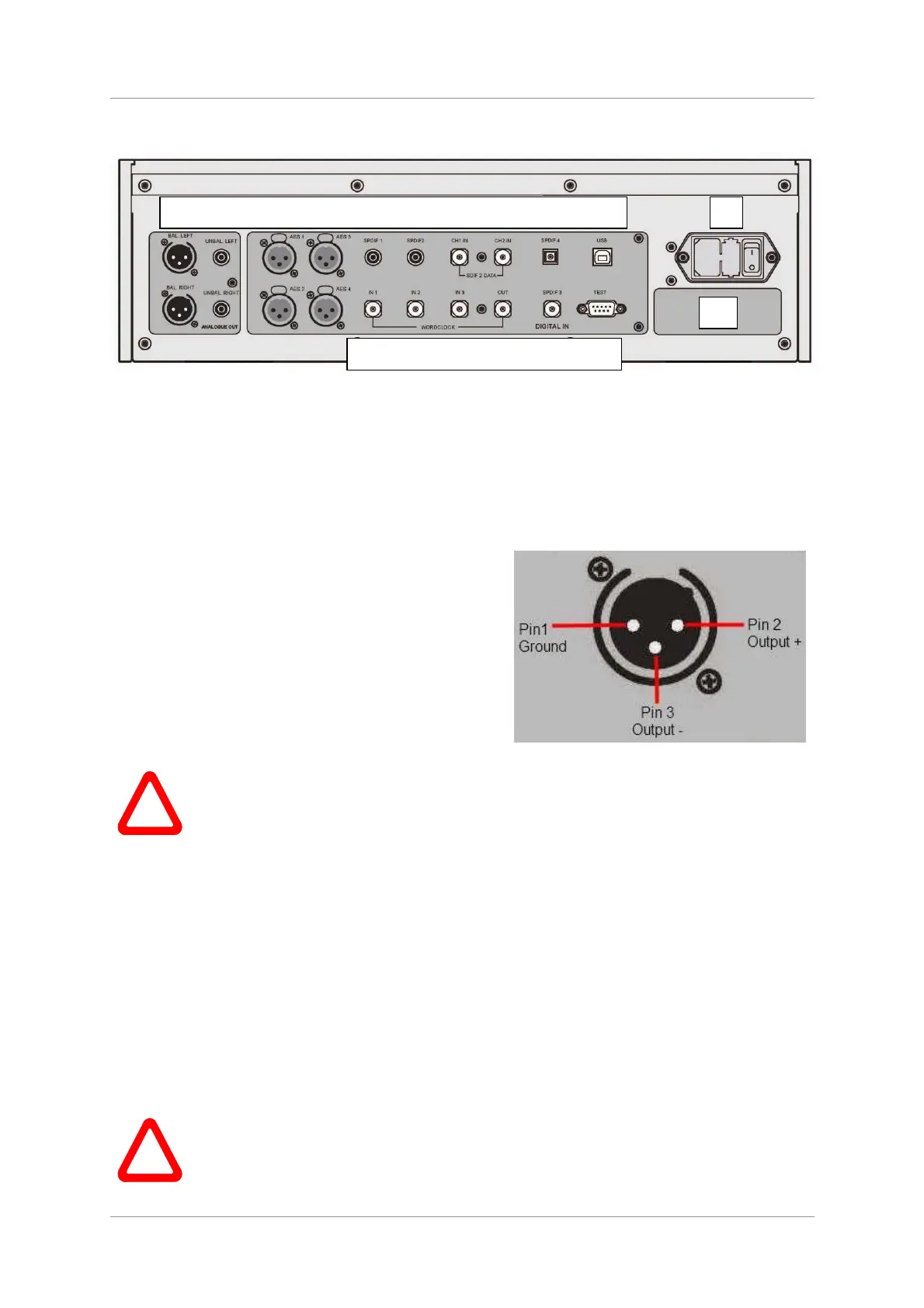
Figure 7 – Rear panel
Analogue Outputs
The unit features independent Balanced Outputs (J) on XLR connectors and Unbalanced Outputs
(K) on RCA connectors. The Left channel outputs are in the top row and the Right channel outputs are
on the lower row.
Our Balanced Outputs are intended to be connected
to true balanced inputs only. They are electronically
balanced and floating, so they behave like an audio
transformer. This arrangement enhances the rejection
of hum and interference picked up by the cable when
used with a true balanced input.
Most other DACs use a much simpler circuit that does
not offer the same level of performance.
!
Some amplifier manufacturers provide unbalanced inputs on XLR connectors by leaving
pin 3 floating. This arrangement does not work correctly with a floating output stage,
resulting in extra noise, unstable signal levels and a “thin” sound. If you want to use the
Vivaldi DAC with this type of input, link pin 3 to pin 1 in the cable at the amplifier end.
In such cases, we recommend that you use the Unbalanced Outputs instead.
AES Digital Inputs
The AES1, AES2 (L), AES3 and AES4 (M) inputs can be used individually at sample rates up to
192kS/s, including DoP.
If the Dual AES1+2 menu page is set to On or Auto, AES1+2 can be used together as a Dual AES
pair at 88.2, 96, 176.4, 192, 352.8 or 384kS/s. AES3+4 behave in the same way if the Dual AES3+4
menu page is set to On or Auto. A Vivaldi Upsampler connected to AES3+4 can tunnel App
commands to the DAC.
Both Dual AES interfaces will also accept dCS-encrypted SACD data from the Vivaldi Transport and
DoP data (DSD/64 or DSD/128 over PCM) from the Vivaldi Upsampler.
!
For Dual AES mode to work correctly, the source must actually generate Dual AES data,
not just the same single AES data on 2 connectors!
--
-- --
--
------
------


 To Next Page