RPM Ports and Cables | 49
10
RPM Ports and Cables
This chapter describes standard RPM cables and adapter pin assignments for the E1200i AC and DC
systems. It contains the following sections:
• RPM Ports
• Cable and Adapter Pin Assignments
• Accessing the 10/100 Ethernet Management Port
This section provides the following:
• RPM Ports
• Cable and Adapter Pin Assignments
• Accessing the 10/100 Ethernet Management Port
RPM Ports
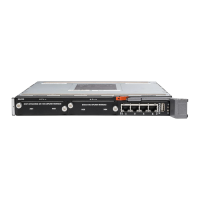
There are three ports on the RPM. They are labeled and described as:
• Console. A Universal Asynchronous Receiver/Transmitter (UART) port with an RJ-45 jack, is used for
system configuration and monitoring. Modem connections are not supported on this port.
• Auxiliary. A UART port with an RJ-45 jack, allows modem access to the E1200 system from a remote
location.
• 10/100 Ethernet. A 10/100 Ethernet port is the Management port, which is a channel to download
images and manage the system, as well as FTP and Telnet operations. You must provide a RJ-45
Ethernet cable to connect to the Ethernet receptacle.
Connecting the Console and Auxiliary Ports
NOTE: Attach an ESD-preventive wrist strap and connect the leash to the ESD connection on the front of the
E1200 chassis. Always wear an ESD-preventive wrist or foot-heel ground strap when handling components.
NOTE: Always wear an ESD-preventive wrist or foot-ground strap when handling components.
The console and auxiliary ports are asynchronous serial ports. If you connect a device to these ports, it
must be capable of asynchronous transmission. Your terminal or terminal emulation mode must be set to
VT100 with the following settings:
• 9600 baud rate (to avoid autobaud input, the default is set to a 9600 bps baud rate)
• No parity



 To Next Page