LT-2329
4
GENERAL INFORMATION
READ ALL INSTRUCTIONS BEFORE USING.
DANGER
• Oxygen causes rapid burning. Do not smoke while your oxygen concentrator is operating, or when you are near a person utilizing oxygen therapy.
• Smoking during oxygen therapy is dangerous and is likely to result in facial burns or death. Do not allow smoking within the same room where the
oxygen concentrator or any oxygen carrying accessories are located.
• If you intend to smoke, you must always turn the oxygen concentrator off, remove the cannula and leave the room where either the cannula or
mask or the oxygen concentrator is located. If unable to leave the room, you must wait 10 minutes after you have turned off the oxygen
concentrator before smoking.
• Oxygen makes it easier for a re to start and spread. Do not leave the nasal cannula or mask on bed coverings or chair cushions if the oxygen
concentrator is turned on but not in use. The oxygen will make the materials ammable. Turn the oxygen concentrator off when not in use to prevent
oxygen enrichment.
• Keep the oxygen concentrator and cannula at least 2 m (6.5 feet) from hot, sparking objects or naked sources of ame.
• Open ames during oxygen therapy are dangerous and are likely to result in re or death. Do not allow open ames within 2 m (6.5 feet) of the oxygen
concentrator or any oxygen carrying accessories.
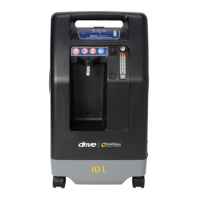
• Drive DeVilbiss oxygen concentrators are equipped with a re mitigating outlet tting that prevents propagation of re into the unit.
WARNING
• To avoid electric shock, do not plug the concentrator into an AC outlet if the concentrator cabinet is broken. Do not remove the concentrator cabinet.
The cabinet should only be removed by a qualied Drive DeVilbiss technician. Do not apply liquid directly to the cabinet or utilize any petroleum-based
solvents or cleaning agents.
• Improper use of the power cord and plugs can cause a burn, re or other electric shock hazards. Do not use the unit if the power cord is damaged.
• Ensure the mains power cord is fully inserted into the concentrator connector (230 volt units) and the power cord plug is completely inserted into a fully
functioning AC wall outlet. Failure to do so may cause an electrical safety hazard.
• In order to prevent a re propagating from the patient through the cannula towards the unit, a means of protection should be located as close to the
patient as practicable. Country Standards may vary. Please contact your provider for information.
• Locate oxygen tubing and power supply cords to prevent tripping hazards and reduce the possibility of entanglement or strangulation.
• Do not lubricate ttings, connections, tubing or other accessories of the oxygen concentrator to avoid the risk of re and burns.
• Do NOT use lubricants, oils or grease.
• Before attempting any cleaning procedures, turn the unit “Off.”
• Use only water-based lotions or salves that are oxygen-compatible before and during oxygen therapy. Never use petroleum or oil-based lotions or
salves to avoid the risk of re and burns.
• Use only spare parts recommended by the manufacturer to ensure proper function and to avoid the risk of re and burns.
• When using the Transller Caddy with a Transll device, always keep the system on a at surface. Disassemble the system prior to moving.
• If you feel discomfort or are experiencing a medical emergency while undergoing oxygen therapy, seek medical assistance immediately to avoid harm.
• Geriatric, pediatric or any other patient unable to communicate discomfort can require additional monitoring and/or a distributed alarm system to
convey the information about the discomfort and/or the medical urgency to the responsible caregiver to avoid harm.
• Use of this device at an altitude above 5000 feet (1524 meters) or above a temperature of 95°F (35°C) or greater than 93% relative humidity may
affect the ow rate and the percentage of oxygen and consequently the quality of the therapy. Refer to specications for details regarding parameters
tested.
• To ensure you receive the therapeutic amount of oxygen delivery according to your medical condition, the Oxygen Concentrator must:
• be used only after one or more settings have been individually determined or prescribed for you at your specic activity levels.
• be used with the specic combination of parts and accessories that are in line with the specication of the concentrator manufacturer and that were
used while your settings were determined.
• Your delivery settings of the oxygen concentrator should be periodically reassessed for the effectiveness of therapy.
• For your safety, the oxygen concentrator must be used according to the prescription determined by your physician.
• Under certain circumstances, oxygen therapy can be hazardous. Seek medical advice before using an oxygen concentrator.



 To Next Page