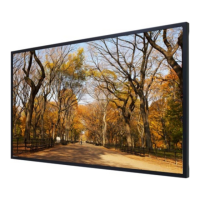
This document serves as the User Manual for the DIAMONDVIEW LCD Display, specifically models DV55RM5. It provides comprehensive information on the device's functions, technical specifications, usage, and maintenance.
Function Description:
The DIAMONDVIEW DV55RM5 is an LCD display designed for various applications, offering a full range of interface types including DisplayPort 1.2 x2, HDMI 2.0 x2, IR Receiver, and Ethernet, along with SPDIF out/DP1.2 out. It supports 1920x1080 FHD format and can display true 1.07 billion colors. Key features include DisplayPort v1.2 input, HDMI 2.0 inputs with HDCP, signal source auto detection, OSD keypad lock function, zero bezel (0.88 mm combined bezel width), landscape/portrait supported, power ON/OFF timer setup, and low power consumption. The display supports multi-source views, including Picture-in-Picture (PiP) and Quad View, allowing for flexible content display from multiple sources simultaneously. It also features multi-display control for creating video walls, with options for matrix configuration and division. The device can be controlled via RS-232 and Ethernet communication ports, enabling remote management and integration into network systems.
Important Technical Specifications:
- Resolution: 1920x1080
- Backlight Illumination: Direct
- Response Time: 8 ms
- Viewing Angle (typ.): 178 / 178 deg
- Pixel Pitch (Sub Pixel): 0.63(H) x 0.63(V) mm
- Aspect Ratio: 16:9
- Brightness (typ.): 500 cd/m²
- Contrast Ratio (typ.): 1100:1
- Input Connectors: DisplayPort 1.2 x2 / HDMI 2.0 x2 / IR extender
- Output Connectors: DisplayPort 1.2 Out with HDCP 2.2 / S/PDIF Out
- Max. Displayed Color Depth: 10-bits / color
- HDCP Support: DisplayPort, HDMI
- Color Adjustment: 3200K, 5000K, 6500K, 7500K, 9300K, User
- OSD Language: English; Chinese
- Power Input: AC100-240V (Worldwide), Max 4.2A, 50/60Hz
- Typical Power Consumption: 205 W
- Max (Non-OPS) Power Consumption: 290 W
- Stand By Power Consumption: <0.5 W
- Dimension (W x H x D): 1210.5 x 681.2 x 94.3 mm
- Active Area: 1209.63(H) x 680.34(V) (54.64" diagonal)
- Bezel Width (L/R/T/B): 0.44 mm
- Net Weight: 28 KG
- Gross Weight: 38.5 KG
- Storage Temperature: Min -20 ~ Max 60 °C
- Operating Temperature: Min 0 ~ Max 40 °C
- Humidity: 35%~85% RH
- OSD Key: 7 keys
- Wall mount: 400 x 400 mm
- Communication port: D-Sub 9 Pin In, RJ45 In / Out
Usage Features:
The display is designed for ease of use, with clear instructions for setup and operation.
- Setting up the Display: Involves plugging in the power cable, turning on the AC power switch, connecting signal source cables, and pressing the power key on the display's keypad or remote control.
- Turning Display On and Off: Can be done via the remote control or keypad. The display automatically goes into power saving (sleep) mode if there is no signal input for a period.
- Adjusting Volume and Input Source: Volume can be adjusted using the VOLUME+/- buttons on the remote. Input source selection is done via the SOURCE button on the display keypad or remote, using arrow buttons to navigate and ENTER to confirm.
- Using the Keypad: The keypad on the display allows for power on/off, source selection, menu navigation (right/volume+, left/volume-, up, down), and menu/exit functions.
- Reading the Status LED: The LED indicator light shows the display's condition: Green for normal operation, Blinking Orange (slow) for no signal, Blinking Orange (fast) for system error, Orange for power saving, and Off for AC off.
- Using the Remote Control: A detailed list of customer codes and functions for the remote control is provided, including INFO, POWER, DISPLAYPORT1/2, HDMI1/2, PIP, OSD, MENU, BRIGHT, CONTRAST, AUTO, SOURCE, SCALING, and various arrow keys for navigation.
- Locking the OSD (On-screen Display): The remote control and keypad can be locked to prevent tampering with display settings. This is achieved by pressing Enter, Enter, Exit, Exit, Enter, and Exit in sequence.
- Navigating through the Menus: The main menu system is accessed via the MENU button. Submenus include Input, Picture, OSD Settings, Setup, Adv. Setup, Communication, and Information.
- Input Menu: Allows selection of the main input source (DisplayPort1/2, HDMI1/2), auto scan for main input source, multi-source views (Off, PiP, Dual View, Quad View), and selection of individual sources (Source 2, Source 3, Source 4). PiP size (Small, Mid, Large) and position (Top R, Top L, Bot R, Bot L) can also be configured.
- Picture Menu: Adjusts aspect ratio (Full Screen, Letterbox, 4:3, Native), scheme (User, Vivid, Cinema, Game, Sport), contrast, brightness, sharpness, hue, saturation, backlight, color temp & gamma, and RGB range.
- Picture Menu – RGB Adjust Submenu: Provides fine-tuning for gamma, temperature, red/green/blue gain, and red/green/blue offset.
- OSD Settings Menu: Configures OSD H/V position, transparency, timeout, rotation (Landscape, Portrait), and language.
- Setup Menu: Includes Overscan adjustment, Power LED enable/disable, Real Time Clock settings (User Mode, Workday Mode, Everyday Mode), CEC control, DPTX (DisplayPort Multi-Stream Transport or Single Stream Transport), and Key Lock.
- Adv. Setup Menu: Offers IRFM (Image Retention Free Mode), Local Dimming, Wake Up From Sleep source selection, Edge Enhancement, DP1/2 Ver. selection, EDID Setup, Temperature & Fan Status, and Factory Reset.
- Communication Menu: Configures RS-232 and Ethernet communication ports, including Baud Rate, IP Address Settings (Dynamic/Static IP), Power Status Alert, Source Status Alert, Signal Lost Alert, Load Default, and SNMP settings.
- Information Menu: Provides read-only information on active sources and firmware version.
- Assigning an IP Address to the Display: Instructions are provided for configuring dynamic or static IP addresses via the Communication Menu.
- Unlocking and Enabling the LAN Port: Details how to access the web interface for network configuration, including login credentials and settings for network parameters, admin setup, and IP command.
- SMTP Setup and Configuration: Explains how to set up SMTP server address, login information, and email alerts for power status, source status, and signal lost status.
- Creating a Video Wall (Daisy-chaining): The manual describes how to connect multiple displays in a video wall configuration using DisplayPort or RS-232/Ethernet, for both landscape and portrait orientations. It also specifies video wall height limits to ensure safe thermal operating limits.
Maintenance Features:
- Safety Precautions: Emphasizes the importance of qualified service personnel for installation and adjustments, and outlines precautions such as not removing the monitor's back cover, avoiding liquids, handling with care, and ensuring proper ventilation.
- Installation Cautions: Provides guidelines for installation environment (high-temperature, high-humidity, outdoors), avoiding heat sources, proper power outlet usage, and ensuring sufficient space for ventilation.
- Use and Cleaning: Advises contacting a dealer for assistance if problems arise during installation, not using extension cords, and using a damp Sham cloth for cleaning. It warns against pressing on the LCD panel, using harsh chemicals, and placing the display face up or down during transport.
- Warnings - Protection against Image Retention: Provides guidelines to prevent image retention, such as limiting operation time, cycling the display type, and avoiding static images for long periods. It recommends using a screen saver and setting the IRFM feature to ON.
- Changing the Remote Control Battery: Detailed instructions with illustrations are provided for removing and inserting AAA batteries. It also includes cautions regarding proper disposal of used batteries and handling the remote control.
- Troubleshooting: A comprehensive chart lists common problems (No Display, The image is not centered, The image does not look right, The remote control doesn't work, The picture color looks poor, Touch no function, Touch out of focus) and corresponding checks to resolve them.
- External Control (RS232 Command Format): Details the RS232 command format for controlling the display from an automation/control system or PC, including STX, IDT, CMD, Value/Reply, and ETX. It provides examples for transmitting and returning commands, and explains serial port settings (Baud rate, Data bit, Parity bit, Stop bit). A detailed table lists various control items, their decimal and hexadecimal values, and corresponding commands for power control, input source, display adjustment (brightness, contrast, hue, saturation, color temperature, RGB gain/offset), OSD settings, EDID, multi-source views, scaling, baud rate adjustment, power saving, auto scan, IRFM, power LED, DisplayPort version, RGB color range, backlight limit control, and remote control key codes. It also includes commands for reading serial number, model name, firmware version, RS232 table version, internal thermal sensor, fan speed, error codes, monitor ID, video wall settings, power on/off delay, and configuration presets.
- Compliance: States compliance with FCC CFR Title 47 Part 15 Subpart B: Class A, CISPR 22, ANSI C63.4, ICES-003 Issue 6, UL 62368-1, CAN/CSA-C22.2 NO.62368-1, and IEC 62368-1.

 Need help?
 General

 To Next Page