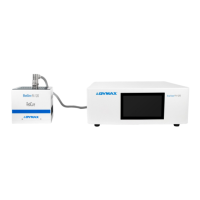
Dymax BlueWave® 200 Version 3.0 User Guide
Definition of Terms
Bulb - Light source generating ultraviolet, visible, and infrared radiant energy from burning matter stimulated
by electrical power conditioned by a proper power supply which is an integral part of a Lamp. A light source is
usually placed into a Reflector (of various geometry) to increase light source efficiency by collecting and
directing radiant energy of selected spectra (for a given curing process).
Intensity - A measure of light energy over the unit of surface area (usually surface at the specified working
distance from the bottom of Reflector Housing) in W/cm
2
or mW/cm
2
. For the UV portion of light, this measure is
often called in literature “irradiance”, i.e. radiant energy arriving at a point on a surface per unit area.
Brightness, also known as Luminance - Description of energy in the visible region of the spectrum (approximately
from 400 to 700 nm) and recorded in photometric units. “Intensity” (see below) of visible light energy is called
Luminance.
Luminance - Luminous flux (energy of visible light) incident per unit area, and measured in Lx (lux) or Lumen/cm
2
.
Ultraviolet (UV) - The invisible region of the spectrum just beyond the violet end of the visible region.
Wavelength ranges in general from 1.0 to 400 nm. Dymax
bulbs (burners) do not radiate energy in deep
ultraviolet; there are very minute amounts below 220 nm and practically nothing can be sensed below 200
nm. This is due to the use of ozone-blocking quartz Bulb Envelope (See Ozone).
1. Ultraviolet A (UV-A) - UV of long wavelength from within approximately 400 to 320 nm of the spectral
band (4000 to 3200) - predominately produced by Dymax Flood Lamps.
2. Ultraviolet B (UV-B) - UV of medium wavelength from within approximately 320 to 280 nm - Dymax Flood
Lamps produce some amount of their energy within this bandwidth.
3. Ultraviolet C (UV-C) - UV of short wavelength below 280 nm (we say from 280 to 200 nm) – a large
amount of this energy is present in the sunlight.
4. Visible - Light that can be seen 400 to 700 nm.
Dose - Irradiance integrated over time, or Irradiance (W/cm
2
) x Time (s) = Dose (Joules/cm
2
). Note: Watt is the
power that gives rise to the production of energy at the rate of 1-joule (J) per second (s).
Ozone - Oxidizing agent (O
3
) produced by the action of ultraviolet radiant energy (below 185 nm) or electrical
corona discharge of oxygen on air.
OSHA 1910.145: “Regulation of Accident prevention Signs and Tags” defines the following headers as:
WARNING - Used when there is a hazardous situation that has some probability of severe injury.
CAUTION - Used to indicate a hazardous situation that may result in minor or moderate injury.
NOTICE - Used to convey a message related directly or indirectly to the safety of personnel, or protection
of property.



 To Next Page