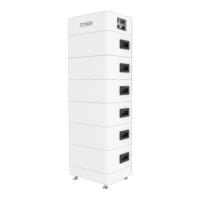
Need help?
Do you have a question about the Dyness DL5.0C and is the answer not in the manual?
Records changes made to the document over time.
Lists critical safety warnings regarding battery handling, fire, and maintenance.
Provides cautionary advice on product inspection, grounding, compatibility, and storage.
Declares the purpose of the manual in detailing the DL5.0C battery system.
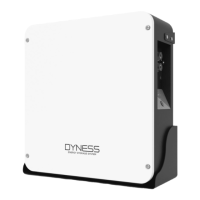
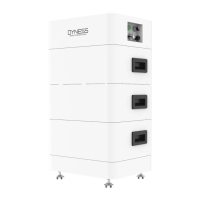
Introduces the DL5.0C as a scalable battery system for long-term power needs.
Details the characteristics and advantages of the DL5.0C battery system.
Explains symbols used in the manual and on the battery module label.
Lists critical safety warnings for handling the battery module as shown on its label.
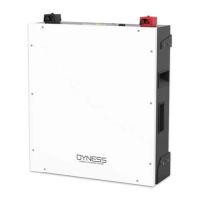
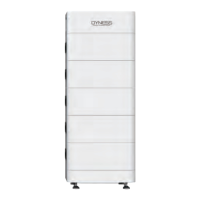
Provides the physical dimensions and weight of the DL5.0C device.
Lists the essential performance specifications of the DL5.0C battery.
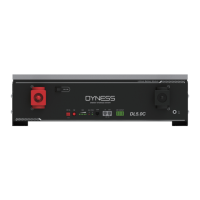
Describes the interface ports and their functions on the front of the device.
Details the function of each item on the DL5.0C interface.
Explains the DIP switch settings for communication protocols and baud rates.
Defines the pinout and function of the CAN/485 communication interface.
Defines the pinout and function of the COM communication interface.
Details low voltage protection during discharging and over voltage protection during charging.
Explains over current protection during charging and discharging.
Describes protection mechanisms for charging and discharging based on temperature.
Covers short circuit protection and self-shutdown features.
Outlines safety requirements and environmental conditions for installation.
Specifies personnel qualifications and safety regulations for installation.
Lists environmental conditions for optimal working temperature, humidity, and location.
Details checks for PV equipment, power supply, and their compatibility with the battery.
Emphasizes the need for firefighting equipment and a safe installation environment.
Confirms the ON/OFF switch is in the "OFF" state before proceeding.
Covers battery placement determination and module installation.
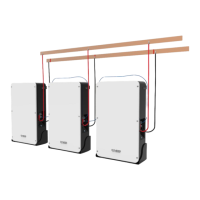
Details ground cable installation and parallel cable connections.
Guides on performing a self-test after initial setup.
Details connecting the battery system to the inverter.
Provides steps to start the battery system after installation.
Explains how alarm signals are given and how to handle them.
 General
| Battery Type | LiFePO4 |
|---|---|
| Nominal Voltage | 51.2V |
| Capacity | 100 Ah |
| Nominal Capacity | 5.12 kWh |
| Usable Energy | 4.6 kWh |
| Weight | 45 kg |
| Storage Temperature Range | -20°C to 60°C |
| Protection Class | IP20 |
| Cycle Life | 6000 cycles |
| Communication | CAN/RS485 |
| Energy Efficiency | 95% |

 To Next Page