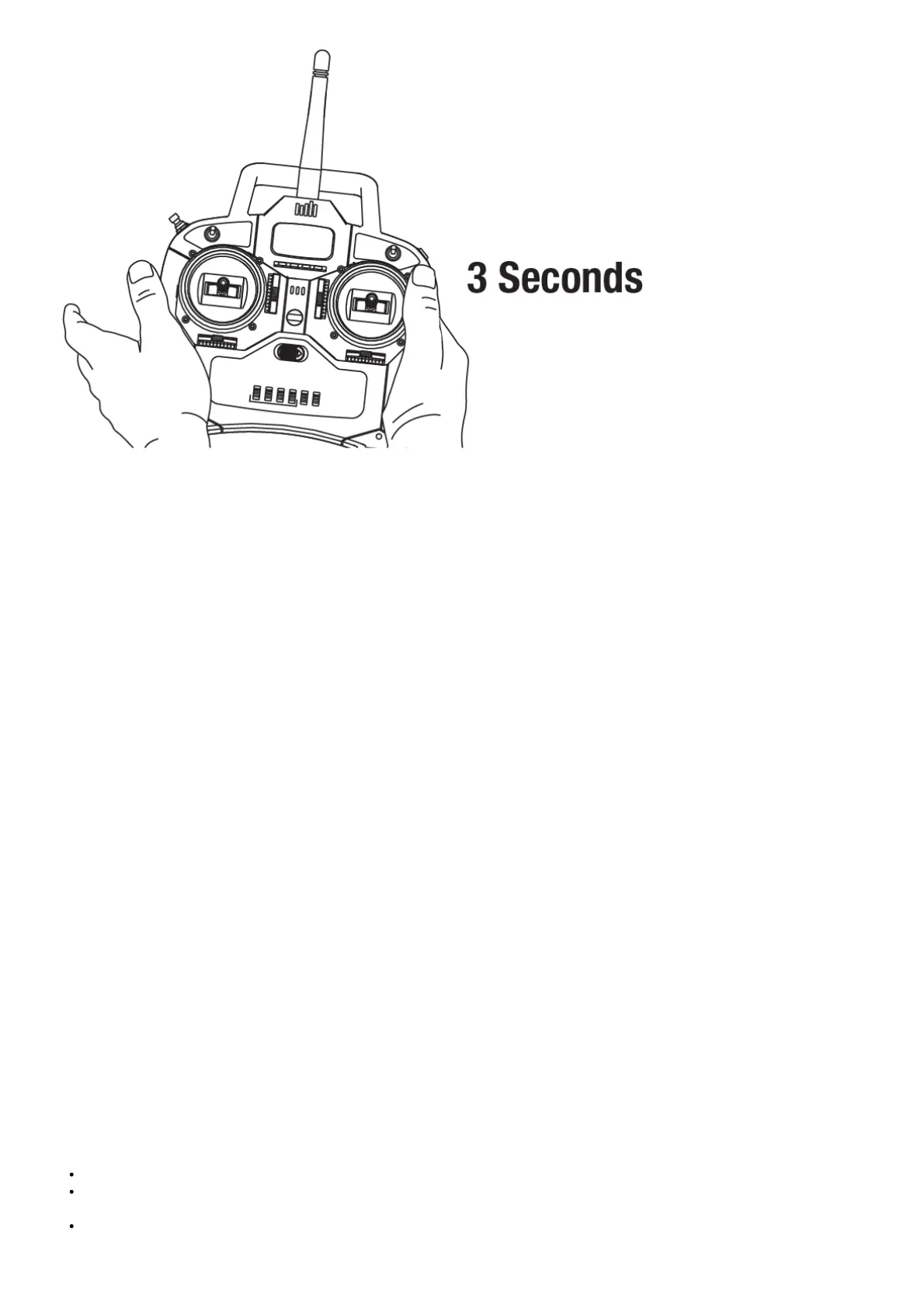
During your first flight, trim the aircraft for level flight at 3/4 throttle. Make small trim adjustments with your transmitter’s trim switches to
achieve straight and level flight.
After adjusting trim do not touch the control sticks for 3 seconds. This allows the receiver to learn the correct settings to optimize AS3X
performance.
Failure to do so could affect flight performance.
Flying Tips and Repairs
Consult local laws and ordinances before choosing a flying location.
Range Check your Radio System
Before you fly, range check the radio system. Refer to your specific transmitter instruction manual for range test information.
Oscillation
Once the AS3X system is active (after advancing the throttle for the first time), you will normally see the control surfaces react to aircraft
movement. In some flight conditions you may see oscillation (the aircraft rocks back and forth on one axis due to overcontrol). If oscillation
occurs, refer to the Troubleshooting Guide for more information.
Takeoff
Place the aircraft in position for takeoff (facing into the wind). Select low rates for first takeoff and gradually increase the throttle to 3/4 to full
and steer with the rudder. Pull back gently on the elevator and climb to a comfortable altitude.
Flying
For your first flights with the recommended battery pack (SPMX22004S30), set your transmitter timer or a stopwatch to 3 minutes. After four
minutes, land the aircraft. Adjust your timer for longer or shorter flights once you have flown the model.
Fly the aircraft and trim it for level flight in Precision Mode at 3/4 throttle. After landing, adjust the linkages mechanically to account for trim
changes and then reset the trims to neutral. Ensure the aircraft will fly straight and level with no trim or sub-trim.
NOTICE: Due to the high-performance nature of the Ultimate 3D’s power system, we recommend allowing the motor to cool to ambient
temperature between flights when using 4S batteries and flying aggressively in temperatures of 90+°F (approximately 32+°C).
Landing
To land the aircraft, fly the aircraft down to the ground using 1/4 –1/3 throttle to allow for enough energy for a proper flare. The aircraft is
easiest to land doing a wheel landing (two point), where the aircraft touches down on the main landing gear first while the tailwheel is still off
the ground. The aircraft can also be landed in a three-point attitude, where all three wheels touch down at the same time. When the aircraft
touches down, reduce back pressure on the elevator stick to prevent the plane from becoming airborne again.
If landing on grass, it is best to hold full up elevator after touchdown and when taxiing to prevent nosing over.
Once on the ground, avoid sharp turns until the plane has slowed enough to prevent scraping the wingtips.
WARNING:
Always decrease throttle at propeller strike.
If a crash is imminent, reduce the throttle and trim fully. Failure to do so could result in extra damage to the airframe, as well as
damage to the ESC and motor.
After any impact, always ensure the receiver is secure in the fuselage. If you replace the receiver, install the new receiver in the same
orientation as the original receiver or damage may result.



 To Next Page