GB
57
57
Measuring the dry ingredients
Gently pour the measured ingredient in the measuring cup using aspoon and then even it with knife. Never scoop the
ingredient directly with the measuring cup, you could scoop up to one teaspoon more this way. Never press down the
content of the measuring cup. Tip: Stir the our before measuring to aerate it. When measuring small amounts of dry
ingredients, e.g. salt or sugar, use ameasuring spoon and make sure that it is even when measured.
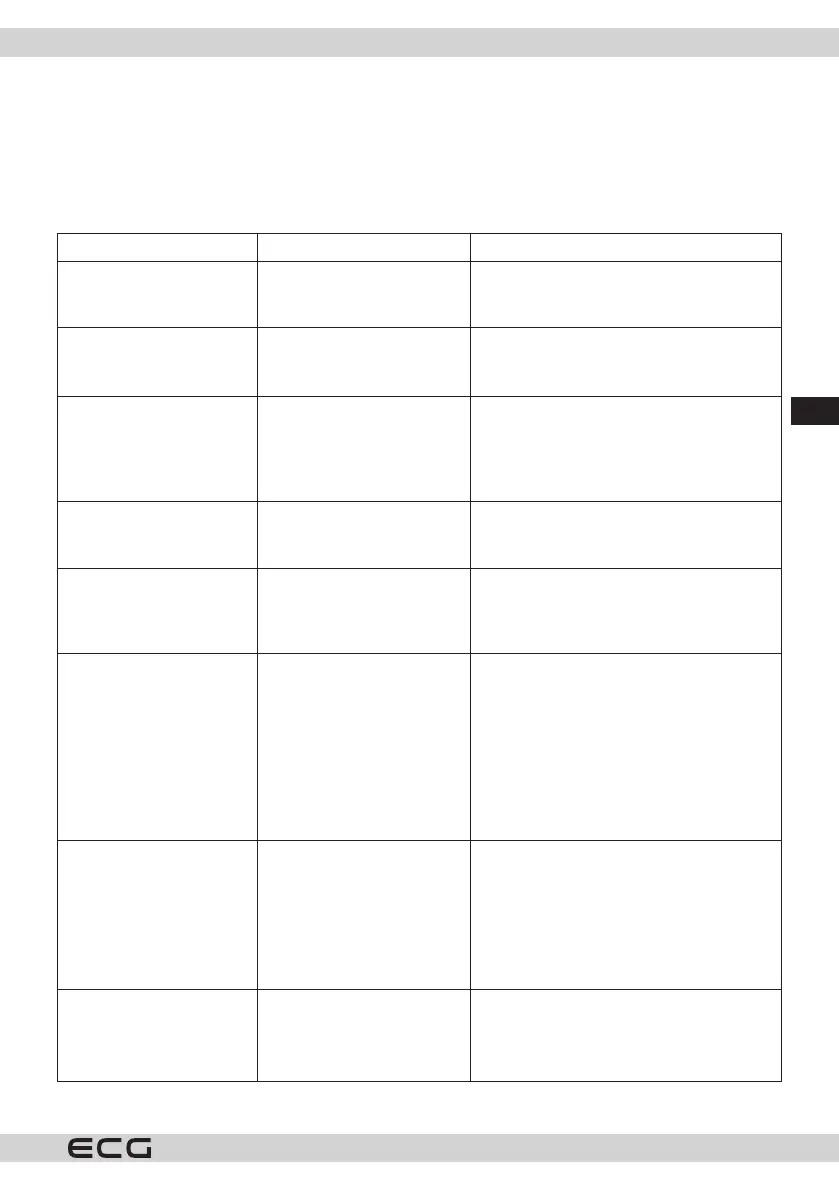
TROUBLESHOOTING
PROBLEM POSSIBLE CAUSE SOLUTION
Odor or smell of burning • Flour or other ingredients
spilled out or fell out of the
baking pan in the appliance.
• Disconnect the bread maker from power
supply and let it cool completely. Wipe o
the excess ingredients with paper towel.
The ingredients do not mix
even though you hear the
motor running.
• Incorrectly inserted baking
pan or the kneading paddle.
• Too many ingredients.
• Make sure that the kneading paddle is
entirely inserted on the shaft.
• Measure exact ingredients.
When you press START/STOP
button the display shows
„H:HH”.
• The internal temperature of
the bread maker is too high.
• Let the bread maker cool between individual
programs. Disconnect the appliance from the
power supply, open the lid and remove the
baking pan. Let cool 15 – 30 minutes before
starting anew program.
The window is fogged or
covered with condensed
water drops.
• This may occur during rising
or mixing.
• Condensation usually disappears in the
baking stage. Clean the window between
uses.
The kneading paddle is
removed together with the
bread.
• Thicker crust when setting
higher degree of browning.
• There is nothing unusual in removal of
kneading paddle together with the loaf.
Once the loaf cools, pull out the paddle from
the loaf using aspatula.
The dough is not thoroughly
mixed; our or other
ingredients adhered to the
sides of the baking pan; the
loaf is coated in our.
• An incorrectly installed
baking pan or kneading
paddle.
• Too many ingredients.
• Gluten free our is usually
very moist. It could require
external intervention in the
form of scraping the walls
using rubber spatula.
• Make sure that the baking pan is properly
inserted in the bread maker and the
kneading paddle is properly attached to the
shaft.
• Make sure that the ingredients are properly
measured and added in correct order.
• Remove the excess our after the loaf
is baked and cools o. Add water with
teaspoons until the dough forms into aloaf.
The dough has risen too high
or it raises the lid of the bread
maker.
• Incorrectly measured
ingredients (too much yeast,
our).
• There is no kneading paddle
in the baking pan.
• You have forgotten to add
salt.
• Measure the ingredients exactly and make
sure that you added sugar and salt.
• Try to add lesser amount of yeast by ¼ of
ateaspoon (1.2 ml).
• Check the installation of the kneading
paddle.
Dough does not rise; small
loaf.
• Incorrectly measured
ingredients or bad yeast.
• Raising the lid while program
is running.
• Measure exactly all ingredients.
• Check the expiration date of the yeast and
our.
• The liquids should be at room temperature.


 To Next Page