3-LCD operating instructions
EST3 System Operation Manual 2.3
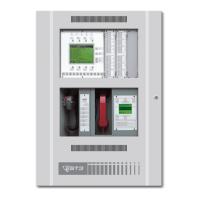
Functional description of 3-LCD controls and indicators (see Figure 2-1)
Index
Control or
indicator Functional description
1 Power LED The Power LED indicates that mains ac is applied to the panel.
2 Test LED The Test LED indicates that a part of the system is in test mode.
A programmable timer automatically exits the test mode after a
period of system inactivity.
3 CPU Fail LED The CPU Fail LED indicates the 3-CPU1 module has detected a
processor failure. Processor failures must be reset manually.
4 Gnd Fault LED The Gnd Fault LED indicates that the 3-CPU1 module has
detected a ground fault.
5 Disable LED The Disable LED indicates that a point or zone has been
disabled using the Disable command.
6 Drill Button / LED Pressing the Drill button activates the Drill command function.
The Drill LED, when lit, indicates that the Drill command function
is active.
7 Panel Silence
Button / LED
For U.S. Local and Canadian Local systems, pressing the Panel
Silence button turns the 3-CPU1 buzzer off. The Panel Silence
LED, when lit, indicates the panel is in an off-normal condition
and the panel has been placed in Panel Silence mode.
For U.S. Proprietary and Canadian Proprietary systems, the
Panel Silence button is not operational. The panel buzzer only
silences after all events have been acknowledged.
Notes
• The 3-CPU1 buzzer can be configured to resound at a regular
interval to remind the operator that the panel has been
silenced
• Pressing the Alarm Silence and Panel Silence buttons at the
same time actives the panel lamp test function
8 Liquid crystal
display screen
168 character, backlit alphanumeric display of system status.
9 Trouble Button /
LED
Pressing the Trouble button places the contents of the Trouble
queue onto the display screen for review. Active trouble events
are displayed in the order in which they are received. When a
trouble event is highlighted on the display, pressing the Trouble
button acknowledges the event and advances the display to the
next event.
The Trouble LED serves as a common trouble event indicator.
The LED, when flashing, indicates that there is an event in the
queue that has not been reviewed (local systems) or
acknowledged (proprietary systems). When on steady, the LED
indicates that all events in the queue have been reviewed or
acknowledged.


 To Next Page