Theoretical Principles
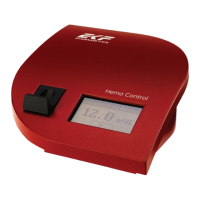
User Manual Hemo Control
11. Theoretical Principles
11.1 Reference ranges
The physiological concentration of the total hemoglobin is specific for
age and sex
,
.
Women: 110 – 160 g/L
Men: 130 – 180 g/L
Children after neonatal period: 100 – 140 g/L,
The highest Hb concentration is measured in neonates.
11.2 Description of the measuring process
11.2.1 Reaction in the microcuvette
In the microcuvette, a modified form of Vanzetti’s azide methemoglobin
method is used
.
In order to use the azide methemoglobin method in undiluted blood,
three reagents are necessary.
Sodium desoxycholate dissolves and disperses the cell walls of the red
blood corpuscles. The hemoglobin formerly contained in the erythrocytes
is now available free in the solution.
The bivalent iron of the oxyhemoglobin and the desoxyhemoglobin
becomes oxidised by sodium nitrite to trivalent iron, in methemoglobin.
Existing and formed methemoglobin and azide ions from sodium azide
form a coloured complex, which exhibits maximum absorption at 540
and 575 nm and hence can be quantitatively determined photometrically.
11.2.2 Principle of photometric measurement
In the Hemo Control photometer the absorbance of transmitted light is
measured. The use of microcuvettes with short light pathways makes it
possible to analyse undiluted blood.
Light of definite wavelength with or without the analyte is directed to a
photo detector and the absorbance A is determined. To compensate
turbidity and the basic absorption of the measuring system two
wavelengths are used for measurement.
H. Greiling, A. Gressner, eds., Lehrbuch der Klinischen Chemie und Pathobiochemie,
[Textbook of Clinical Chemistry and Pathobiochemistry] F. K. Schattauer
Verlagsgesellschaft, Stuttgart, 3. Auflage, 1995, S. 521, 818-819
Lothar Thomas, ed., Labor und Diagnose Indikation und Bewertung von Laborbefunden
für die medizinische Diagnostik [Laboratory and diagnostic indications and assessment of
laboratory findings for clinical investigation], TH-Books Verlagsgesellschaft mbH,
Frankfurt/Main, 5. Auflage, 1998, S. 485, 488
G. Vanzetti, An azide-methemoglobin method for hemoglobin determination in blood,
Am. J. Lab. & Clin. Med. 67 (1966) 116


 To Next Page