25
Reducing Interference and Noise
The K3 provides several waysto cut interference,
including DSP noise reduction, manual and auto
notch, and noise blanking. Also see Audio Effects
(AF X , pg. 35).
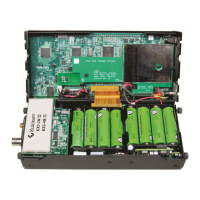
There are actually two noise blankers: one at the
first I.F. (KNB3 module), andthe other at the 2nd
I.F. (DSP).
Noise reduction, noise blanking, andnotch
filtering should only be used when necessary.These
signal processing techniques are extremely
effective, but can introduce side effects. Sometimes,
reducing the filter bandwidth is the most effective
interference-reduction strategy.
Noise Blanking
First, tap N B to enable I.F. and/or DSP noise
blanking.
Next, hold LEVEL to set the DSP level (VFO A)
and I.F. level (VFO B). You’ll initially see DSP
OFF and IF OFF on the VFO A and B displays.
Rotating VFO A clockwise will turn on the DSP
NB, showing DSP t1-1 through DSP t3-7.The
first number shows the relative pulse integration
time, and the second shows the blanking level. The
higher the numbers,the more aggressive the DSP
blanking action.
Rotating VFO B clockwise will turn onthe IF NB,
showing IF NARn, IF MEDn, or IF WIDn,
where n is 1-7. NAR/MED/WID refers to narrow/
medium/wide blanking pulse widths, and n isthe
blanking level. Higher n means more aggressive
blanking action. Use NAR width when possible to
minimize strong-signal interaction effects.
The NB icon will flash slowly if the I.F.
blanker setting istoo high for the present signal
conditions. Ifthis happens, use a lower setting.
Both the DSP and IF blanking settings are saved on
a per-band basis. If CONFIG:NB SAVE is set to
YES, the on/off status of NB will be also be saved
for each band.
The DSP noise blanker is inthe 2
nd
I.F., where
it can’t be activated by signals outside the crystal
filter passband. It can be used with high-duty-cycle
and complex-waveform noise generated by
computers, switchingpower supplies, light
dimmers, etc.The I.F. noise blanker is in the 1
st
I.F., where it can use very narrow blanking widths.
It is most effective at blanking AC line noise,
lightning, andother very broadband noise. Often, a
combination of the two isthe most effective.
Noise Reduction
Noise reduction reduces random background noise
while preserving meaningful signals. It adds a
characteristic “hollow” sound to all signals.
Tap N R toturn on noise reduction. NR isnot
applicable in DATA and FM modes, or with AGC
turnedoff.
Hold ADJ to display the NR setting; use the VFO
B knobto tailor NR for the present band conditions.
The settings are F1-1 through F4-4. Higher
settings can degrade weak signals. The first part of
the number (Fx) determines which NR algorithm is
used; F1 is the least-aggressive setting. The second
part (-y) controls how much of the signal is routed
through noise reduction, from 1 (50%) to 4 (100%).
Notch Filtering
Notch filteringremoves interfering carriers while
leavingthe desired signal relatively unaffected. The
K3 provides automatic and manual notch tuning.
Auto notch will find and remove one carrier, and in
some casesmorethan one. It isonly available in
SSB modes, and AGC must be turned on.
Manual notch removes one carrier at a specified
pitch, and can be used in CW and DATA modes as
well as voice. Since manual notching sets up a fixed
(rather than adaptive) notch, it can even suppress a
keyed carrier, i.e. a CW signal.
Tap N TC H to turn on notch filtering (NTCH icon).
Thisturns on Auto notch if applicable. Tap a
secondtime if necessary to select manual notch
(adds icon).Tap again to turn notch off.
Hold MAN to adjust the manual notch frequency
using VFO B. This also selects manual notch.



 To Next Page