through of the local oscillator (synthesizer) signal. The mixer also incorporates a balanced VHF low-pass filter
to suppress both internally and externally generated VHF/UHF spurs. Thiskeeps the K3’s HF spur complement
extremely low, despite the use of a down-conversion system architecture.
KANT3 and KAT3
The basic K3/10 includes a KANT3 antenna input module. If you’ve ordered a KAT3 antenna tuner, the
KANT3 isnot required and will not be supplied with the kit. In either case,the module plugs into the RF board
at the back-right corner. Both the KANT3 and KAT3 provide antenna surge protection, as well as resistors for
bleeding off static DC charge. The KAT3 provides a wide-range, switchable C-in/C-out L-network for matching
a variety of antennas with SWR as high as 10:1 (100 W) or 20:1 (10 W).There are 8 inductors and 8 capacitors
in the L-network, each switched with a DPDT relay for high reliability.The KAT3 also includes a second
antenna jack and associated switching relay. There’s an additional jack on the board for routing the unused (non-
transmit) antennato the KRX3 sub receiver module.
KIO3
All audio and digital/computer I/O isrouted through the KIO3. The KIO3 ismade up of three PC boards: Main,
Audio IO and Digital IO.
The Main KIO3 board plugs directly into the RF board. It includes a relayto disconnect the right speaker
channel in case a mono speaker isplugged into the external speaker jack, isolation transformers for Line In and
Line Out signals, a connection point for the internal speaker, a low-noise oscillator to provide voltages for the
RS232 serial interface, andvarious control line inputs and outputs for externaltransverters, band decoders, and
the like. This board also contains a differential output microphone amplifier to equalize the gain between the
front andrear microphone jacks, as well as to provide noise immunity forthe microphone signal from the rear
panel area.
Circuitry to allow use of the serial port RTS or DTR signal lines asPTT and/or KEY inputs is also locatedon
this board. This feature isto support logging and control programs which may use these linesfor controlling
transmit/receive switching or CW keying.
The Digital IO board plugs into the KIO3 Main board. It includes a DE-9 serial port connector for use with an
external PC, and a DE-15 accessory connector for external band decoders(such asthe KRC-2), transverters
(such as the Elecraft XV-series), and similar devices. It is also the connector to which direct FSK orPSK
signaling is applied.
The Audio IO board includes three stereo outputs: headphone jack, speaker jack, and a transformer-isolated Line
Out jack. It also provides two monophonic inputs: microphone and an isolated Line In. The Microphone jack
can provide bias for an electret microphone when enabled via the MAIN:MIC SEL menu entry.
Both Digital and Audio IO boards include extensive bypassing and decouplingto help prevent RF signals
getting into the radio through cables attachedto their respective connectors.
Front Panel and DSP
The Front Panel is a large plug-in module that includes boththe Front Panel and DSP boards, as well as the Aux
DSP (if a sub receiver is installed) and digital voice recorder module (if the KDVR3 option is installed).
Front Panel Board
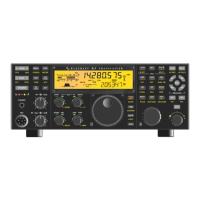
This board provides the K3’s user interface: 35 custom-labeled switches; two dual-concentric potentiometers for
gain and squelch control; seven shaft encoders; custom, 240-segment, high-contrast LCD; and 13 discrete LED



 To Next Page