main BPF array, and due to its very short connections, has no effect on the performance of the main BPFs
during ham-band operation.
First I.F. Stages
The front-left portion of the RF board is dedicatedto the receive/transmit first I.F. (intermediate frequency)
circuitry, most of which is onthe bottom ofthe board. The first I.F. is 8.215 MHz, which is low enough to
permit the construction of high-quality, narrow-band crystal filters, but high enough to offer good image
rejection. The I.F. stages are reversible; i.e., they’re usedin one direction in receive mode, andthe other during
transmit. In receive mode, the filtered signal from the BPFs is first routedthrough a relay-switched attenuator,
then to a low-noise diode-switched preamp, high-level switching mixer, andpost-mixer amp. The signal next
encountersthe noise blanker (KNB3), then the crystal filters (see below),
Crystal Filters and 2
nd
I.F.
In either receive or transmit mode, the I.F. signal is routedto one of up to five plug-in, 8.215-MHz crystal filters
(FL1-FL5). These can be fixed-bandwidth, or in the case of FL3-FL5, optionally variable-bandwidth. Following
the crystal filters isthe receive I.F. and second mixer, which mixes the 8.215 MHz down to an I.F. of 15 kHz for
use by the digital signal processor module (DSP). Excellent 2
nd
-I.F. image rejection is obtained by cascading an
additional crystal filter just ahead of the second mixer. There’s also a 15 kHz transmit I.F., which is mixed up to
8.215 MHz on the KREF 3 module, which plugs in near the front-middle of the RF board.
Support Circuitry
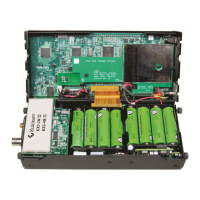
Several other modules plug intothe RF board. The KPAIO3, located at the back edge of the RF board, is a
vertically mounted board used as an interface between the RF board andthe KPA3 100-W amp module. It
provides current sensing, bypass relay, andother functions for the KPA3, and eliminatesthe need for any
interconnecting cables. The KIO3 and KXV3, in the back left corner, provide RF, audio, and digital I/O. The
main synthesizer, used for the main receiver as well as the transmitter, plugs in at front left and is attached to the
front shield. To the right of this isthe reference oscillator module (KREF3), as well as the second synthesizer,
used for the sub receiver. These also attach tothe front shield. The Front Panel/DSP module plugs in at the very
front of the RF board. Finally, at the far right you’ll find two low-noise linear voltage regulators, one for 5 volts
and the other 8 volts. Both are heat-sinkedtothe right side panel.
Noise Blanker
There are two noise blanker subsystems in the K3: the KNB3 module, and a DSP-based blanker (see DSP on
pg. 69). The KNB3 is a narrow I.F. pulse blankerthat plugs into the RF board. Its broad input bandwidth
ensures minimum stretching of fast noise pulses, so it’s ideal for suppressing noise from power lines,
thunderstorms, and auto ignitions. The DSP blanker can be used on many other types of noise, including radar
and other noise with complex waveforms that might cause heavy intermodulation if an I.F. blanker were
engaged. Using thetwo blankers in combination isoften extremely effective.
The KNB3 includes a triple-tuned bandpass/time-delay filter, wide-range AGC, and a noise gate. You can think
of the noise gate as a switch that is normally closed, allowing received signalsto pass unimpeded. When a noise
pulse appears, it is amplifiedto a high level and used to trigger a one-shot circuit. This opensthe noise gate very
briefly (from 5 to about 100 microseconds) to blankthe noise pulse. Boththe threshold at which blanking action
occurs andthe length of time the gate is opened are under control ofthe operator.
1
st
Mixer
The 1
st
mixer combines signals from the input band-passfilters with the output of the synthesizer to obtain the
1
st
I.F., at 8.215 MHz. The mixer is based on a video switching IC with very low ON resistance, resulting in low
loss and high signal-handling capability. Since this type of mixer requires low drive, there’s very little leak-



 To Next Page