38
Receive Antenna In/Out
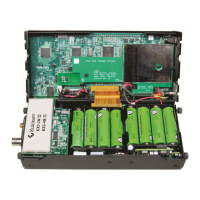
The RX ANTIN/OUT jacks, supplied with the
KXV3 option, have various uses:
Low-noise receiving antenna: Some operators
use a Beverage, tuned loop, or other low-noise
receiving antenna. You can connect such
antenna tothe RX ANT IN jack, then tap
RX AN T to select it. The RX icon will turn on.
Narrowband filters or preamps: You can
"patch in" a specialized filter or preamp (e.g.,
the Elecraft PR6 preamp for 6 meters) between
RX ANT IN / OUT. Tap RX AN T to switch the
filter in (per-band). It will be in-line only during
receive, so you can use low-power devices.
Test signal injection: The RX ANT IN jack is
ideal to inject atest signal, because the
generator won't be damaged if youtransmit.
Receiver comparisons: If you connect the RX
ANT OUT jack to a second receiver, and leave
the RX ANT IN jack open, you can A/Btest the
K3 against the other receiver. When the R X
ANT is not selected (RX icon off),the K3 will
be receivingon itsmain antenna jack, andthe
other receiver will have no input. If youthen
tap RX ANT, the K3 will have no receive
antenna, while the other receiver will be
operating fromthe K3's main antenna.
If you’re comparingthe K3 to a transceiver and
using its transmit/receive antenna, be sure to set its
power to 0 so you won't damage the KXV3 when
youtransmit.
Buffered I.F. Output
The KXV3 provides a buffered first I.F. signal at
the IF OUT jack. This signal (about 8.215 MHz) is
compatible with some panadapters. Refer to
panadapter documentation for interfacing and
operating instructions. The frequency of the first
I.F. for a given mode/filter setting can be queried by
a computer using the command “FI;” (refer to the
K3 Programmer’s Reference).
Use a short, high-quality coax cable between
the K3 and the panadapter. Additional isolation
circuitry may also be required.
Using Transverters
Nine user-definable bands are provided for use with
transverters. Once enabled, each will appear in the
band rotation above 6 m. You can use Elecraft XV-
Series or other transverters withthe K3. See pg. 18
for transverter control connections.
Transverter Band Setup
Transverter bands are set up usingthe XV menu
entries. Tap 1 –9 within menu entries to select a
transverter bandto configure.
XVn ON must be set to YES to enable
transverter band n.
XVn RF selectsthe transverter operating
frequency in MHz.
XVn IF specifies a K3 band to use as the
transverter I.F. (7, 14, 21, 28, or 50 MHz).
XVn PWR sets the K3 power output range to
be used with thistransverter band. L .01-
L1.27 specifies a power level in milliwatts,
which requires the KXV3 option (use the
XVTR IN and OUT jacks). H 0.0-H12.0
specifies power in watts, and selects the K3’s
main antenna jack(s) for output.
XVn OFS can compensate for frequency offset
in the transverter’s oscillator/multiplier chain.
The value shown is in kHz.
XVn ADR specifies an Elecraft XV-Series
transverter select address (see XV manual).
For weak-signal work: If youhave a KXV3,
you can improve isolation between XVTR IN/OUT
and RX ANT IN/OUT by removing any antenna
connectedto RX ANT IN. If you have a KAT3,
you shouldtap ANT to select the antenna (1 or 2)
that has lower sensitivity on thetransverter I.F.
band in use. (Note: The ANT 1/2 icons are not
displayed if XVn PWR is set for L power range.
Use H range temporarily to see the icons.)
CAUTION: When possible, use mW-level
drive with transverters (via XVTR OUT). If you
use ANT1 or 2, you could accidentally transmit
into alow-level transverter at high power.



 To Next Page