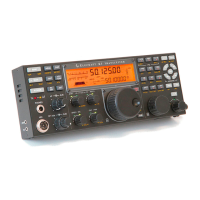
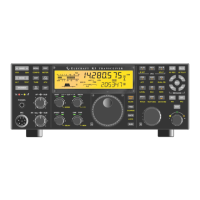
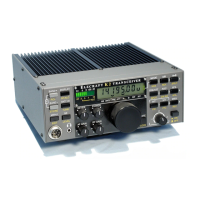
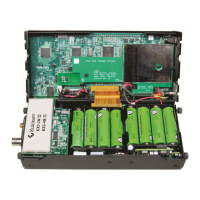
indicators. Mic andheadphones can be plugged into the front panel, or optionally at the rear panel (see KIO3
description, pg. 68).
The Front Panel PCB also includes the microcontroller unit (MCU), which managesthe operation of the K3. All
inputs, whether from a switch, knob or external PC, are recognized and acted on by the MCU. All control
outputs –such as switching from transmit to receive, sending a CW code element, adjustingthe transmitter
power, controlling LED brightness, etc. –are produced by the MCU.
The Front Panel also contains a large amount of EEPROM memory for parameter storage, and FLASH memory
for program storage. This allows the K3 to be re-programmed with the newest firmware by a simple download
from the Internet. It also enables the K3 to remember your favorite settings, particular configuration preferences,
and the last settingof controls when power is removed fromthe radio.
DSP Board
The K3’s Digital Signal Processing (DSP) capabilities provide a rich set of features to help combat QRM and
QRN while generating some of the cleanest signalsto be found in Amateur radio today. A 32-bit floating point
DSP is used for highest performance.
In receive, a 15 kHz IF signal fromthe RF board is buffered andthen digitized by a 24-bit Analog to Digital
Converter (ADC). This provides over 100 dB of dynamic range within the passband of the selected crystal
(roofing) filter. Afterthe ADC, the DSP convertsthe signal into a floating point value so dynamic range is not
compromised during further processing. Noise blanking and limiting, AGC, amplification, IF and AF filtering
are all done within the DSP. Several noise blanking algorithms(methods) are available in the DSP, and a
sophisticated AGC system is employed. AM, FM, SSB and CW detectors are also implemented by the DSP.
Various audio effects, such as Quasi-Stereo and Binaural, are provided here as well as combining the audio
signals fromthe KRX3 (if installed).
After processing, the resulting audio signals are generated in a stereo 24-bit Digitalto Analog Converter (DAC)
and appliedto separate amplifiers for headphones (front and rear) and speaker. A separate 24-bit DACand
amplifier provide Line Out signalsthat are not affected by the AF Gain control. This output istypically used by
sound card digital mode software.
In transmit, Line In, rear or front Microphone signals are sent to a 24-bit ADC andthen processed by the DSP.
In speech modes (SSB, AM and FM) and soundcard-based data modes, VOX is derived fromthese signals as
well as receive audio. Microphone equalization, bandpass limiting, conversionto 15 kHz IF, envelope clipping
and filtering(if applicable) are all done in DSP, thenthe signal is passed to another 24-bit DAC and presentedto
the RF board as a 15 kHz IF signal. Direct FSK, direct PSK and CW signals are generated within the DSP for
those modes.
Thus, the DSP isresponsible for all signal processing between audio andthe 15 kHz IF for both receive and
transmit. Like all other modules in the K3, the DSP is managed by the MCU.
The DSP board is piggybacked onto the Front Panel board as part ofthe Front Panel assembly. The Auxiliary
DSP (used if the KRX3 Second Receiver Option is installed) andthe KDVR3 option plug into the DSP board.
KREF3
The KREF3 module’s49.380-MHz temperature-compensated crystal oscillator (TCXO) isthe common signal
source for the K3’s synthesizers. This signal is also divided by 6 to provide the 8.230-MHz signal used by the
second receive andtransmit mixers. Firmware is used to compensate for any small drift in the TCXO and its
derived signals, resulting in excellent stability (with the high-stability option, better than +/- 0.5 PPM over the 0
to 50 Ctemperature range). In addition to the TCXO and dividers, the KREF3 provides the 2
nd
transmit I.F.
mixer, which convertsthe DSP's 15-kHz transmit I.F. output to 8.215 MHz. This signal passes through a wide
crystal filter to ensure good rejection of the carrier and other mixer products before being routedto the RF




 To Next Page