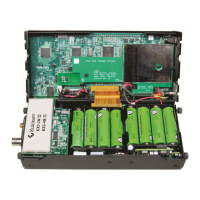
Diversity Receive
Diversity receive can greatly improve signal copy
during fading (QSB). True diversity requires a pair
of identical receivers running from a common
frequency reference and using two different
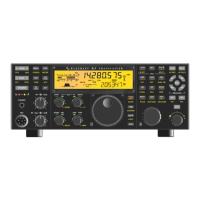
antennas. The K3S is one of very few transceivers
that offer this capability. Most offer only a low-
performance sub receiver, or “dual watch” (split-
I.F.) circuitry, which doesn’t provide for separate
main/sub antennas.
An antenna with different polarization, or at least
different orientation, should be used for the sub
receiver (via its AUX input). This ensures that the
two receivers will not experience the same fading
characteristics.
To turn on diversity mode: Hold DIV. This sets
the sub to the same frequency as main (VFO A),
matches the sub’s filter bandwidth to main, and
switches the sub receiver to its AUX antenna. The
kHz decimal point of the VFO A display flashes as
a reminder. VFO A sets the receive frequency for
both main and sub in diversity mode. This leaves
VFO B free for use as the transmit frequency in
SPLIT mode (see details at right).
Mode and filtering changes made to the main
receiver will immediately be made at the sub, as
well, to preserve diversity characteristics. However,
PRE, ATTN and other receive controls remain
independent for the sub. These must be changed
using BSET. (See pg. 25 for preamp 2 limitations.)
You can change the sub receiver’s antenna selection
by holding BSET, then tapping ANT. When you’re
not using BSET, holding RX ANT will accomplish
the same thing, providing a convenient shortcut.
The K3S saves the sub receiver’s MAIN/AUX
antenna selection independently for diversity and
non-diversity modes. The AUX antenna should be
used for diversity, as explained above. You might
use MAIN with diversity when comparing main/sub
receiver gain, such as when adjusting crystal filter
gain compensation (CONFIG:FLx GN). The built-
in true-RMS voltmeter is ideal for this purpose.
Entering diversity mode will allow you to tune both
receivers with VFO A, while VFO B displays the
voltage (see AFV/dBV, pg. 38).
Sub Receiver Crystal Filter Considerations
Like the main receiver, the sub has slots for up to
five crystal filters. For best dynamic range, we
strongly recommend the use of the narrowest filter
consistent with each operating mode. CW and
DATA operators should have at least one narrow
filter, e.g. 400 or 500 Hz, on each receiver.
For diversity receive, we recommend using
identical crystal filter configurations for the two
receivers. This will ensure that both receivers have
the same characteristics when strong QRM is
present.
You should also use crystal filters with closely
matched offsets (CONFIG:FLx FRQ). Otherwise,
you may hear a slow phase modulation (similar to a
beat note) between the two receivers on some
signals. 8-pole filters are already matched (FLx
FRQ = 0.00). Elecraft can provide pairs of 5-pole
crystal filters with offsets within 40 Hz of each
other on request. When setting up FLx FRQ, use
the average of the filters’ marked offsets as the
value entered for both filters (main and sub). If you
enter different offsets, you’ll hear phase
modulation, even if the offsets are very close.
SPLIT Mode with the Sub Receiver
With the sub receiver installed, in a sense all
operation is “split,” since you listen on the sub’s
frequency (VFO B) and listen/transmit on the main
RX/TX frequency (VFO A). Cross-mode and even
cross-band operation is possible in this case. Cross-
band operation may require the use of the sub’s
AUX antenna source to avoid the low-pass filter
problem described on the previous page.
If you do turn on SPLIT, the VFO’s roles are
reversed, with VFO B controlling the transmit
frequency, and VFO A used only for receive. The
advantage of this is that the receive controls are
always “visible” for VFO A, while receive controls
for VFO B must be accessed using BSET .
Diversity with SPLIT: In diversity mode you can
still use SPLIT, transmitting on the indicated VFO
B frequency. But both receivers will tuned to the
frequency of VFO A. Both receivers will always be
in the same mode, and will use the same filter
settings.



 To Next Page