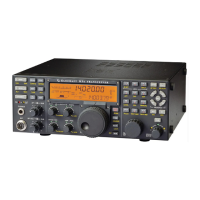
Remote Control of the K3S
With appropriate software, any computer with a
USB or RS232 port can be used to control the K3S.
A K3S (or K3) can also be controlled remotely from
anywhere in the world using a K3/0-Mini panel (pg.
47). The –Mini provides full control, transmit and
receive audio, and CW keying, all via a single USB
cable to a network-connected local computer. The
-Mini duplicates all K3S/K3 front panel functions,
as well as the display.
Third-party logging and contesting software is
available for various computers and operating
systems. Existing applications written for the K2 or
K3 should work with the K3S.
For a list of compatible software applications,
including configuration requirements, please visit
www.elecraft.com/K3/k3_software.htm
Remote-Control Commands
The K3S has a rich set of remote-control
commands. These commands use ordinary ASCII
text, so they can be easily tested using a terminal
emulator. For example, the command “FA;” returns
the current VFO A frequency. Using the same
command, you can set the VFO A frequency, e.g.
“FA00007040000;” sets the VFO to 7.040 MHz.
Many new commands are provided in addition to
the core set of commands supported by the K2.
Some existing commands have been updated to
directly control the sub receiver (e.g., “AG$;”,
which controls sub AF gain). Please refer to the
K3/KX3 Programmer’s Reference for further
details.
Front-Panel Switch Macros
You can set up any programmable front-panel
switch (e.g. PF1) to execute sequences of remote-
control commands directly from the K3S. This is
useful for automation of sequences such as: enter
split mode, assign VFO A to B, move VFO B up 5,
and turn on diversity receive. Refer to K3 Utility
help or the Programmer’s Reference for examples.
Also see CONFIG:MACRO x.
Remote Power On/Off
A remote-control system can pull the POWER ON
line to ground (ACC connector, pg. 20) to turn the
K3S ON. To turn it OFF, the controller must send
the K3S a “PS0;” remote-control command via the
RS232 interface, wait at least 100 ms, then
deactivate the POWER ON signal. This sequence
ensures that nonvolatile memory is updated
correctly before shut-down.
Automatic Antenna Control
Some antenna control units (e.g., those used with
SteppIR™ antennas) can track your band and
frequency by watching for “IF;” (rig information)
packets from the K3S. Some computer
logging/contesting applications set up the K3S to
output these messages periodically, allowing the
antenna control unit to “eavesdrop.”
If you’re not using such software, or if you’re not
using a computer at all, you can still set up the K3S
to output “IF;” packets periodically by setting
CONFIG:AUTOINF to AUTO 1. The packets are
sent once per second while the VFO frequency is
being changed, as well as on any band change.
If you’re using logging/contesting software,
check with the manufacturer before setting
AUTOINF to AUTO 1. Some applications may
not be tolerant of unsolicited “IF;” packets.
CW/DATA Terminal Applications
The K3S directly supports CW, PSK31 and PSK63,
and RTTY ASCII text transmit and receive via its
USB or RS232 port. Our K3 Utility application
includes a simple Terminal function that lets you try
out these modes using your computer’s keyboard
and monitor.
Elecraft Frequency Memory Editor
Frequency memories can be easily viewed and
changed using our Elecraft Frequency Memory
Editor application. This program shows the
contents of all 100 regular memories, and optionally
the per-band memories, in a spreadsheet format.
You can also QSY directly to a memory within the
editor program using the provided buttons.



 To Next Page