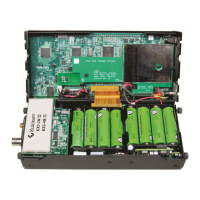
The DSP board is piggybacked onto the Front Panel board as part of the Front Panel assembly. The Auxiliary
DSP (used if the KRX3A Second Receiver Option is installed) and the KDVR3 option plug into the DSP board.
KREF3 (Ref./2
nd
LO)
The KREF3 module’s 49.380-MHz temperature-compensated crystal oscillator (TCXO) is the signal source for
the synthesizers. The high-stability TCXO option is typically better than +/- 0.5 PPM over the 0 to 50 C
temperature range. This signal is also divided by 6 to provide the 8.230-MHz 2
nd
-LO signal used by the second
receive and transmit mixers. In addition to the TCXO and dividers, the KREF3 provides the 2
nd
transmit I.F.
mixer, which converts the DSP's 15-kHz transmit I.F. output to 8.215 MHz. This signal passes through a wide
crystal filter to ensure rejection of mixer products before being routed to the RF board. The KREF3 obtains its
DC and low-frequency I/O signals via an 8-pin connector on the RF board, but its RF outputs are fed to the RF
board (and sub receiver) via coax cables. The K3EXREF option locks the KREF3 to an external reference.
KSYN3A (Synthesizer)
Low phase noise is key to both receiver and transmitter performance. The KSYN3A uses an extremely clean,
integrated oscillator I.C. to generate a wide-range, low-noise local oscillator signal for injection into the first
mixer. The local oscillator is locked to the internal 49.380-MHz frequency reference to within a small fraction
of 1 Hz on all bands.
The KSYN3A is a significant upgrade to the original KSYN3 synthesizer used in the K3. The earlier design
used separate stages for the VCO, PLL (phase-locked loop) and DDS (direct digital synthesizer). In contrast, the
KSYN3A’s integrated circuitry operates at much higher frequency, and is then divided down to provide the low-
jitter signal required to drive the mixer. This results in lower phase-noise at close spacings from the carrier, as
well as faster VFO update during T/R switching, enhancing high-speed CW timing. The KSYN3A can also tune
to much lower frequencies, allowing operation down to 100 kHz.
Firmware
Overview
The K3S is controlled by a Microchip PIC18F8722 microcontroller (MCU) on the Front Panel PCB module. It
uses a highly-optimized, custom operating system to efficiently handle many complex tasks.
At the highest level, the MCU firmware in the K3S runs a continuous executive loop. Within this loop, calls are
made to handlers for the all user interface elements (switches, potentiometers, encoders, LEDs, LCD, etc.), I/O
(USB and RS232 command handling, AUXBUS, SPI peripheral control, T/R switching), and process control
(timers, state machines, etc.). In addition, a fast interrupt handler runs every 200 microseconds to service high-
speed events such as optical encoder state changes and incoming serial data. This interrupt handler also provides
fine-timing services for other functions and state machines, such as RTTY or PSK31/PSK63 text
encode/decode.
The main and aux DSPs are peripherals of the MCU. They execute an extensive set of commands, allowing the
MCU to specify operating mode, BFO frequencies, keying waveform start/stop, sidetone pitch, AF and IF gain,
filter bandwidth and position, and many other parameters. In some cases the MCU polls the DSP for information
periodically. For example, if voice VOX is enabled, the MCU polls every few milliseconds to see if the present
mic level is above the user’s specified VOX threshold, in which case the rig will be switched to TX mode.



 To Next Page