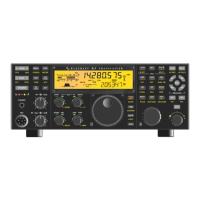
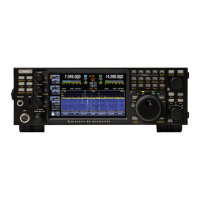
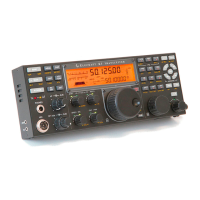
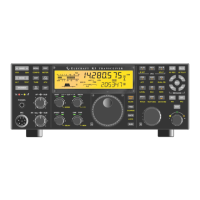
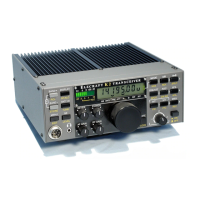
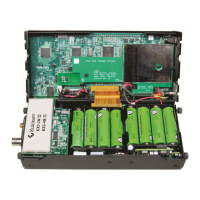
Front Panel Board
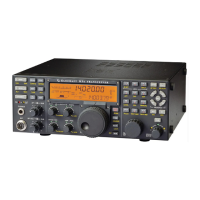
This board provides the transceiver’s user interface: 35 custom-labeled switches; two dual-concentric
potentiometers for gain and squelch control; seven shaft encoders; custom, 240-segment, high-contrast LCD;
and 13 discrete LED indicators. Mic and headphones can be plugged into the front panel, or optionally at the
rear panel (see KIO3B description, pg. 79).
The Front Panel PCB also includes the microcontroller unit (MCU), which manages the operation of the K3S.
All inputs, whether from a switch, knob or external PC, are recognized and acted on by the MCU. All control
outputs – such as switching from transmit to receive, sending a CW code element, adjusting the transmitter
power, controlling LED brightness, etc. – are produced by the MCU.
The Front Panel also contains a large amount of EEPROM memory for parameter storage, and FLASH memory
for program storage. This allows the K3S to be re-programmed with the newest firmware by a simple download
from the Internet. It also enables the K3S to remember your favorite settings, particular configuration
preferences, and the last setting of controls when power is removed from the radio.
DSP Board
The Digital Signal Processing (DSP) capabilities provide a rich set of features to help combat QRM and QRN
while generating some of the cleanest signals to be found in Amateur radio today. A 32-bit floating point DSP is
used for highest performance.
In receive, a 15 kHz IF signal from the RF board is buffered and then digitized by a 24-bit Analog to Digital
Converter (ADC). This provides over 100 dB of dynamic range within the passband of the selected crystal
(roofing) filter. After the ADC, the DSP converts the signal into a floating point value so dynamic range is not
compromised during further processing. Noise blanking and limiting, AGC, amplification, IF and AF filtering
are all done within the DSP. Several noise blanking algorithms (methods) are available in the DSP, and a
sophisticated AGC system is employed. AM, FM, SSB and CW detectors are also implemented by the DSP.
Various audio effects, such as Quasi-Stereo and Binaural, are provided here as well as combining the audio
signals from the KRX3A (if installed).
After processing, the resulting audio signals are generated in a stereo 24-bit Digital to Analog Converter (DAC)
and applied to separate amplifiers for headphones (front and rear) and speaker. The speaker amplifier was
redesigned for the K3S to reduce low-level intermodulation products. The power amplifier stage operates at no
voltage gain; instead, the required gain is provided by an extremely low-distortion dual audio driver.
A separate 24-bit DAC and amplifier provide Line Out signals that are not affected by the AF Gain control. This
output is typically used by sound card digital mode software. When the USB port is used for line-level audio
purposes, the analog line in/out signals from the DSP are digitized and added to the USB data stream.
In transmit, Line In, rear or front Microphone signals are sent to a 24-bit ADC and then processed by the DSP.
In speech modes (SSB, AM and FM) and soundcard-based data modes, VOX is derived from these signals as
well as receive audio. Microphone equalization, bandpass limiting, conversion to 15 kHz IF, envelope clipping
and filtering (if applicable) are all done in DSP, then the signal is passed to another 24-bit DAC and presented to
the RF board as a 15 kHz IF signal. Direct FSK, direct PSK and CW signals are generated within the DSP for
those modes.
Thus, the DSP is responsible for all signal processing between audio and the 15 kHz IF for both receive and
transmit. Like all other modules in the K3, the DSP is managed by the MCU.




 To Next Page