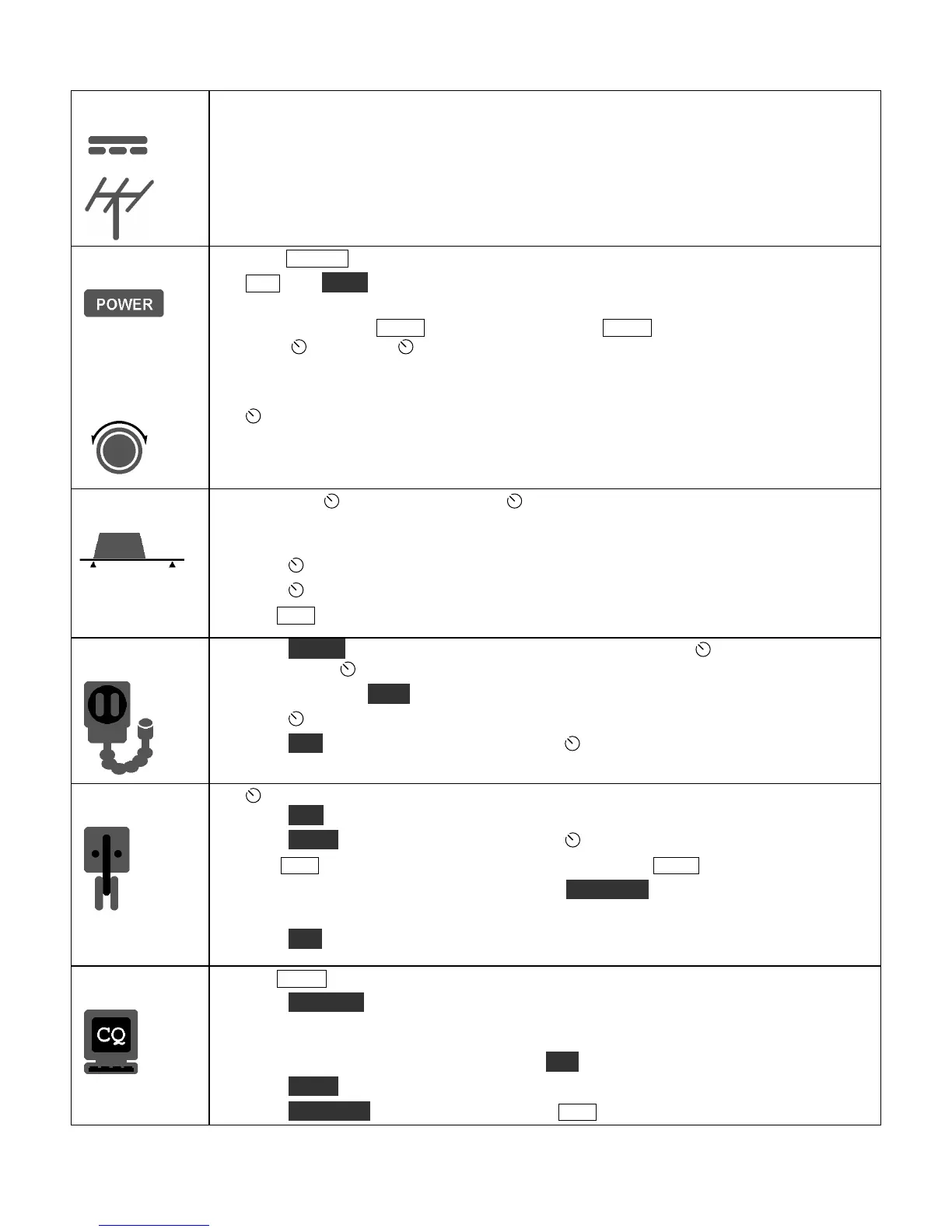
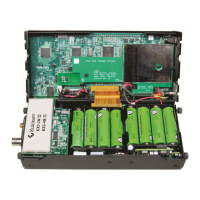
• Connect a power supply to the DC input jack {26} (see Specifications, pg. 8).
• On the K3S /100, a circuit breaker is provided on the fan panel for the 100-W stage {39}.
• You can power an accessory device from the switched DC output jack {40} (1.0 A max).
• Connect antenna to ANT1 {29} and ground {38}. With an ATU (pg. 24), you can also use
ANT2 {28}. AUX RF {27} is for the sub RX; see pg. 17. ANT3 {30} is used with the
internal 2-m module (K144XV). Connect an RX-only antenna to RX ANT IN {35}.
• Press POWER {5} to turn on the K3S. If there are any error indications, refer to pg. 74.
• TAP and HOLD Functions: Tapping briefly activates the function labeled on a switch.
Holding for about 1/2 second activates the function labeled below a switch.
• Tap either end of BAND {7} to select a band, and MODE {6} for the mode. Set AF gain
using AF {2}. Set RF to max. Plug phones in at {3}. For SUB controls, see pg. 39.
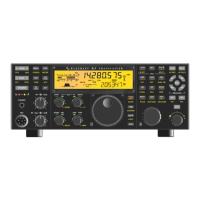
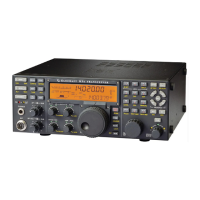
• The large knob {22} controls VFO A (upper display, {10}). The medium knob {19}
controls VFO B (lower display, {11}). VFO A is main RX/TX except in SPLIT (pg. 38).
• CMP / PWR is one of four multifunction controls {24}. Each has two primary
functions, indicated by green LEDs. The knob has a built-in switch; tap it to select either
CMP (compression level) or PWR (power output). Hold the knob in to access its
secondary function, MONitor level. Tap again to restore the primary function.
• Rotate the SHIFT / LO CUT and HI CUT / WIDTH controls {23} to adjust the filter
passband. Crystal filters FL1-FL5 are automatically selected as you change the band-
width. Tap either knob to select shift/width or hi cut/lo cut. (See filter info, pg. 85.)
• Hold SHIFT / LO CUT to NORMalize the bandwidth (e.g., 400 Hz CW, 2.8 kHz SSB).
• Hold HI CUT / WIDTH to alternate between two filter setups, I and II (per-mode).
• Tap X FIL {13} to select crystal filters manually; this also removes any passband shift.
• Hold METER {8} to see CMP / ALC levels. While talking, set MIC {25} for 4-7 bars
of ALC, and CMP for the desired compression. Then return to SWR / PWR (pg. 30).
• Optional: Hold TEST {6} for TX TEST mode; allows off-air TX adjustments (pg. 13).
• Hold CMP / PWR {24} to set speech MONitor level; tap to return to CMP / PWR.
• Hold VOX {7} to select PTT or VOX. Hold SPEED / MIC to set VOX DELAY.
• Details: VOX, pg. 31; TX EQ, pg. 37; MIC SEL, pg. 55; SSB/AM/FM, pg. 30.
• SPEED {25} sets the CW keyer speed. Hold this knob to set semi-break-in DELAY.
Hold QSK {7} to select full QSK (pg. 32.). Hold VOX {7} to select hit-the-key CW.
• Hold PITCH {18} to set sidetone pitch. Hold CMP / PWR to set sidetone MON level.
• Tap CWT {18} for tuning aid {9} (pg. 36). With CWT on, SPOT auto-spots (pg. 32).
• To select CW text decode/display mode, hold TEXT DEC {18}; rotate VFO B (pg. 32).
• CW keying is converted to DATA in FSK D and PSK D modes (below and pg. 36).
• Hold APF {13} to turn on audio peaking (APF) or dual-passband filtering (pg. 32).
• Tap MODE {6} until you see the DATA icon turn on (see Data Modes, pg. 33).
• Hold DATA MD {18}. Use VFO B to select from: DATA A (PSK31, JT65, and other
soundcard-based modes), AFSK A (soundcard-based RTTY), FSK D (RTTY via data
input or keyer), or PSK D (PSK via data input or keyer). VFO A selects data baud rate
for internal encoder/decoder, if applicable. APF turns on an RTTY filter (DTF, pg. 34).
• Hold PITCH {18} to select mark tone and shift (for encoder/decoder and RTTY filter).
• Hold TEXT DEC {18} to set up text decode. CWT shows tuning aid (pg. 36).




 To Next Page