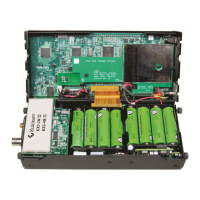
Set to PA NOR if KPA3A 100-W amp installed. Set to PAIO ON if KPA3A is
not installed, but the KPAIO3A transition PC board is. Other settings include PA
BYP (disables PA if installed), PA fan test settings (PA FN1-FN4 or PAIO
FN1-FN4), and PAIO BYP (if transition board is installed, but not the KPA3A
module, this setting can be used to test the high power bypass relay).
Controls the KRC2 band decoder’s accessory output settings. Shows ACC OFF
or ACC1-3 if a KRC2 is detected; - - if not.
To ensure compatibility with both old and new KRC2 firmware, two different 6
meter band decodes are provided. Tap 1 to select BAND6=B6 (addr=10) or
BAND6=B10 (addr=9). Refer to the KRC2 manual for further details.
If KRX3A option (sub receiver) is installed, set the parameter to match your
selected sub receiver AUX RF source: ANT=ATU (the KAT3’s non-transmit
antenna) or ANT=BNC (the AUX RF BNC jack on the rear panel). Turn power
off, then back on.
The KXV3B module is supplied with the basic K3S. If it is installed: set to NOR,
exit menu, and turn power off/on. If not, set to NOT INST. The KXV3B
provides RX ANT IN/OUT jacks, transverter I/O jacks (XVTR IN/OUT), preamp
2 (see CONFIG:PREAMP2), a buffered I.F. output for the P3, and internal 2-m
module support (K144XV).
If the menu entry name is shown as KXV3 (without the B suffix), tap 9 to
change it, then exit the menu and turn power off/on. This instructs the K3S to look
for the KXV3B module, which includes the preamp 2 circuitry. If you see ERR
XV3, refer to Troubleshooting.
If KXV3B is set to TEST, the K3S will transmit at low power (0.10 to 1.50 mW)
on all bands, including HF and transverter bands. RF input/output is via the
XVTR IN/OUT jacks in this case. Used for troubleshooting or, at present, to
transmit at ~0.5 mW on the 630-meter band (472 kHz). Note: The TEST setting
is not available until the KXV3B has been configured as described above.
Rotating VFO A to turn on all LCD segments for test purposes.
Sets the LINE OUT level. LINE OUT connections go to PC soundcard inputs.
Settings above 10 may result in overdrive of the soundcard or saturation of the
KIO3’s isolation transformers; monitor signals using the PC to avoid this.
The LINE OUT jack is active even if CONFIG:RS232 is set to USB. The USB
port also provides line-out audio via the USB cable. See pgs. 18 and 22.
Note: Normally, LIN OUT sets a fixed-level receive-only output for main/sub
(Left/Right), compatible with digital modes. Tapping 1 switches LIN OUT to
=PHONES, where the line outputs match headphone audio. In this case, line out
audio level is controlled by the AF/SUB gain controls.
Used to assign macros (sequences of remote-control commands) to any of the
programmable function switches. For example, a single macro can do the
equivalent of “SPLIT, up 2 kHz, turn on diversity mode”; setup transmit EQ for a
specific operator; configure the K3S for a contest, etc.
Macros must first be created using K3 Utility and sent to the K3S. Next, locate the
MACRO x menu entry, tap 1 -8 to select a macro number (x), then hold the
desired programmable switch (e.g. PF1) to assign that macro to it. For details, see
K3 Utility help or the Programmer’s Reference.




 To Next Page