23
Reference Manual
00809-0200-4420, Rev HC
Section 3: Installation
July 2015
Installation
In 2003, IEEE 802.3af standard for PoE was adopted. It specified:
The wires that would carry power and how
Devices that could source power and devices that could be powered
Supplied wattage would be up to 15 Watts (in 2009, IEEE 802.3at was adopted, which
allowed power up to 25 Watts)
The voltage used
A method of protecting against damaging non-PoE devices
There are two types of IEEE 802.3 PoE devices
1. PSE (Power Sourcing Equipment) is a device that acts as a voltage source and supplies
PoE to devices via the ethernet cable.
2. PD (Powered Device) is a device that is supplied with power via PoE from a PSE device
via the ethernet cable.
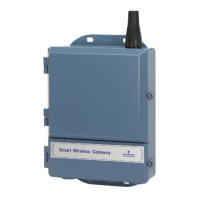
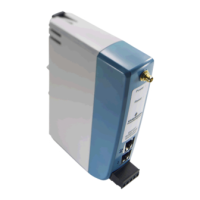
The Gateway can be configured by jumpers to work in either one of the modes referenced
above. Therefore the Gateway can source power or be powered via the ethernet cable.
Note
The Gateway cannot be a PSE and a PD at the same time. PoE can only be configured on one
Gateway port at a time.
PoE advantages
To save costs on planning, wiring and installation of networks, devices are supplied with power
directly via the ethernet cable (e.g. via a Cat 5/5e cable up to 100m). PoE makes the network
planning flexible, independent of power supply cabinets, and junction boxes. There are no extra
costs for the electrical wiring. An advantage of PoE is that you can install devices with an
ethernet interface in places of difficult access or in areas in which running cable would be
inconvenient. This in turn saves installation time and costs. This technology is in use today
typically in IP telephones, cameras, or wireless transmission devices such as WLAN Access
Points.
An excellent application is a Gateway connected to a Wi-Fi back haul unit; such as a Cisco
®
or
ProSoft
®
unit. For example a Cisco unit could power the Gateway or in another case the Gateway
could power the ProSoft unit as in a PFN with the addition of an external power supply.
Selecting devices to work with a PoE Gateway
The connecting device to the Gateway whether it is a PSE or a PD must be labeled as compliant
with IEEE 802.3af or IEEE 802.3at. Many companies use labels on their packaging such as PoE for
IEEE 802.3af or PoE+ for IEEE 802.3at. Check the specific manufacturer's specifications of any
device to make sure somewhere it references IEEE 802.3; otherwise it may not work.
The Gateway works as either a PoE PSE for IEEE 802.3af (sourcing 15 Watts) or PoE+ PSE for IEEE
802.3at (sourcing 25 Watts) depending on the input voltage to the Gateway from the power
supply. For 12 VDC nominal input, the Gateway can source 15 Watts. For 24 VDC nominal input,
the Gateway can source up to 25 Watts. No additional adjustment is necessary.



 To Next Page
 Loading...