5. If the transmitter is in Hold when the fault occurs, the output remains at the
programmed hold value. To alert you that a fault exists, the word FAULT appears in
the main display, and the display flashes. A fault or diagnostic message also appears.
6. If the transmitter is simulating an output current when the fault occurs, the
transmitter continues to generate the simulated current. To alert you that a fault
exists, the word FAULT appears in the display, and the display flashes.
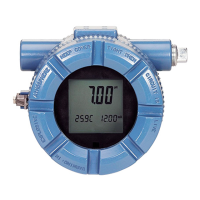
Fault annunciationFigure 8-2:
When a disabling condition, a fault, occurs, the display appears as pictured above. To further alert you
that measurements are in error, the display flashes. Diagnostic messages appear in the temperature/
output area on the screen.
8.1.2 Calibration errors
If an error occurs during calibration, an error message appears in the main display, and the
transmitter does not update the calibration. The calibration errors are Std Err, SLOPE Err LO,
and SLOPE Err HI. See Section 8.1.4 for an explanation of the error messages and suggested
ways of correcting the problem.
8.1.3 Troubleshooting - general
Follow the steps below to troubleshoot your transmitter.
1.
Look for a diagnostic message on the display to help identify the problem.
Refer to Section 8.1.4 for an explanation of the message and a list of the possible
problems that triggered it.
2. Refer to Section 8.1.5 for common measurement problems and the recommended
actions to resolve them.
3. Follwo the step-by-step troubleshooting approach, offered in Section 8.1.6, to
diagnose and correct less common or more complex problems.
Diagnostics and troubleshooting
54 Rosemount 5081


 To Next Page
 Loading...