Installation
5.4 Installer/service notes for the use of gas oil with bio blends up to 10% where gas oil use is permitted by the
appliance manufacturer
• During the burner installation, check that the gas
oil and biofuel blends are in accordance with EOGB’s spec-
ications (please refer to the chapters “Technical Data” and
“Guidance for the use of biofuel blends up to 10%” within
the burner technical manual).
• If a bio blend is in use the installer must seek
information from the end user that their fuel supplier can
evidence that the blends of fuel conform to the relevant
standards.
• Check that the materials used in the construction
of the oil tank and ancillary equipment are suitable for
biofuels, If not these must be upgraded or replaced with
bio compatible parts. (Please contact EOGB for more info
on other biofuel compliant products)
• Particular attention should be given to the oil stor-
age tank and supply to the burner. It is recommended that
existing oil storage tanks are cleaned, inspected and any
traces of water are removed BEFORE biofuel is introduced
(contact the tank manufacturer or oil supplier for further
advice). If these recommendations are not respected this
will increase the risk of contamination and possible equip-
ment failure.
• In line oil lters should be replaced making sure
that they are bio compatible. It is recommended that a
good quality bio compatible oil lter at the tank and a
secondary 60 micron lter are used to protect the burner
pump and nozzle from contamination.
• The burner hydraulic components and exible oil
lines must be suitable for biofuel use (check with EOGB if
in doubt). EOGB have carefully chosen the specication
of the bio compatible components including the exible
oil lines to protect the pump, safety value and nozzle.
The EOGB warranty is dependent upon the use of EOGB
recommended components including the oil lines, being
used. The burner must be commissioned and combustion
parameters set to appliance manufacturer’s recommenda-
tions.
• Regularly check visually for any signs of oil leakage
from seals, gaskets and hoses.
• It is strongly recommended that with Biofuel use,
oil lters are inspected and replaced every 4 months. More
regularly where contamination is experienced.
• During extended periods of non operation and/or
where burners are using oil as a standby fuel, it is strongly
recommended that the burner is put into operation for
shorts periods at least every three months.
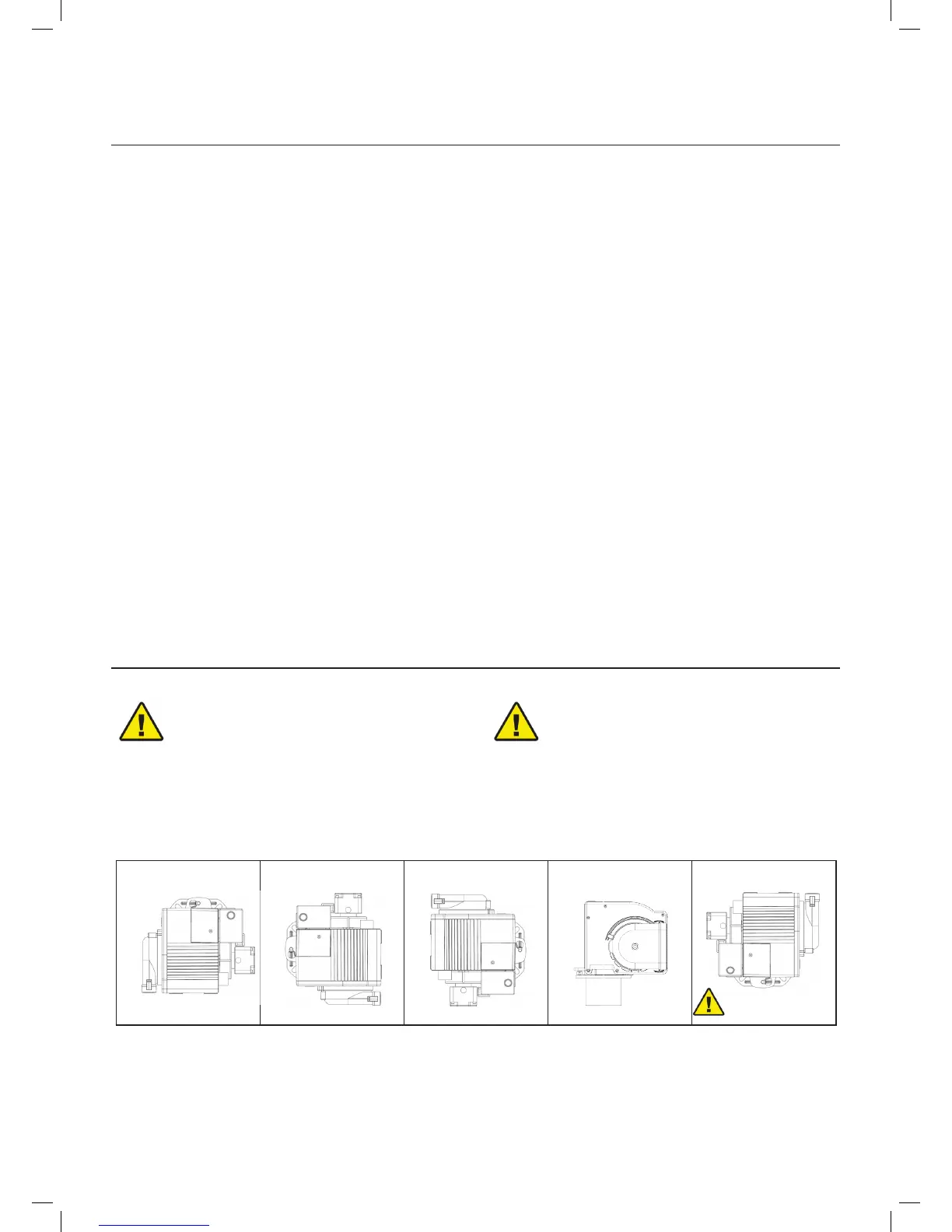
5.5 Working position
The burner is designed to operate only in the
positions 1, 2, 3 and 4 (Fig. 5).
Installation 1, 2 and 3 is preferable, as it is the
only one that allows performing maintenance
operations as described in this manual.
Installation 4 allows for working operations but
may incur maintenance issues as some adjusta-
ble settings may be obstructed
Any other position could compromise the correct op-
eration of the appliance. Installation 5 is forbidden for
safety reasons, unless the burner has been supplied
to suit an upside down ring position or the burner has
been modied so the oil pump has been rotated 90
degrees to prevent the solenoid coil ring in a down-
wards orientation (please seek further assistance from
EOGB on this modication.)
WARNING
CAUTION
Fig. 5
2
3
4 5
1
See note above
CAUTION


 To Next Page