32
Faultyrelays
• Turnoffthecabinet.
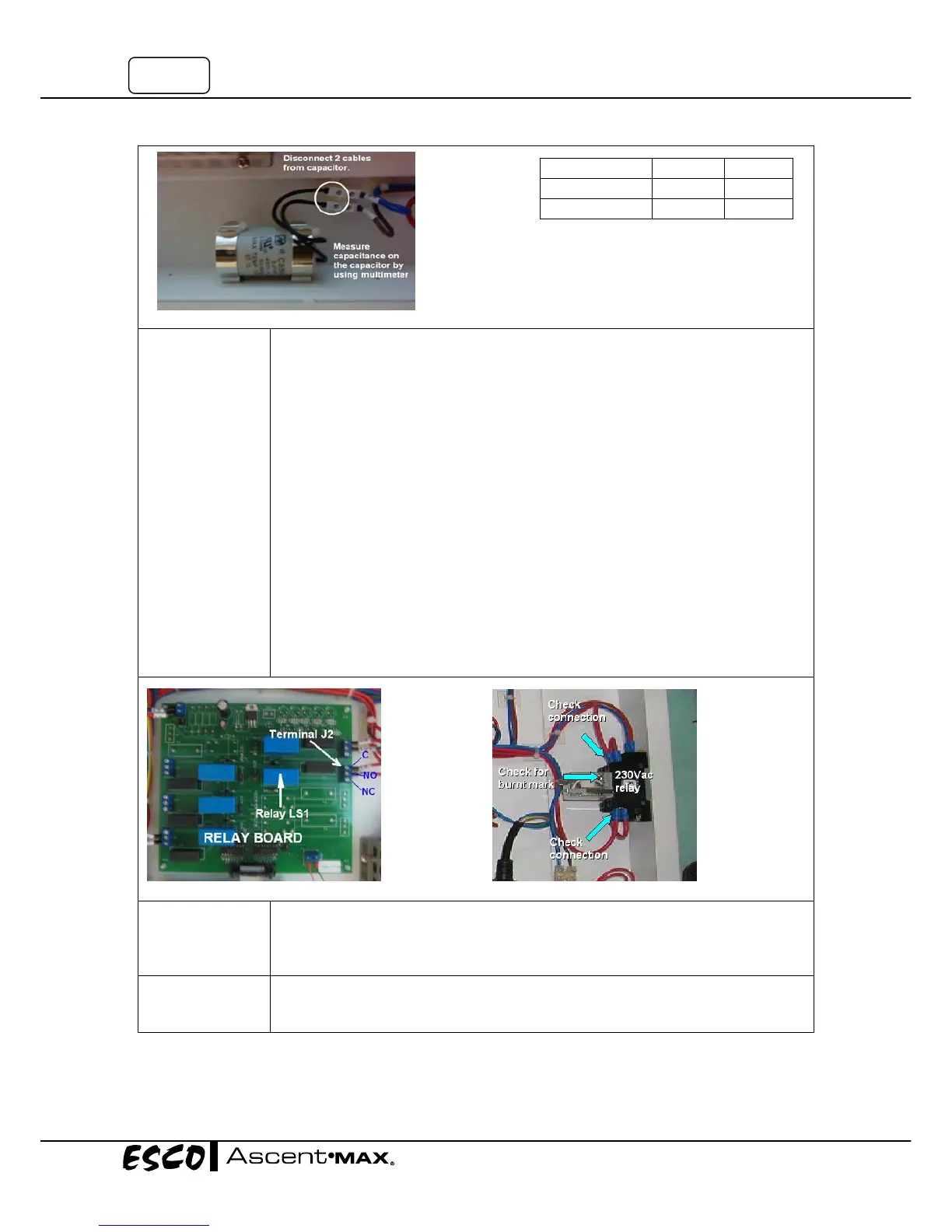
• CheckLS1relayontheRelayBoard.SeeDrawing2‐5below.
• Makesureallwiringandconnectionsarecorrect.
• OnterminalJ2,checktheNOtoCommonandNCtoCommoncircuitsbychecking
continuity.
• IftheNO
toCommonandNCtoCommoncontactsarenotcorrect,replacetheRelay
Board.
• IftheNOtoCommonandNCtoCommoncontactsarecorrect,proceedtothenext
step.
• CheckK1relay,seedrawingLayoutAattheendofthissectiontolocatetheK1
relay.
• Withcabinetstillswitched‐off,checkifthecablesconnectedtotherelaysocketare
tight.Seedrawing2‐6below.
• Visuallyinspecttherelayforburntcontactsorflaskmarksontheinsideoftherelay
case.(Relayistheonewithtransparent,rectangular,plasticcase)
•
CheckNOtoCommonandNCtocommoncontactsonrelayK1.Themethodissame
asforLS1relay.
• IftherelayK1showssignsofarching(burntmarks)ortheNO‐CandNC‐Ccircuitsare
notcorrect,replacetherelay.
Auto‐thermalcut‐
off
• ChecktheFanforoverheating–Themotorhasathermalcutoutbuilt‐in.
• Wait60minuteswiththeFANturnedoffandthentrytorestart.
• IftheFANrestartsdeterminewhythereisexcessiveheatinthecabinet.
• Ifthe
FANdoesnotrestartproceedtothenextstep.
Motorfailure
• Checkwhetherthemotorcanrotateproperlyandnotloosened.
• Checkforphysicaldamage.
• Ifpresent,replacetheblower.
Power 50Hz 60Hz
115VAC±10%18‐22μf
230VAC±10% 7.5‐8μf 9‐11μf
Figure2‐4
Table1
Figure2‐5
Figure2‐6


 To Next Page