101
Ventilation System
10.3 Carbon Monoxide &
Proper Ventilation
FAILURE TO PROPERLY VENTILATE THE BOAT WHILE THE
ENGINES OR GENERATOR ARE RUNNING MAY PERMIT CARBON
MONOXIDE TO ACCUMULATE WITHIN THE CABIN AND OPEN
AREAS OF YOUR BOAT. CARBON MONOXIDE IS A COLORLESS
AND ODORLESS GAS THAT IS LETHAL WHEN INHALED. CARE
MUST BE TAKEN TO PROPERLY VENTILATE THE BOAT AND
TO AVOID CARBON MONOXIDE FROM ACCUMULATING IN THE
BOAT WHENEVER AN ENGINE IS RUNNING.
A by-product of combustion, carbon monoxide
(CO) is invisible, tasteless, odorless and is pro-
duced by all engines and gas heating and cooking
appliances. The most common sources of CO on
boats are gasoline engines, auxiliary generators
and propane or butane stoves. These produce
large amounts of CO and should never be operated
while sleeping. The hazard also may be created
by a boat nearby whose exhaust fumes are enter-
ing your boat. Boats also have a problem due to
the “station wagon effect” where engine exhaust
fumes are captured in the vacuum or low pres-
sure area, usually the cockpit, bridge deck and
cabin, that can be created by the forward speed
of the boat.
Boats underway should close all aft facing hatches
and doors. The forward facing deck hatch should
be open whenever possible to help pressurize
the living spaces of the boat. No sleeping in the
cabin should be permitted while underway. Proper
ventilation should be maintained at the helm by
opening the windshield to help pressurize the area
when the enclosure is installed. Canvas drop or aft
curtains must be removed to increase air ow and
maintain proper ventilation whenever the engines
are running. Under no circumstances should
the engines be operating with windshield
closed and an aft or drop curtain installed.
Extreme caution must be taken while at anchor
or in a slip when an auxiliary power generator is
operating. Wind still nights can easily allow ex-
haust fumes, containing high concentrations of
CO, from the generator on your boat or from an
adjacent boat’s generator to enter the boat. The
exhaust fumes may enter your boat through open
hatches or windows.
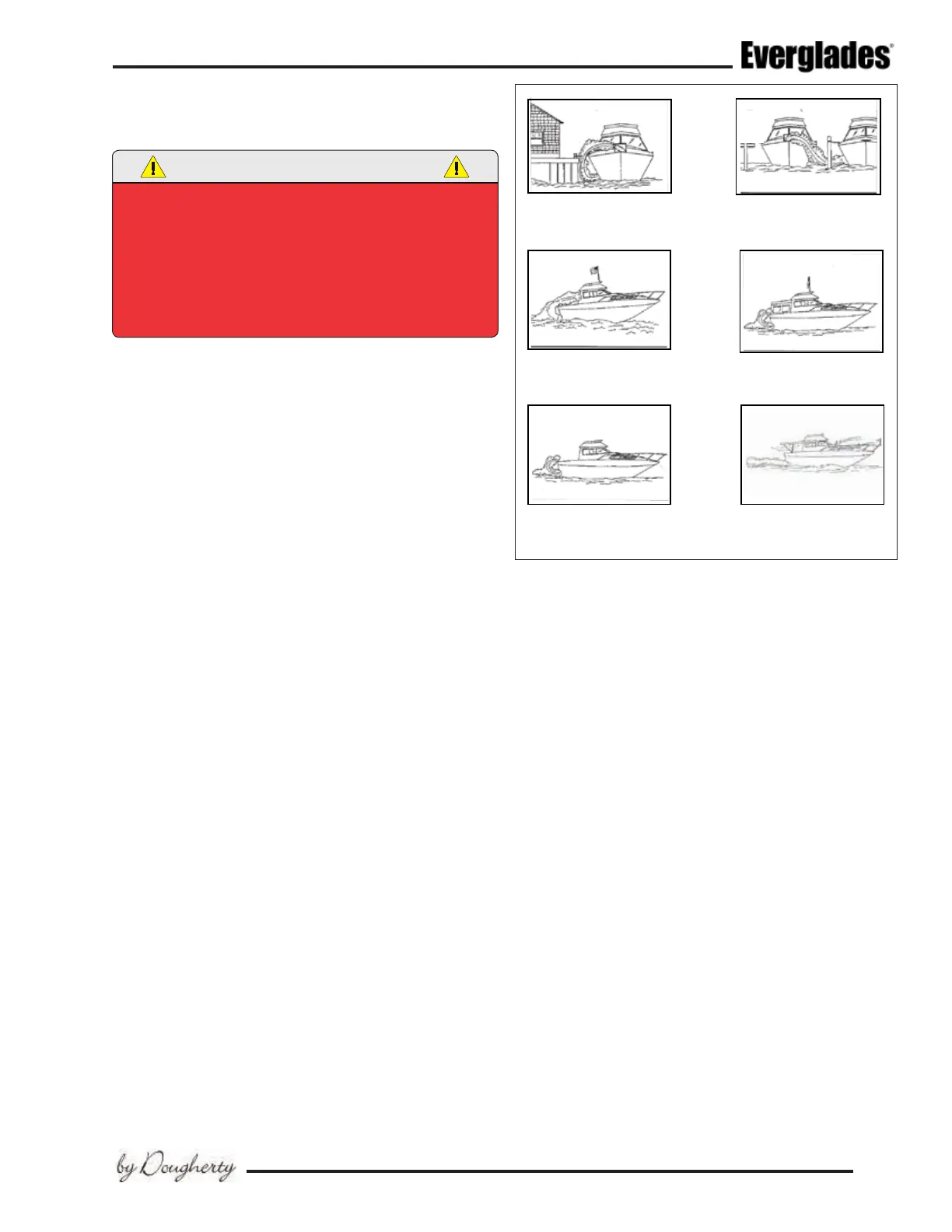
Back Drafting / Station Wagon
Effect - at cruising speed with
no forward ventilation
Back Drafting / Station Wagon
Effect - at cruising speed with
canvas closed
Slow Speed or Boat Stopped
w/ engines running - CO can
accumulate in cabin, cockpit &
bridge
Desired Air Flow Through the
Boat
Onboard Generator Exhaust -
exhaust accumulates because
of bulkhead.
Nearby Generator Exhaust -
wind carries exhaust to the
other boat



 To Next Page