20
Safety Equipment
1.7 Carbon Monoxide
Monitoring System
CARBON MONOXIDE IS COLORLESS, ODORLESS AND
DANGEROUS. ALL ENGINES, GENERATORS AND FUEL
BURNING APPLIANCES EXHAUST CARBON MONOXIDE (CO).
DIRECT AND PROLONGED EXPOSURE TO CO WILL CAUSE
BRAIN DAMAGE OR DEATH. SIGNS OF EXPOSURE TO CO
INCLUDE NAUSEA, DIZZINESS AND DROWSINESS.
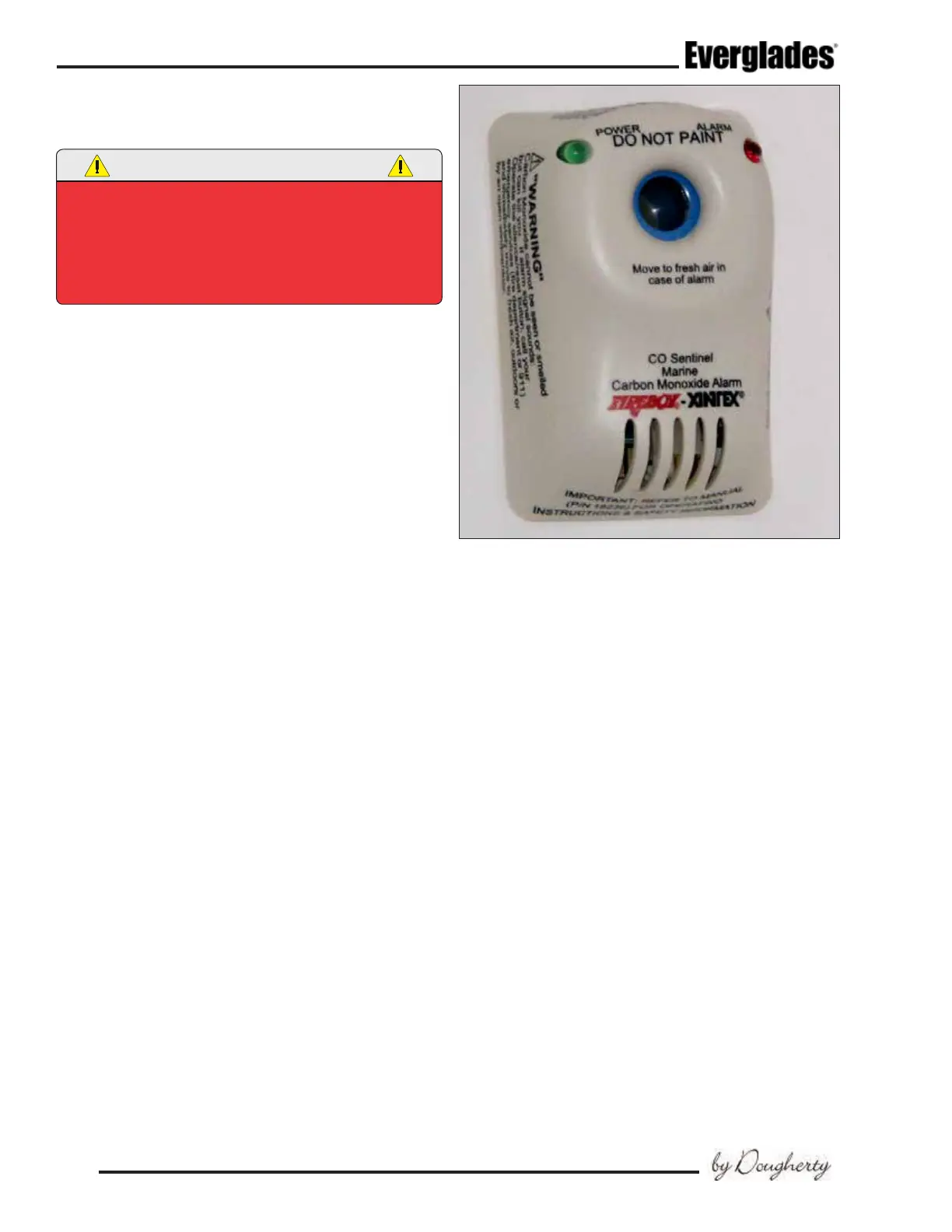
The carbon monoxide (CO) detector is installed in
the cabin as standard equipment and warns the
occupants of dangerous accumulations of carbon
monoxide gas. If excess carbon monoxide fumes
are detected, the detector will sound an alarm
indicating the presence of the toxic gas.
Should a very high level of carbon monoxide exist,
the alarm will sound in a few minutes. However,
if small quantities of CO are present or high lev-
els are short-lived, the alarm will accumulate the
information and determine when an alarm level
has been reached.
The carbon monoxide detector is automatically ac-
tivated whenever the House battery is connected.
The power light on the carbon monoxide detector
should be lit to indicate that the carbon monoxide
detector is activated.
Always make sure the power light on the
carbon monoxide detector is lit whenever
the cabin is occupied.
A by-product of combustion, carbon monoxide
(CO) is invisible, tasteless, odorless and is pro-
duced by all engines, heating and cooking appli-
ances. The most common sources of CO on boats
are the engines, auxiliary generators and propane
or butane stoves. These produce large amounts of
CO and should never be operated while sleeping.
A slight buildup of carbon monoxide over several
hours causes headache, nausea and other symp-
toms that are similar to food poisoning, motion
sickness or u. High concentrations can be fatal
within minutes. Many cases of carbon monoxide
poisoning indicate that while victims are aware
they are not well, they become so disoriented they
are unable to save themselves by either exiting
the area or calling for help. Also, young children,
elderly persons and pets may be the rst affected.
Drug or alcohol use increases the effect of CO
exposure. Individuals with cardiac or respiratory
conditions are very susceptible to the dangers
of carbon monoxide. CO poisoning is especially
dangerous during sleep when victims are unaware
of any side effects. The following are symptoms
which may signal exposure to CO: (1) Headache
(2) Tightness of chest or hyperventilation (3)
Flushed face (4) Nausea (5) Drowsiness (6)
Fatigue or Weakness (7) Inattention or confusion
(8) Lack of normal coordination.
Persons who have been exposed to carbon mon-
oxide should be moved into fresh air immediately.
Have the victim breath deeply and seek immedi-
ate medical attention. To learn more about CO
poisoning, contact your local health authorities.
Low levels of carbon monoxide over an extended
period of time can be just as lethal as high doses
over a short period. Therefore, low levels of car-
bon monoxide can cause the alarm to sound before
the occupants of the boat notice any symptoms
Cabin Carbon Monoxide Detector



 To Next Page