34
Operation
2.9 Flooding or Capsizing
Boats can become unstable if they become ooded
or completely swamped. You must always be
aware of the position of the boat to the seas and
the amount of water in the bilge. Water entering
the boat through the transom door or over the
stern gunnels can usually be corrected by closing
the door and turning the boat into the waves. If
the bilge is ooding because of a hole in the hull or
a defective hose, you may be able to plug it with
rags, close the thru-hull valve or assist the pumps
by bailing with buckets. Put a mayday call in to
the Coast Guard or nearby boats and distribute
life jackets as soon as you discover your boat is
in trouble.
If the boat becomes swamped and capsizes, you
and your passengers should stay with the boat as
long as you can. It is much easier for the Coast
Guard, aircraft or other boats to spot, than people
in the water. If your boat is equipped with an
EPIRB, make sure it is activated. When activated,
EPIRBs will send distress code homing beacons
that allow Coast Guard aircraft to identify your
boat and nd you quickly.
2.10 Fishing
Fishing can be very exciting and distracting for
the operator when the action gets intense. You
must always be conscious of the fact that your
primary responsibility is the safe operation of your
boat and the safety of your passengers and other
boats in the area.
You must always make sure the helm is properly
manned and is never left unattended while trolling.
If your boat is equipped with a tower, caution and
good common sense must be exercised whenever
someone is in the tower. Remember, weight in
the tower raises the boat’s center of gravity and
the boat’s motion is greatly exaggerated for the
person in a tower.
If you are shing in an area that is crowded with
other shing boats, it may be difcult to follow
the rules of the road. This situation can become
especially difcult when most boats are trolling.
Being courteous and exercising good common
sense is essential. Avoid trying to assert your
right-of-way and concentrate on staying clear and
preventing tangled or cut lines and other unpleas-
ant encounters with other boats. Also keep in
mind that shing line wrapped around a propeller
shaft can damage seals in the engine lower unit.
2.11 Tower Operation (Optional)
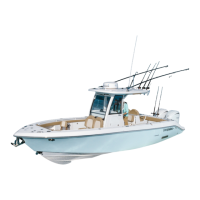
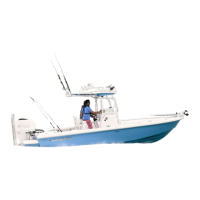
Your boat could be equipped with an optional
fabricated aluminum tower or upper helm station.
Towers are normally equipped with full engine con-
trols, trim tab controls, compass, engine alarms,
stop and start buttons, emergency stop switch and
tachometers. This allows for complete operation
of the boat from the tower.
Operation of the Upper Station Controls
The engines should be started at the lower helm.
Monitor the gauges to make sure all systems are
normal and the engines have been allowed to
warm up slightly before proceeding to the tower
helm. The ignition or restart switches on the tower
are only used to restart an engine in the event it
should stall. The shift controls must be in neutral
for the start switches to be functional.
Electronic engine controls are equipped with a
station transfer button that allows the operator to
transfer control from one station to another with
the push of a button. Always make sure that you
activate the controls as soon as you reach the
upper helm station.
Refer to the Control Systems chapter and the
electronic engine control owner’s manual for more
information on the control system operation and
selecting the controls on boats with dual stations.
The following is a list of safety precautions
for tower operation:
• Do not operate the boat from the tower in
rough sea conditions. The boat’s motions are
exaggerated in the tower and this motion may
become excessive in rough seas.
• Be careful when using the trim tabs from the
tower. The reaction of the trim tabs will be
exaggerated in the tower. Use small tab cor-
rections and wait ten (10) seconds for the tabs
to react. Keep making small corrections until
the hull is at the desired attitude.
• Do not overload the tower. Most towers are
designed to hold the weight of only two aver-
age- sized people. Weight in the tower raises
the boat’s center of gravity. Too much weight
in the tower could make the boat unstable.
• Do not operate the boat in tight quarters, such
as marinas, from the tower. The operator is
isolated from the boat while in the tower and
will not be able to assist in docking procedures.



 To Next Page