22
interlock to provide a slip free connection. Additionally, the units can be
locked semi-permanently together by installing the connecting screws with
the bracket provided with the cooler. See the separate water-cooler manual
for proper connection and pairing of the welder and cooler.
By accessing the background menu on this unit, the water-cooler can be
selected to cycle on and off with the arc or can be selected to run full-time
during heavy use. The cooler does not monitor or switch itself. The power
supply to the water-cooler is cycled on and off by the welder.
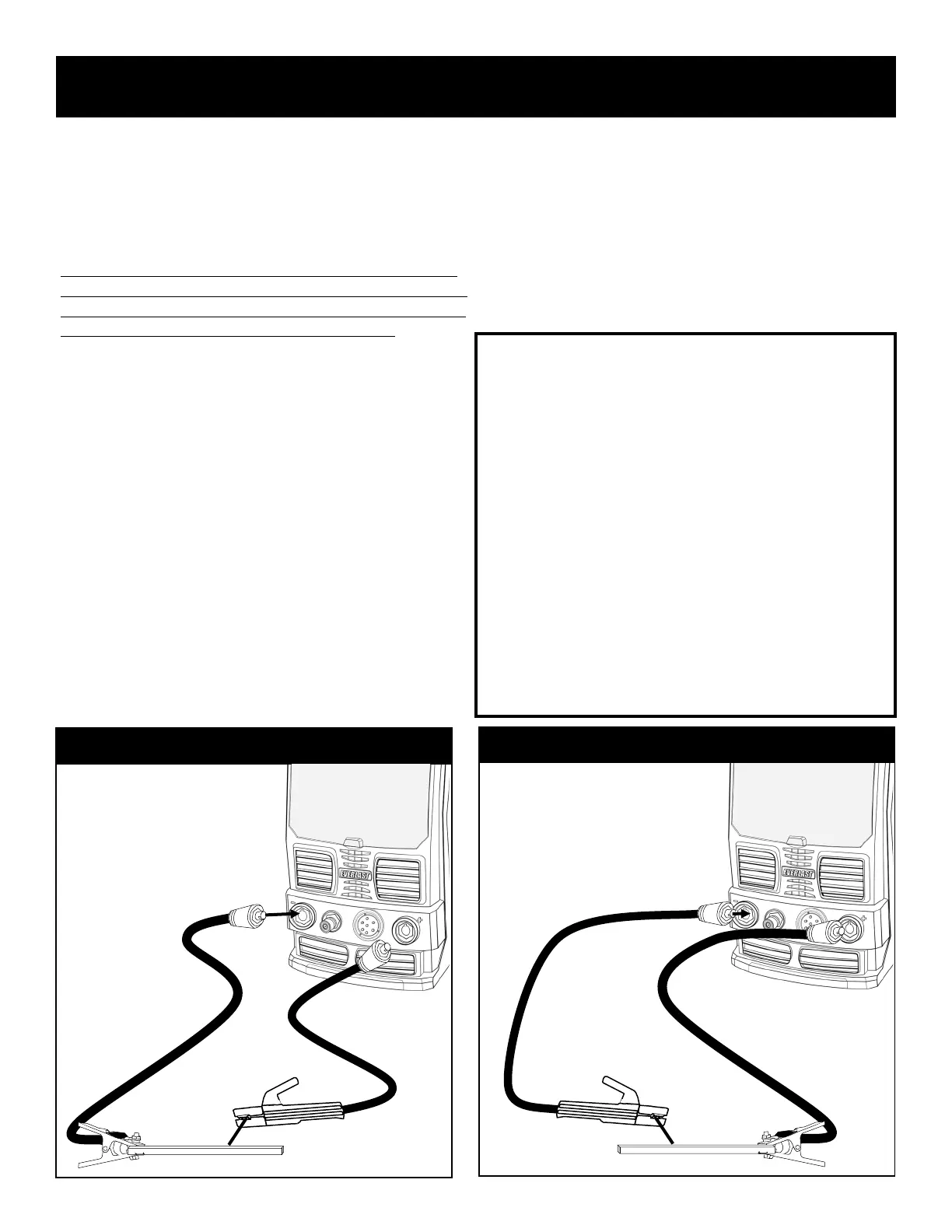
SELECT THE PROPER STICK POLARITY.
The electrode holder, or stick torch (also commonly called a “Stinger”) will
almost always be connected to the right positive terminal of the machine
when welding in DC Mode. By default, the work clamp will then be con-
nected to the negative. This is known as DCEP (DC, Electrode Positive),
Although it is an older term, this is sometimes this is known as “reverse
polarity.” Most all welding rods weld primarily in DCEP. There are a few
rods like E6011 which can operate well with either polarity. Even so, the
preferred polarity, is DCEP. Reasons for welding with DCEN are usually to
provide a softer arc, or to reduce burn through with aggressive rods.
Switching to straight polarity in DC mode will not harm the welder, but it
may not produce reliable or sound welds.
In AC mode, due to the conguration of the welder output, the electrode
holder (Stinger) should be connected to the negative terminal, the same as
you would for TIG welding. This is because of the way the machine reads
and adjusts the AC parameters when welding in stick mode. It is similar to
TIG and uses electrode positive as a reference point. The display will re-
mind you to operate with the electrode holder in the Negative Terminal.
Not all welding rods can create a satisfactory weld in AC mode. Welding
rods such as E6011, E6013, and E7018 can be used and welded with in
the AC mode. Depending upon brand, E7018 may not be recommended
for AC use. However, most companies actually offer a specially formulated
E7018-AC, which provides better arc striking in AC mode, and still can be
used in DC if necessary. AC Stick mode will typically be used only when
arc-blow becomes an issue and a stable DC arc cannot be maintained.
USE THIS AREA FOR MAKING OPERATION NOTES:
Where Do I Connect the Stinger for DC?
Stick Torch
EN(+) for DC
Work Clamp
Electrode Holder (Stinger)
Setup Guide
Getting Started
Where Do I Connect the Stinger for AC?
Stick Torch
EN(-) for AC
Work Clamp
Electrode Holder (Stinger)


 To Next Page