SAFETY DEVICES
5
ENGLISH
SAFETY DEVICES3.
SAFETY DEVICES
Key: * = present,
- = not present
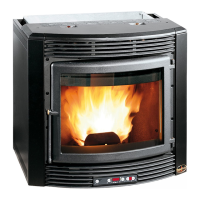
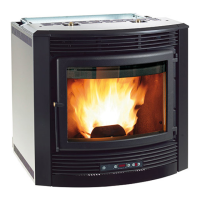
STOVES
INSERTS
Circuit board: intervenes directly by sending the product
into alarm conditions until complete cooling, in the case
of: breakage of ue gas motor, pellet feed motor breakage,
black out (if more than 10 seconds), no ignition
**
Upper door micro switch (combustion chamber): if the
combustion chamber is opened, the pellet feed motor
functioning is blocked (*in some models)
*_
Insert blocking micro switch: if the end run micro switch
warns that the insert is not blocked, electric energy does
not pass to power it
-*
Flow sensor: in the case of inadequate depression, it
takes the machine to alarm conditions
**
F2.5 A 250V fuse (stoves): protects the machine from
violent current drops
**
85°C calibrated mechanical bulb with manual rearm:
intervenes by blocking fuel feed whenever the pellet tank
t° reaches the limit of 85°C. Rearm must be performed
by quali ed sta and/or the manufacturer's technical
after-sales assistance.
**
Pellet feed-box temperature control probe: if the tank
should overheat, the machine modulates automatically in
order to return to normal temperature values (* in some
models)
**
Mechanical air pressure switch: blocks the pellets in
the event of insu cient depression (in the models where
envisioned)
**
INSTALLATION4.
The installation must be in compliance with:
UNI 10683 (2005) heat generators fed with wood and
other solid fuels: installation.
The chimneys must be in compliance with:
UNI 9731 (1990) chimneys: classi cation based on thermal
resistance.
EN 13384-1 (2006) Thermal and uid dynamic calculation
methods.
UNI 7129 point 4.3.3 Fire Department dispositions, local rules
and prescriptions.
UNI 1443 (2005) chimneys: general requisites.
UNI 1457 (2004) chimneys: clay/ceramic ue liners.
GLOSSARY
CLOSED HEARTH APPLIANCE
Heat generator which opening is only allowed through the loading
of the fuel during use.
BIOMASS
Biological material, excluding the material incorporated in
geological formations and transformed into fossils.
BIOFUEL
Fuel produced directly or indirectly by biomass.
CHIMNEY
Vertical pipe with the aim of collecting and expelling the fuel
products coming from only one appliance, at a convenient height
from the ground.
SMOKE CHANNEL OR FITTING
Pipe or connecting element between heat generator appliance
and chimney to evacuate fuel products.
INSULATION
Group of set-ups and materials used to prevent the transmission
of heat through a wall that separates rooms with di erent
temperatures.
CHIMNEY CAP
Device positioned at chimney peak to ease the dispersion of
combustion products into the atmosphere.
CONDENSATE
Liquid products which form when the fuel gas temperature is lower
or equal to the water dew point.
HEAT GENERATORS
Appliance which allows to produce thermal energy (heat) through
the rapid transformation, through combustion, of the chemical
energy of the same fuel.
GATE VALVE
Mechanism for modifying the combustion gas dynamic
resistance.
COMBUSTION PRODUCT EVACUATION SYSTEMS
Flue gas exhaust system independent from the appliance
constituted by a tting or smoke channel, chimney or individual
ue and chimney cap.
FORCED DRAUGHT
Air circulation by means of the fan activated by electric motor.
NATURAL DRAUGHT
Draught which determines in a chimney/ ue due to e ect of
the volume mass di erence existing between smoke (hot) and
surrounding atmosphere air, without any mechanical intake aid
installed inside it or at its peak.
RADIATION AREA
Area immediately near the hearth in which the heat caused by
combustion is di used, where there must be no combustion
materials .
REFLUX AREA
Area where leaking of the fuel products is veri ed, from the


 To Next Page
 Loading...